In 1905, two powerful events unfolded in the timeless Hindu city of Varanasi, and together they lit a spark that would help change India’s destiny.
In that single year, the sacred soil of Varanasi witnessed both the historic Banaras Session of the Indian National Congress and the extraordinary discovery of the Lion Capital at Sarnath. One event awakened political courage, the other revived cultural pride. Side by side, they stirred the sleeping spirit of the nation and helped shape the rising wave of Indian nationalism.
The Lion Capital and the Rise of Indian National Pride
In the year 1905, two remarkable events took place in the ancient and sacred city of Varanasi, which would silently shape the course of India’s future.
(I)
The first was the Banaras Session of the Indian National Congress, where national leaders called upon the people to support the Swadeshi Movement — a movement urging Indians to boycott foreign goods and revive indigenous industries.
(II)
The second, though seemingly an archaeological event, was no less significant — the discovery of the Lion Capital at Sarnath, built by Emperor Ashoka more than two thousand years ago.
These two moments — one political and the other historical — came together like two flames merging into a single fire of awakening.
The Congress session reminded Indians of the need for action and unity, while the Lion Capital whispered from the soil of history, reminding them of their ancient greatness.
A Voice from the Soil of Sarnath
When British archaeologists unearthed the Lion Capital in Sarnath in 1905, they did not know they had uncovered more than a sculpture — they had unearthed a nation’s pride.
The polished sandstone sculpture, featuring four majestic lions standing back-to-back atop a circular abacus, was a masterpiece of Mauryan craftsmanship. Each lion faced a different direction, symbolizing power, courage, and confidence radiating to every corner of the world.
Beneath them was the Dharmachakra, the Wheel of Law, with twenty-four perfectly spaced spokes, representing truth, justice, and righteousness. Alongside the wheel were carvings of a bull, horse, elephant, and lion, symbolizing strength, energy, wisdom, and pride — the noble virtues of Indian civilization.
This grand creation stood on a bell-shaped lotus, symbolizing purity and enlightenment rising from the mud of ignorance. Today, this very sculpture — perfectly preserved and displayed at the Sarnath Museum — continues to inspire millions.
The Symbol That Awakened a Sleeping Nation
India in 1905 was still under British rule, a time when foreign powers not only controlled its land but also attempted to weaken its spirit.
People were losing confidence in their culture, language, and traditions. But when the Lion Capital was rediscovered, it was as if India’s buried soul had spoken again.
The four lions seemed to roar: “Your land was once a beacon of peace, strength, and wisdom. Remember who you are.”
The message struck a deep chord in people’s hearts. At a time when national leaders were urging Indians to believe in themselves and resist foreign control, the Lion Capital stood as living proof that India had once been the cradle of one of the greatest civilizations on earth.
In the same year, the Swadeshi Movement encouraged Indians to produce their own goods and depend on their own skills.
The Lion Capital complemented this spirit perfectly — it reminded everyone that Indian artisans, thousands of years ago, had achieved levels of perfection in art and geometry that the world still admired.
Together, these two events became a turning point. The political energy of the Swadeshi Movement and the historical pride rekindled by the Lion Capital gave rise to a new wave of national consciousness.
Rediscovering India’s Glorious Past
For centuries, India’s rich history had been neglected or misrepresented. Many people had begun to believe that India had always been weak, divided, or dependent on outsiders.
The discovery of the Lion Capital shattered that myth. It proved that long before foreign invasions and colonial rule, India had been a land of power, peace, and progress.
The Lion Capital was built by Emperor Ashoka, one of the greatest rulers in human history, who chose peace over war.
Through his inscriptions and pillars, he spread the message of dharma, or righteous living, across Asia. His empire stretched from Afghanistan to Bengal — and yet, his greatest conquest was not of territory but of the human heart.
The Lion Capital became a silent teacher. Its lions roared not for conquest but for moral strength. Its wheel spun not for power but for justice. Its lotus bloomed not for show but for purity. In every curve and carving lies the timeless values of India — compassion, wisdom, and unity.
A Symbol Reborn
When India achieved independence in 1947, the newly formed government sought an emblem that could represent the nation’s spirit — something that embodied truth, justice, peace, and power. The choice was clear.
On January 26, 1950, the Lion Capital of Ashoka was adopted as the National Emblem of India. The Ashoka Chakra, taken from the same sculpture, found its place at the center of the national flag. Its 24 spokes became symbols of eternal progress, reminding citizens that the wheel of dharma must never stop turning.
Today, the Lion Capital stands tall on government buildings, coins, passports, and official documents — a reminder of India’s moral and cultural heritage. Whenever we see the emblem or the Ashoka Chakra, we are reminded of the values it represents — truth, compassion, service, and unity.
A Legacy That Still Roars
The Lion Capital is more than stone — it is India’s spirit carved in rock. From the peaceful sands of Sarnath, it speaks to every Indian heart: “Walk the path of righteousness, stay united, and be proud of your heritage.”
Even after more than two millennia, its message remains alive. The lions still roar for courage. The wheel still turns for truth. And the lotus still blooms for purity.
The Lion Capital continues to guide India — a symbol born in ancient times, rediscovered in the age of freedom, and still glowing in the heart of every Indian as a timeless emblem of pride, wisdom, and peace.
If someone travels to Varanasi from Kolkata or Gaya by train or road, they must cross the river Ganga to enter the city.
Today, crossing the Ganga is easy, thanks to modern bridges. But in the past, it was not so simple—it was a challenging task. Building a bridge over the Ganga was the solution, and the story of how this bridge was constructed is quite interesting.
The Rise of Railways and Bridges in British India
In 1853, the British started rail service in India. After the First War of Independence in 1857, they realized the importance of efficient postal services, telegrams, and railways. To maintain control over such a vast territory, they needed an excellent postal system and reliable transportation.
The British wanted a modern transport system that could allow them to reach any part of India within 24 hours. They believed this was essential to quickly suppress any uprisings. Railways became the obvious solution to this need.
As the railway network expanded, hundreds of bridges were built across the country. Among these, the construction of a railway bridge over the Ganga in Varanasi was completed during this time.
Rajghat Bridge: A Timeless Landmark of Varanasi
Rajghat in Varanasi is home to a monumental bridge built over the Ganga during the British Raj. Remarkably, this bridge remains fully operational and continues to serve as a vital connection.
While locals commonly refer to it as the Rajghat Bridge, its official name has changed several times over the years, reflecting its enduring significance and historical legacy.
The image titled ‘Views of Benares, from the River Side’, captured by Brajo Gopal Bromochary in 1869 offers a rare glimpse into the historic pontoon bridge at Rajghat.
Before the Permanent Bridge: The Temporary Pontoon Bridge at Rajghat
Before the construction of the permanent bridge at Rajghat, a temporary pontoon bridge was used to facilitate crossing the Ganga. This floating bridge was removed during the monsoon season when the river’s water level rose.
A rare photograph taken by Brajo Gopal Bromochary in 1869 captures this temporary bridge, offering a glimpse into the innovative yet challenging engineering solutions of that era.
Rajghat Bridge at present
* SOME INTERESTING FACTS RELATED TO THE RAJGHAT BRIDGE
This is a two-floor bridge and holds the distinction of being the first bridge in the Indian subcontinent with railroad tracks on both the top and bottom levels.
Construction began in 1882 AD and was completed in 1887 AD. The total cost of construction was ₹750,000, a significant amount in the 1880s.
Spanning a length of 1,048.5 meters, this bridge connects Rajghat to Padav across the Ganga River.
Located in the Rajghat area of Varanasi, the bridge has been popularly referred to as “Rajghat Bridge” by residents since its inception and continues to be known by this name today.
THE DUFFERIN BRIDGE
Oudh and Rohilkhand Railway Collaboration: The bridge was constructed collaboratively by engineers from the Oudh (Awadh) and Rohilkhand regions.
The Dufferin Bridge: Inaugurated by Lord Dufferin on 16th December 1887 AD, the bridge was initially named the Dufferin Bridge in his honor.
Malviya Bridge: After India gained independence, on 5th December 1947, the bridge was renamed Malviya Bridge to commemorate the contributions of Madan Mohan Malviya, a prominent freedom fighter and educationist.
The stairs leading from the Kashi railway station down to the ghat take you towards the sacred river Ganges. These stairs are an important part of the pilgrimage route for many visitors to Varanasi, providing access to the ghats where people come to bathe, offer prayers, and perform religious rituals.
The small bridge-like structure, visible in the image, was designed to provide convenient access for rail passengers, allowing them to directly travel from the bridge to the Kashi railway station.
Even today, this bridge remains in use by pedestrians and cyclists, offering a safe and easy passage over the busy area. It serves as a vital link between the railway station and nearby areas, making travel more efficient for local commuters and visitors alike.
During the British Raj, gunmen were stationed at the bridge to ensure its protection. This was a period marked by heightened security concerns, and strategic locations like the bridge were often guarded to maintain order and prevent potential threats or disturbances. The presence of gunmen symbolized the British authority’s efforts to control and safeguard important infrastructure, ensuring smooth operations and deterring any unrest in the area.
DUFFERIN’S BRIDGE
The book “Dufferin’s Bridge”, published in 1887 AD from Banaras, is a rare historical document, with only 50 copies printed. It provides valuable information about the bridge, including detailed plans, maps, and other crucial details related to the structure.
This book is considered an important piece of history as it offers insights into the construction and strategic significance of the bridge during the British era.
The scarcity of copies makes it a collector’s item for historians and researchers interested in colonial-era infrastructure and its impact on the local communities.
BRITISH RAJ AND RAJ GHAT
In 1781, the people of Varanasi rose against the East India Company, leading to the deaths of hundreds of British soldiers, many of whom were killed in areas like Padao and Ramnagar near Raj Ghat.
The British suffered significant losses again during the First War of Indian Independence in 1857. These uprisings taught the British valuable lessons, and they became cautious, avoiding interference in the religious affairs of the Hindus.
However, even with the construction of the bridge, many Hindus were suspicious and unhappy. The Ganges River was revered as the holiest river in Hinduism, and there were concerns that the British might be attempting to humiliate Hindus by constructing a bridge over it. Some believed this act could anger Ganga Maiya (Mother Ganga) and bring about an epidemic.
To mitigate these fears, the British sought the help of the king of Banaras to reassure the public that the construction of the bridge would not harm the sacredness of the Ganges.
The king’s efforts helped quell the protests, and over time, the people of Varanasi accepted the bridge, acknowledging that it would make the journey for pilgrims much easier.
After India gained independence, most research on the freedom struggle was influenced by political interests.
Historians following Nehruvian and Marxist ideologies often ignored nationalist ideas and strong nationalists in school textbooks. These historians, who focused on hero-worship and pleasing political leaders, tried to sideline Bankim Chandra Chatterjee, a man of great talent and versatility.
Life Introduction
Bankim Chandra Chatterjee was born on 27 June 1838 in a prosperous Bengali family in Naihati, Bengal. A versatile genius, he was a writer, poet, novelist, essayist, and journalist. Bankim Chandra utilized his literary talents to serve the nation and inspire people.
He was likely the first Indian writer to deeply connect with the common people through his literature. Before him, literature was either strictly religious or a status symbol for the elite. The credit for making literature accessible to all sections of society in India goes to Bankim Chandra Chatterjee.
Political and Social Condition of India at the Time
The Hindu population, overwhelmed by the changing circumstances, was in despair. India was slipping from one imperial power to another, with little hope of liberation.
It was at this critical juncture that Bankim Chandra Chatterjee emerged as a source of hope and inspiration. His works revived a sense of strength and pride among Hindus, awakening a nation that had been dormant for centuries to rise against imperialist forces with renewed vigor.
During Bankim Chandra Chatterjee’s time, India was experiencing immense turmoil. The East India Company (EIC) was expanding its control over the country, while the Islamic empire was collapsing.
The dream of reviving a strong Hindu nation had been shattered with the defeat of the Maratha and Sikh empires. There was widespread chaos and uncertainty across the land.
India had become isolated under Islamic rule, disconnected from the advancements taking place in the rest of the world. While the Western world was undergoing the industrial revolution and making great strides in science, India remained stuck in medieval times.
In the West, literature played a crucial role in awakening and motivating the masses, but in India, literature was largely confined to religious texts.
Anand Math is undeniably Bankim Chandra Chatterjee’s most significant work. The novel is set during the Sanyasi Rebellion of 1773 in Bengal and portrays the courage and sacrifice of the rebels who fought against the British colonial powers. It showcases the valor of those who stood up to imperialism, embodying the spirit of resistance and patriotism.
One of the most iconic aspects of Anand Math is the inclusion of the song “Vande Mataram”, which became India’s national song. While most people are familiar with the book because of this patriotic anthem, there is much more to Anand Math than just the song. The novel presents numerous ideas that formed the foundation for India’s freedom struggle, though these aspects remain underappreciated by many.
Additionally, Anand Math offers valuable insights into the questions and doubts related to Indian civilization and culture, making it a vital literary work that reflects the nation’s historical and cultural consciousness. Its translations are available in almost all major languages spoken in India, making it accessible to a wide audience.
SCARCITY IN INDIA
BRITISH PLENTY
Background of Anand Math (The Abbey of Bliss)
The novel Anand Math is rooted in the grim realities of Bengal around 1770, when a devastating famine struck the region, leading to the death of millions. The famine was so severe that people were forced to eat leaves, tree bark, and other inedible items to survive. This tragic period was chronicled by British officer Wilson Hunter in his book, The Annals of Rural Bengal.
As the famine ravaged the land, it brought with it a host of diseases, including cholera, tuberculosis, and smallpox. These illnesses claimed countless lives, with families often abandoning their sick members. Amid this misery, crime surged—thieves, swindlers, and dacoits exploited the chaos to plunder and terrorize.
Despite these dire circumstances, the ruling class showed no compassion. Instead of providing relief, they imposed heavier taxes, exacerbating the suffering of the common people. Witnessing this, the monks of Bengal rose in rebellion, rallying the oppressed masses and challenging the exploitative British rule.
This heroic uprising of the revolutionaries forms the foundation of Anand Math. The novel vividly captures their courage and sacrifice, offering a powerful depiction of resistance in the face of tyranny.
Influence and Inspirations
Bankim Chandra Chatterjee’s profound impact is evident in the nationalist ideologies of luminaries such as Swami Vivekananda, Sri Aurobindo (Arvind Ghosh), and Sachindra Nath Sanyal.
His works stirred a sense of self-respect and awakened the spirit of independence among Indians during a time of colonial oppression.
The Anushilan Samiti, known as the cradle of revolutionary activities in India, drew heavily from Bankim Chandra’s ideas. His emphasis on cultural revival, self-reliance, and patriotism inspired the organization’s vision and actions.
Moreover, Bankim Chandra’s interpretation of the Bhagavad Gitadeeply influenced Sri Aurobindo, who further developed his interpretation based on these ideas. Bankim’s ability to weave spirituality and nationalism into a cohesive narrative became a guiding principle for the freedom struggle, leaving an indelible mark on India’s fight for independence.
Conclusion
Bankim Chandra Chatterjee was a pioneer who laid the foundation for India’s cultural and intellectual renaissance during a time of colonial domination. Through his writings, particularly Anand Math and the iconic Vande Mataram, he awakened a sense of patriotism and self-worth among Indians. His literary genius democratized literature, making it a tool for national awakening and cultural revival.
Bankim’s influence extended beyond literature, inspiring revolutionary movements, nationalist leaders, and spiritual reformers. He instilled pride in India’s heritage while addressing the need for progress, leaving a legacy that continues to resonate. Bankim Chandra Chatterjee remains an enduring symbol of India’s fight for independence and the power of ideas to shape a nation.
WALKING IN THE FOOTSTEPS OF THE BUDDHA The route from Rajghat to Pandeypur has been used to enter the city of Varanasi since ancient times. Around 2,600 years ago, Gautam Buddha traveled to Sarnath using this same path. Even today, this route is an important part of the Panchkoshi Parikrama, an ancient religious festival in … Continue reading “The Forgotten Wells Along India’s Ancient Routes”
WALKING IN THE FOOTSTEPS OF THE BUDDHA
The route from Rajghat to Pandeypur has been used to enter the city of Varanasi since ancient times. Around 2,600 years ago, Gautam Buddha traveled to Sarnath using this same path. Even today, this route is an important part of the Panchkoshi Parikrama, an ancient religious festival in Varanasi.
Because of its historical and religious importance, many temples and ponds can be found along this route. However, the old wells here are often neglected due to the modern water supply system. That’s why I decided to focus on them in this post.
I have often walked long distances to gather information for my writing, so it is not difficult to cover a long distance.
I started my padayatra (walk) of about seven kilometers from Panchkoshi Marg at five a.m.
An Ancient Well on the Path to Sarnath
(I)
Just after the sacred confluence of the Ganga and Varuna rivers, a path leads to Sarnath. A short distance down this path, I found an old well standing on a platform about six feet above the ground. At first glance, the well had not been used for years.
There are a few steps leading up to the well’s platform. Climbing these stairs and looking inside, I noticed:
*An iron ladder placed inside the well, reaching the bottom, was likely used for cleaning.
*An iron pipe is connected to a motor to draw water from the well.
*The well’s structure was octagonal.
I learned that the water from this well is not used for drinking. Instead, it is used to wash vehicles and clean nearby houses. The residents rely on taps and hand pumps for clean drinking water.
A Forgotten Well Along the Ancient Route
(II)
Walking another two to three hundred meters ahead, I came across another well that was completely covered. According to the locals, this well has been sealed since 1980, as the introduction of taps and hand pumps made it unnecessary.
The water used for bathing was not wasted. It flowed through the drain built on the platform and was collected in a nearby stone vessel, where cattle could drink from it. This well is a clear example of the historical Hindu tradition of conserving every drop of water.
carved well channel: a silent testament to the exquisite craftsmanship of a bygone era. The delicate engravings on the stone whisper stories of devotion and meticulous artistry, reflecting the reverence with which water was once revered.
Time may have dimmed its luster, but the good channel still stands as an enduring emblem of a rich cultural heritage, where every carved motif tells a tale of ingenuity and sacred utility.
(III)
Kapil Dhara
A little further ahead is Kapil Dhara, a sacred place for Hindus. It is an ancient religious site with a beautiful pond.
On the road leading to Kapil Dhara, I found an ancient well that has been renovated multiple times, though its water is no longer in use today. Across the road, there are several Dharamshalas, which were once used as resting places for pilgrims. Each Dharamshala has its temple and well. Unfortunately, the condition of these wells is poor, as they have not been in use for over a century.
Panch Koshi Parikrama
The history of the Panchkoshi Yatra is difficult to trace, but it is known that during Islamic rule, there were several attempts to halt the pilgrimage. However, with the rise of the Marathas in the 18th century, temples began to be rebuilt in Varanasi, and the Panchkoshi Yatra regained its importance.
To make the journey more convenient for Hindu pilgrims, numerous buildings, Dharamshalas, and wells were constructed and renovated. Most of these structures were built by the Maratha rulers.
The Panchkoshi Yatra was also quite popular in South India during the 18th century. People who undertook the Parikrama in South India were considered to earn special merit. The Kapil Dhara Dharamshala is one such example of the sacred sites built for pilgrims during this time.
The famous Vishwanath Temple in Varanasi was rebuilt by Maharani Ahilyabai Holkar between 1777 and 1780. During the Maratha rule, many temples were constructed in Varanasi, and the Dharamshala at Kapil Dhara is one of the significant structures from this era.
This Dharamshala was likely built in the late 17th or early 18th century by the Marathas, contributing to the religious and spiritual heritage of the region.
Dharamshala Gateway
The priest of Kapil Dhara Tirtha shared his thoughts on the changing nature of pilgrimage, saying, “In the past, pilgrimage was a long and challenging journey that took months to complete.”
Today, with the availability of better transportation, the pilgrimage has become much easier. While there are more pilgrims than before, many no longer need to stay in places like Kapil Dhara. Pilgrims traveling from distant areas prefer staying in hotels in the main city, arriving by bus or car, and leaving after a short visit. As a result, the traditional Dharamshalas and wells have become less relevant.
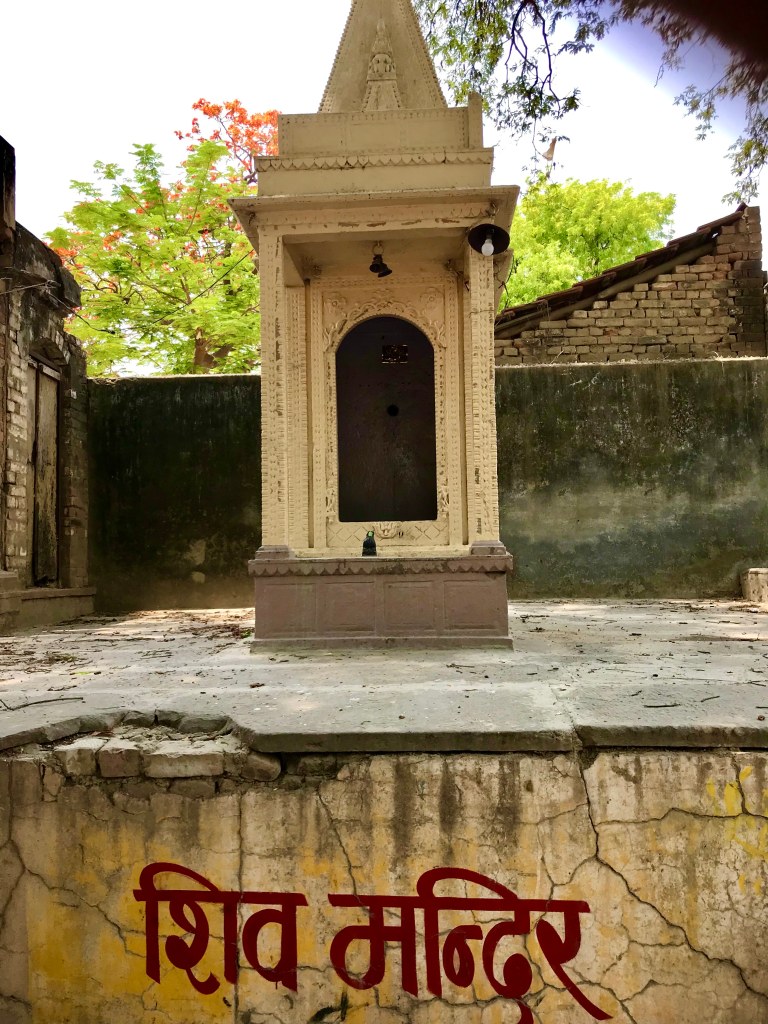
Shiv temple inside Dharamshala
Inside the Dharamshala, there is an octagonal well that is no longer in use. However, it is cleaned once a year during the Panchkoshi Yatra, keeping the tradition alive.
A fewtimeless glimpsesof theancient Dharamshalas, standing as silent witnesses to history and devotion.
This well has a hexagonal structure and was built later. The name of the person who constructed it is written on its wall. According to the inscription, the well was built in 1890 AD. Some domesticated cattle can be seen around the well, seeking relief from the intense heat.
There were pillars at the four corners of this well, but one of them is now broken. The remaining three pillars still clearly show the shape of an urn.
Shiva Temple
I saw a small Shiva temple on the side of the road. Made of sandstone, the temple looked beautiful and stood on a square stone platform. It is well-preserved and remains in good condition even today. However, the Dharamshala next to the temple is almost in ruins. The well attached to the temple has been closed and is no longer in use. Local shopkeepers informed me that a large part of the temple courtyard now belongs to a school situated next to it. Since the school was closed, I couldn’t see that part of the temple. The temple structure dates back to the 18th century.
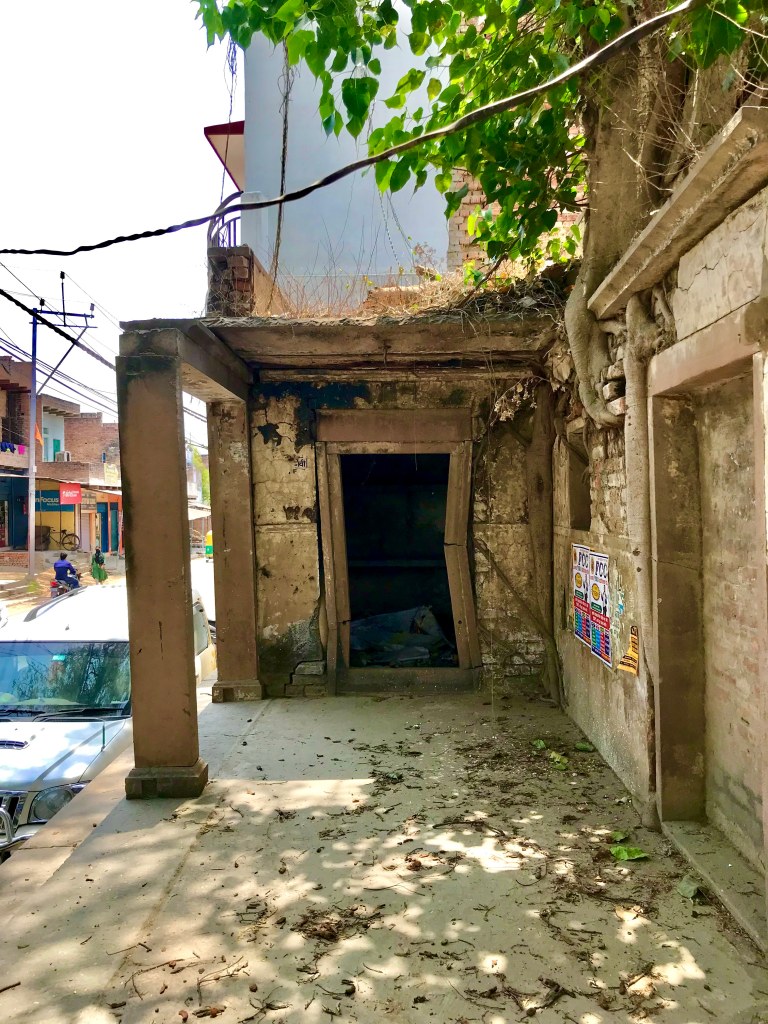
Partially destroyed the entrance of Dharamshala.
(IV)
HANUMATAISHWAR MAHADEV
I drank water from this well, and it is undoubtedly clean and safe to drink.
(V)
SWARG BHUMI (paradise Land)
PRITHESWAR OR PRITHVISHESHWAR
HISTORY:-
This ancient well was rebuilt by Baijnath Ji of Banaras in 1753 AD. In 1851 AD, Gopinath Ji, Veni Ram Ji, and Kripa Ram Ji of Maharashtra renovated it again. The Gyani Fateh Ram Ji constructed the Shiva temple and Dharamshala located on the well. Later, other people completed the work of repairing this well and the building.
Structure:
This octagonal well is located in the middle of a two-story building. A temple is on the top floor of the building. However, the well is no longer in use.
Most of the ancient wells along this route have an octagonal shape.
Surprisingly, the local people, especially the younger generation, are unaware of the history of this ancient route. Hindu religious texts, Jataka tales, and Buddhist literature provide detailed descriptions of this path. Unfortunately, local history is not included in the school curriculum.
Path to Kashi: Hidden Treasures Beneath the Ancient Wells
The wells built along this route were certainly reconstructed in the 17th century, but their origins undoubtedly date back to much earlier times.
Wells have always held great significance in Hindu religious traditions, where providing water to a thirsty traveler is considered one of the highest acts of virtue.
This ancient route served as the gateway to Kashi, the holiest city for Hindus, drawing countless pilgrims and travelers over the centuries. The discovery of some of Varanasi’s oldest sites has only taken place in recent times, revealing the hidden layers of its rich history.
The Hindu side claims that the old Shiva linga was found from the sanctum sanctorum of the temple. In the drawing of James Prinsep, this part of the temple is depicted as Mahadev. In this article, I have written in detail on this topic below.
HISTORICAL REASON
VISHWANATH TEMPLE OF BANARAS OR VISHVESHVAR TEMPLE is a major reason for the religious struggle that has been going on for centuries between Hindus and Muslims. The army of Muhammad Ghori and Qutbuddin Aibak defeated the king of Banaras a prominent North Indian king of that period ~ Jaichand.According to Islamic belief, no other religion can be practiced under Islamic rule. Idol worship is a crime in Islam and Banaras was the center of idol-worshipping of Hindus for thousands of years.
As a result, all the major Hindu temples of Banaras were demolished and their property was looted by the Muslims.
Some major Hindu temples were demolished and mosques were built at that same place from their rubble. Surprisingly some of the temples which were demolished in 1194 and were converted into mosques, still survive in Banaras though only their leftover remains can be found.For more information about this subject please visit:- https://nithinks.com/2021/12/06/the-search-for-hindus-lost-temples-in-the-city-of-templesvaranasi/
AS SHARIAT LAWS WERE IMPOSED IN THE CITYthe pity-minded Hindu kings of India began to express their loyalty to it. The rule of Banaras was handed over to an Amir (Governer) so that he could suppress paganism and yet satisfy people with his justice.(Justice here refers to Sharia Law)
IBN AL- ATHIR,a Muslim chronicler wrote that after plundering the city of Banaras, the loot was loaded in 1400 camels and sent to Ghazni.
HAR -HAR MAHADEV, HOW HINDUS FOUGHT BACK AND REFUSED TO CONVERT
Soon Banaras recovered from this setback and the Hindus tried to take their temples back. And a BLOODY STRUGGLE BEGAN. The Vindhya hills around Banaras were a great place for guerilla warfare.
According to some Afghan Islamic scholars and Islamic historians, about one lakh fifty thousand Muslims were killed in this conflict by the Hindus.
This anarchy ended only when Islamic rulers accepted religious freedomto Hindus in this way the process of demolishing the temple and rebuilding it continued……………….
Some of the major events during this period
A- IN 1194, ALMOST ALL THE MAJOR TEMPLES OF BANARAS WERE DEMOLISHED. The Vishwanath temple would have been demolished for the first time during this period.
B- PADMASADHU,a monk, built the temple of PADMESHWARin Varanasi in 1296 AD in front of Vishwanath temple in Banaras. This shows that the Vishwanath temple existed at that time, so the Vishwanath temple must have been rebuilt between 1194 AD and 1296 AD.(Fuhrer Sharqi Architecture of Jaunpur )
C- In 1447, the Vishwanath temple was demolished again by Sultan Mahmud Shah of Jaunpur.
D-During the reign of Akbar, with the help of minister RAJA TODARMAL, NARAYAN BHATT once again constructed the Vishwanath temple around 1585 AD.
E- On 18 April 1669, Aurangzeb issued a decree ordering the destruction of the Kashi Vishwanath temple. This decree document is still safely preserved in the Asiatic Society Kolkata.
F- The construction of the temple was once again completed between 1777 AD and 1780 AD by MAHARANI AHILYABAI of Indore.
KHALIFA -TUL ARD
Khalifa-tul Ard, that is, he has been called upon to play the role of being a successor to earth. The earth has its own potentialities. It, too, has been created for a purpose. But man has been sent down as a responsible being and he is here to secure improvement of earth, of making this brown earth of God green. He is here to introduce order and reform, in the light of Heavenly mandate, what has been deformed by Satanic forces.
Muhi-ud-Din Muhammad (Aurangzeb)
Aurangzeb was a staunch Sunni Muslim. Unlike his ancestor Akbar, he was not at all an advocate of Hindu-Muslim unity, nor was he in the mood to give any concession to the Hindus, also unlike Jahangir, he was not at all interested in any kind of building and construction work of gardens, minarets, buildings etc.
Shah Jahan followed Sharia law. Under the guise of this, he tried to break the Vishwanath temple in Banaras, but due to the strong opposition of the Hindus, his army could not break the Vishwanath temple, but then also 63 temples were destroyed in Benares during the reign of Shah Jahan. As a true Muslim, the expansion of Islam was the main goal of Aurangzeb’s life, he resolved to do the unfinished work of his father.
Aurangzeb probably wanted to make all the Muslims of the world as well as the Hindus feel the superiority of Muslim religion over other religions.Soon the Sharia laws were re-imposed on Banaras. Under the Sharia law-:
a.Jizya tax was imposed on Hindus. b. All Hindu schools were closed. c.The name of Banaras was changed to Muhammadabad. d. The Vishwanath temple of Banaras and some other famous temples were demolished.
Saqi Mustad Khan has written extensively on this subject in Maasir-I- Alamgiri.
Demolition of Vishwanath Temple in Banaras
(18th April,1669) , it reached the ear of His Majesty, the protector of the faith, that in the provinces of Thatta, Multan, and Benares, but especially in the latter, foolish Brahmans were in the habit of expounding frivolous books in their schools, and that students and learners, Musulmans as well as Hindus, went there, even from long distances, led by a desire to become acquainted with the wicked sciences they taught. The “Director of the Faith’’ consequently issued orders to all the governors of provinces to destroy with a willing hand the schools and temples of the infidels ; and they were strictly enjoined to put an entire stop to the teaching and practicing of idolatrous forms of worship. On the 15th i Rabi’u-l akhir it was reported to his religious Majesty, leader of the Unitarians, that, in obedience to order, the Government officers had destroyed the temple of Bishnath at Benares.
The Presently disputed mosque. I have deliberately selected the black and white images so that the walls of the old temple which are currently being painted with lime are clearly visible.
Aurangzeb also wanted to break the order of Hindus repeatedly taking back their temples, To carry out his plan, Aurangzeb took some cruel decisions and implemented them.
As per the orders of Aurangzeb, the Vishwanath temple in Banaras was demolished, the sanctum sanctorum (the holiest part of the temple where the idol of God is installed)was also demolished and leveled and a mosque was constructed at the same place from its rubble.
2. After the construction of the mosque on the main part of the temple, a Islamic graveyard was also constructed in the courtyard of the temple. It can be clearly seen in the drawing of James Princip. Generally, in Hindu belief, temples are never built at such a place where the rituals related to the dead person have been completed. In future, Hindus cannot build any temple at this holy place, undoubtedly this must have been the intention behind the construction of this graveyard.
3. Aurangzeb’s intention was not only to destroy the most sacred temple of Hindus, but he also wanted to humiliate Hindus forever.For this a part of the temple was deliberately left out so that the Hindus always felt inferior, and the feeling of a conqueror remained among the Muslims.
The wall of the ancient temple is clearly depicted in the book Benares illustrated, in a series of drawings written by James Prinsep, published in 1833.
This can be better understood from James Prinsep’s drawings. In the temple courtyard, the place where the mosque was built is shown point-wise. This place is still in the possession of Muslims due to the construction of the mosque.
THE MARATHAS
After Aurangzeb’s death, the Mughal Dynasty got weakened due to struggles for inheritance of the throne, several governors proclaiming themselves independent rulers, and most importantly the Marathas and Sikhs challenging the Mughal Empire. The politics of India in the eighteenth century was very similar to the politics of the seventeenth century in Germany. The old dynasties were subsiding and the struggle for the throne to fill their place was at its peak. Soon Banaras overcome the shock it got from Aurungzeb’s side and the Hindu Maratha rulers came to dominate Banaras.
Maratha’s also got the Mughal rulers of that time to write an assurance to compensate for the destruction of the Vishwanath temple by Aurangzeb in Banaras.
Malla Rao thought of demolishing the Gyanvapi mosque and building a temple on it, but due to the dilemma of the Pandits of Banaras, this work was postponed. Because of the struggle to inherit the throne in the country, the Marathas couldn’t even pay much attention to it.
In 1781, the East India Company’s dominance over Banaras was established. The East India Company’s effort was to avoid Hindu-Muslim conflict as much as possible. In the year 1777-80, the temple was rebuilt again by the Maharani Devi Ahilyabai Holkar of Indore. The disputed site (the mosque built by Aurangzeb was left intact) still remains in the same condition presently.
In 1809, a Hindu-Muslim riot had also taken place over the Vishwanath temple, which got controlled with great difficulty, hundreds of people died in this riot.
Mr. Watson, the Magistrate of Banarasat that time wanted an end to this quarrel and therefore requested the officers of the Company toHANDOVER THIS PLACE TO HINDUS.
Unfortunately, doing this was not possible in the future due to the complex political conditions of India in those days. Later, learning from the revolution of 1857, the British focused on maintaining the status quo in the Hindu-Muslim religious dispute, due to which the Vishwanath temple dispute still continued.
The area inside the red boundary in this picture is still occupied by the mosque.This is the reason for the present Hindu-Muslim tension. The present courtyard of Kashi Vishwanath temple has been expanded. It has been expanded from three thousand square feet to five lakh square feet, but the disputed structure of the mosque remains the same.
INFORMATION OBTAINED FROM THE SURVEY
A. Hindu artworks on the walls, and statues of some Hindu Gods and Goddesses have been found in the survey of the mosque.
B. A dome of the mosque rests on the top of the temple.
The place indicated by the arrow is the sacred pond described by James Prinsep. Presently, Muslims use this pond for Wuzu. Wuzu is an Islamic process.
C. In the survey, a small pond was found in the mosque’s courtyard, and a Shivling was also found inside the pond. This is not at all a fact of utter surprise because James Prinsep has described this pond very clearly in his book ‘Benares Illustrated in a Series of Drawings’.
The principal lingam of Mahadeo stood in an ornamented reservoir in the centre,(center) having a drain below to carry off the Ganges water continually poured over it by day and night. Mundip signifies vestibule: Dundpan and Dwarpal are respectively the staff-bearer and door-keeper. The latter situation is held by Kal Bhyro, the offspring of Shiva’s rage; the former appointment was conferred upon Hurikeshu, a Yukshu, or one of the attendants upon the Deity of riches, in reward for his having abandoned the sports of youth to devote himself to ascetic meditation at Kashi. Tarakeswur and Manikeswur are two inferior lingums of Shiva.
To a large extent, it is possible that this is the holy pond of the Hindus as described by James. Presently, Muslims use this pond for Wuzu. Wuzu is an Islamic process. Cleaning the body before offering Namaz includes washing hands, mouth, head, feet, and inner part of the nose. I think a few more ancient mysteries can be uncovered by examining this holy pond.
One thing is clear the scientific analysis of the ancient Vishwanath temple done by James in 1831 is still unmatched.There is no difference between the conclusion of James and the condition of the Vishwanath temple today.
AT LAST, WE ARE THE FREE PEOPLE
“Doublethink means the power of holding two contradictory beliefs in one’s mind simultaneously, and accepting both of them.” GEORGE ORWELL
With the independence of India, India got a new constitution and there was also hope of a solution to this issue. After independence, instead of handing over their holy place to Hindus through a new law, the Congress party made it more controversial.Nehru, who believed in the communist ideology, felt that Hindu political parties could take advantage of this problem in elections, so it would be right to keep the temple-mosque dispute entangled in the cumbersome court proceedings. According to a section of the law,the status quo before 15 August 1947 in a religious dispute shall be maintained. It was the political compulsion of Nehru and Congress to maintain the Hindu-Muslim dispute over Vishwanath temple otherwise it might have got resolved years before.
Presently, this disputed mosque near Vishwanath temple is a living example of Islamic imperialism. Hardly any Muslim goes to this mosque to offer prayers,but this disputed temple definitely knocks the eyes of every Hindu. Most of the foreign travel writers who have visited this place in the sixteenth century and after believed thatTHIS PLACE SHOULD BE HANDED OVER TO THE HINDUS.These foreign travel writers have explained their side in detail in their writing.Any person who looks at this disputed mosque objectively rather than from a religious point of view will come to the conclusion that no doubt this place should be handed over to the Hindus. After all it was built by demolishing their ancient temple.
The Most Sacred Experience of My Journalism Career: Meeting Sachindra Nath Sanyal’s Friend.
This post is about my meeting with Sachindra Nath Sanyal’s friend in 2004-2005.
In my 25 years of journalism, I consider this incident to be the most important and sacred one. Even today, nearly 20 years later, I still remember every detail of that meeting.
I came across a rare line drawing of Sachindra Nath Sanyal, also known as Sachin Da, in a magazine from the 1970s. I found this magazine while browsing through a library in Banaras.
Beyond the Textbooks: Rediscovering Sachindra Nath Sanyal
Sachin Da
After India gained independence, Marxist writers often shaped the history taught in schools. In these textbooks, figures like Lenin and Stalin were glorified, while only revolutionaries who followed communist ideologies were given significant attention.
As a result, many of India’s other freedom fighters, especially those who did not align with communist views, were overlooked or minimized.
One such revolutionary was Sachindra Nath Sanyal. His name barely made it into the history books. In fact, during my school days, the entire knowledge I had about Sanyal was limited to just two facts:
*Sachindra Nath Sanyal founded the Hindustan Republican Association (HRA).
*He wrote the book Bandi Jeevan (Life in Prison).
That was all I knew about him—nothing more, nothing less.
Growing up in Sanyal’s hometown, I never learned about the depth of his contributions or his true significance in India’s freedom struggle. Like many other revolutionaries, his story was overshadowed by political ideologies that shaped our education system.
A Discovery at Banaras Hindu University
It wasn’t until I was pursuing my undergraduate degree at Banaras Hindu University (BHU) that I learned for the first time that Sachindra Nath Sanyal had lived in Varanasi. It came up during a lecture by my history teacher, who was discussing the contributions of Varanasi to India’s freedom struggle.
Ravindra, one of my classmates, also seemed to know a lot about the subject. When the teacher finished, I approached him and asked, “Where do you get all this information from?” He smiled and replied, “From the wall of the school!”
I was confused and didn’t quite understand what he meant. Sensing my confusion, he added, “I’m an alumnus of the Bengali Tola School. The main building of the school has the names and information of Sachindra Nath Sanyal and other revolutionaries who were former students there.”
I had often seen the Bengali Tola School building from a distance. It’s located on the road connecting Godauliya to Banaras Hindu University. A few days later, while passing by that route again, I remembered Ravindra’s words as soon as I spotted the school. Curious, I parked my bicycle near the school gate and decided to go inside.
The main building stood about 10 meters from the gate, just as Ravindra had described. And there, on the walls of the building, were the names of some students and teachers who had made significant contributions to India’s freedom struggle. It was a revelation for me, a hidden chapter of history I had never learned before.
A Journey into Forgotten History
Five or six years after my experience with the Bengali Tola School, when I had started my journalism career and was writing for several magazines, one of them asked me to write an article for India’s Independence Day.
As I sat down to work on the piece, I found myself stuck—unsure of what to write next. And then, suddenly, a memory struck me: The revolutionaries honored on the walls of the Bengali Tola School. That’s when I decided I would write a separate story focusing on these forgotten revolutionaries.
A few years later, I found myself once again at the Bengali Tola School campus. I carefully wrote down the names of the revolutionaries inscribed on the school’s walls and headed home, thinking it would be a simple story to complete.
At home, I called my good friend and talented photographer, “Dinesh Bhaiya”—whom I had mentioned in my previous post about the Vishwanath Corridor Project—and asked him to take a photo of the stone plaque at the school and send me the pictures.
In those days, I was an avid reader and frequented a nearby library. I was confident that I would find plenty of information about these revolutionaries. I believed that, after working alongside several experienced journalists for a while, I could seek their help as well. I planned to gather photographs of places connected to these revolutionaries and collect stories from the locals who lived near their homes. With around fifteen days to work on this, I was sure I would have enough time to finish the story.
However, when I started working on the article, I quickly realized I was mistaken. The library had very little information on the subject, and even the seasoned journalists I approached had no detailed knowledge of these revolutionaries. The biggest shock came when I discovered that no one knew where most of these revolutionaries had lived.
Determined, I expanded my search to the older libraries in Banaras. I did manage to find some material on the subject, but it was scattered across many books. This meant that I had to read through all of them patiently, which clearly wouldn’t be possible within the fifteen-day timeframe.
Some of my journalist friends suggested names of people who might have more information, but meeting all of them in such a short time proved impossible. After much consideration, I reluctantly decided to put aside my idea of writing about the revolutionaries of Varanasi for the time being, with plans to return to it later.
In the Footsteps of a Revolutionary: My Meeting with a Friend of Sachindra Nath Sanyal
Meeting with Bhaduri Ji
Later, while working as a journalist, I stumbled upon the famous book Bandi Jeevan written by Sachindra Nath Sanyal at the Carmichael Library, one of the oldest libraries in Varanasi.
Coincidentally, Sanyal Ji himself had mentioned this library in his book.
He used to visit the library to browse through books, much like I was doing at that time. A few years ago, Bandi Jeevan was republished by a Delhi-based publisher, giving new life to Sanyal’s account.
Around this time, while working on another article, I was introduced to Dr. Bhattacharya, a homeopathic doctor whose knowledge of history was remarkable, despite being a medical professional. During a conversation about Sachindra Nath Sanyal, Dr. Bhattacharya recommended I meet Bhaduri Ji, a figure with a rich history in the freedom struggle.
A few days later, I visited the address Dr. Bhattacharya had given me. I met Bhaduri Ji’s son and explained the reason for my visit. He kindly invited me to wait in the dining room. During our conversation, I learned that Bhaduri Ji himself had been a freedom fighter and had spent time in prison during India’s struggle for independence. He was also a scholar.
His son shared that, when renowned filmmaker Satyajit Ray was in Varanasi shooting for his famous film Feluda, he came to seek advice from Bhaduri Ji.
By this time, Bhaduri Ji was quite elderly and had difficulty speaking, so his son kindly requested me to limit my questions. As Bhaduri Ji struggled to walk, his son helped him into the room where I was waiting. I wasted no time and immediately asked,
“Did you ever meet Sachindra Nath Sanyal?” To my surprise, Bhaduri Ji answered, “Yes, I met him thrice.”
I was taken aback. This was the answer I hadn’t expected. Trying to contain my excitement, I asked, “Is there anything specific that you remember from those meetings?”
Bhaduri Ji explained that the last time he met Sanyal was probably in 1939, near Niranjani Akhara.
I knew that around this time, Sachindra Nath Sanyal had been associated with Subhas Chandra Bose and had edited Bose’s mouthpiece, Agragami, which was published near Niranjani Akhara.
Bhaduri Ji shared a recollection of their last conversation. “Sachindra da told me,” he said, “that soon Hindus would have to fight on two fronts—against British imperialism and also against Islamic imperialism.”
This wasn’t surprising to me, as Sanyal had written extensively about both these issues in his works.
I thanked Bhaduri Ji, touched his feet, and left. That meeting clarified something important:
Sachindra Nath Sanyal had perhaps been the only revolutionary who had foreseen the coming storm. His philosophy was grounded in the reality of the times, and he had a deep understanding of the issues that would shape India’s future.
Sachindra Nath Sanyal was the voice of the common Indian. He didn’t explore India from the comfort of a car, nor did he live in the realm of Gandhi’s idealism. Gandhi’s idealism, though noble in thought, was ultimately powerless against the brutal reality of Jinnah’s Two-Nation Theory. Gandhi’s vision of a united India crumbled in the face of partition and the massacre of millions of Hindus.
Sanyal did not oppose Muslims as a community, but he was fiercely critical of Muslim leaders who prioritized Muslim-majority countries over India.
He knew that many Muslims in India saw the pride of Turkey as their own and that there were those who still, even today, place the Muslim Brotherhood’s spirit above their Indian identity.
Even today, some political parties continue to exploit such sentiments for votes, further dividing the nation.
The truth cannot be hidden behind the curtain of fake idealism or glossy ideals. The actual thoughts and vision of Sachindra Nath Sanyal must be taught in schools, colleges, and universities. This true son of Mother India deserves a rightful place in history. His contributions must not be overlooked or forgotten.
The Young Gandhi’s Visit to Varanasi: An Account of the Sacred Kashi Vishwanath Temple
“After the ritual was finished, I went to the Kashi Vishwanath temple for darshan, but I was deeply disappointed by what I saw. The approach to the temple was through a narrow, slippery lane, and there was noise everywhere—pilgrims, shopkeepers, and swarming flies.
The atmosphere that should have been peaceful and spiritual was missing. Instead, it felt more like a marketplace.
Inside the temple, the entrance was surrounded by a pile of rotten flowers, and the floor, although made of fine marble, was marred by dirty rupees left by some devotees.
I was hoping for a serene, holy space, but instead, I found a chaotic, noisy environment. The temple authorities should have worked to create a calm, pure atmosphere, but instead, I only found distractions and discomfort.”
Gandhi was deeply disappointed by the state of the temple, feeling that it was not maintained well and lacked the serene environment that should have surrounded such an important place.
Vishwanath Gali: Capturing the Chaos Gandhi Described in 1902
BENARES HOLY COW FLOWERS FAIR (FROM JOURNEY TO INDIA )
The painting “Vishwanath Gali” by Jan Ciągliński, created in 1907 and housed at the National Museum in Warsaw, vividly depicts the scene Mahatma Gandhi described in 1902.
It shows a crowded, narrow street next to the Vishwanath Temple, where devotees are gathered, and some vendors are selling flowers. This painting captures the same issues Gandhi observed during his visit, such as the congested space and the hustle and bustle surrounding the sacred site.
Navigating the Chaos: A Banarasi’s Perspective on Temple Visits
Like many visitors, I have witnessed the challenges around the temples, such as the noisy streets filled with shopkeepers and crowds of people, which create a suffocating atmosphere due to the limited space.
During major religious festivals, when people come to bathe in the Ganges and visit the temples, the situation worsens. Long queues and complicated procedures make the darshan experience tiring and often less spiritual.
The streets around the Kashi Vishwanath Temple and other areas in Varanasi are slippery due to several factors:
Since ancient times, the area adjacent to the Ganges has been regarded as the holiest part of Varanasi. The Ganges river itself is considered sacred in Hinduism, and as a result, a long line of temples has been built in this limited space along its banks.
This historic area of the city has been densely populated for centuries, serving not only as a hub for residents but also attracting devotees and individuals involved in various occupations.
With the constant influx of people, both locals and pilgrims, the narrow streets of Varanasi have always been crowded. The area has evolved organically over time, with its infrastructure and layout shaped by the historical, spiritual, and social dynamics of the city.
These narrow streets, which have been in place for centuries, were not designed to accommodate the large number of visitors and the bustling activities that occur today, which is why they remain crowded and sometimes difficult to navigate.
The tradition of visiting the Vishwanath Temple after a holy bath in the Ganges has been followed for thousands of years. Devotees offer Gangajal (water from the Ganges) and flowers to Lord Shiva during the darshan, a practice deeply rooted in religious customs.
As part of this tradition, many shops lining the narrow lanes near the temple sell flowers and small earthen pots filled with Gangajal. Devotees are required to enter the temple barefoot, and they often leave their shoes at the same shops where they purchase the offerings.
In exchange for this service, the devotees offer money to the shopkeepers, typically based on their will and reverence—there are no set charges for these religious services.
However, the continuous flow of Gangajal and the movement of people carrying it can cause the narrow lanes to become slippery.
As devotees walk through these lanes, water from the Ganges is spilled, contributing to the slippery conditions. This, combined with the high volume of foot traffic, often makes the environment more challenging to navigate, especially for those who are unfamiliar with the area or visiting during peak hours.
From Congestion to Comfort: The Vishwanath Temple Expansion and its Impact on Varanasi
The Government of India’s project to expand the Vishwanath temple has been widely welcomed by people from all walks of life.
This expansion has finally addressed the long-standing issue of congestion, allowing visitors to experience the temple more comfortably while also paving the way for the growth of religious tourism in Varanasi.
For centuries, temples in Varanasi have been a major source of employment, both directly and indirectly, through religious activities and associated services.
Prime Minister Narendra Modi, during the inauguration of the expanded courtyard, highlighted the remarkable increase in space.
The temple courtyard, which previously measured 3,000 square feet, has now been expanded to an impressive 5 lakh square feet.
A new pathway has also been created, connecting the Ganga Ghat to the temple, making it easier for devotees to bathe in the Ganges and visit the Vishwanath Temple for darshan.
Varanasi holds immense significance not only for Hindus but also for Buddhists and Jains. It is home to Sarnath, where Gautam Buddha delivered his first sermon after attaining enlightenment.
Varanasi is also the birthplace of four of Jainism’s twenty-four Tirthankaras. Every year, millions of devotees and tourists from around the world visit Varanasi to experience its spiritual richness.
The expansion of the Vishwanath temple has not only improved the centuries-old tradition of Shiva darshan but also created new opportunities for employment and tourism.
As the number of visitors to the temple rises, Varanasi’s tourism industry is expected to see significant growth, further strengthening the city’s position as a major religious and cultural destination.
These pillars, dating back to the 8th-9th century or possibly even earlier, once belonged to a grand temple. Today, they stand as part of a mosque.
A Sultan’s Mission to Erase Idolatry
"Below is a paragraph fromTaj-ul-Masir, the first official history (Sultan Chronicle) of the Delhi Sultanate, written in Persian by Sadruddin Hasan Nizami."
He purged by his sword the land of Hind (INDIA) from the filth of infidelity… and the impurity of idol-worship, and left not one temple standing… When he arrived at Mirat (Meerut) all the idol temples were converted into mosques. He then marched and encamped under the fort of Delhi. The city and its vicinity were freed from idols and idol-worship, and in the sanctuaries, mosques were raised by the worshippers of one God.The royal army proceeded towards Benares,(VARANASI) which is the Centre of the country of Hind, and here they destroyed nearly one thousand temples. The temples were converted into mosques and abodes of goodness, and the ejaculations of bead-counters and voices of summoners to prayer ascended to high heaven, and the very name of idolatry was annihilated.
The Taj-ul-Masir, the first official history of the Delhi Sultanate, written in Persian by Sadruddin Hasan Nizami, explicitly records how temples were demolished and mosques were built in their place—an act inscribed in history with the blade of the Islamic sword, steeped in the blood of Hindus.
Murmurs from the Past: How Varanasi’s Ruins Tell the Story of Conquest
The echoes of a forgotten past still linger in the heart of Varanasi, where stone whispers to those who listen.
The words of a medieval Muslim historian leave no room for doubt—the mosques of this sacred city were not merely built but inscribed upon the ruins of temples, their foundations set in the shattered relics of an ancient faith, their walls silent witnesses to ahistory written with the sword, stained in the blood of Hindus.
Even today, in the holiest city of Hindus, remnants of these lost temples endure—hidden in the columns of a mosque, buried beneath the courtyard of a shrine, or scattered around a nameless grave.
These fragments of stone stand frozen in time, murmuring stories of a civilization that once flourished but was left to decay under the weight of conquest.
Wandering Through Varanasi’s Past: A Journey Amongst Forgotten Temples
For months, I wandered through the oldest quarters of Varanasi, tracing the footprints of history on its narrow lanes. Among ruins swallowed by time, I uncovered the remains of countless temples—standing as solemn markers of an era when faith clashed with force and when the spirit of a people was tested by the tide of imperialism that arose from the deserts of Arabia.
Faith and Fire: When Temples Fell and Mosques Rose
Islamic ideology swept through Varanasi like a storm of destruction, targeting a city that had long been a center of multiple faiths, including Hinduism, Buddhism, and Jainism.
The very land where Mahatma Buddha preached non-violence, peace, and public welfare faced immense devastation at the hands of an ideology that originated in Arabia.
Countless temples across India were demolished by Muslim invaders. While some of these grand temples were later rebuilt, many remain unchanged—converted into mosques.
In Varanasi, the holiest city for Hindus, the first major temple demolitions occurred in 1193-94 CE. The Hindus had to fight a long and difficult battle to reclaim their sacred sites.
Even today, several temples destroyed during that time remain under the shadow of Islamic imperialism, standing as reminders of history written in ruins.
There are many mosques and dargahs in Banaras (Varanasi) that were built from the ruins of temples. However, in this post, I have decided to focus on the region around Rajghat for a few important reasons, which are listed below.
RAJGHAT AREA
Varanasi is not only the holiest city for Hindus but also one of the oldest cities in the world. The earliest signs of this ancient city are found in the Rajghat area, which undoubtedly housed some of the most famous, sacred, and ancient temples of Hinduism.
2. When Qutbuddin Aibak and Shahabuddin Ghori conquered Banaras in 1194, the king of Banaras at that time was Jaichand. Many of the temples in the Rajghat area, which held great reverence for Jaichand, were destroyed during this period.
JAICHAND’S KINGDOM
Who was Jaichand?
Jaichand was a powerful Gaharwar Rajput king who ruled over eastern Uttar Pradesh and parts of Bihar. His father was Vijaychandra, and his grandfather was Govindchandra. Even today, a significant population of Gaharwar Rajputs can be found in Varanasi and surrounding towns.
Unfortunately, Jaichand is often remembered as one of India’s most traitorous kings. He is believed to have harbored a longstanding enmity with the renowned king Prithviraj Chauhan.
It is believed by some that Jaichand invited Muhammad Ghori to India with the intention of humiliating and defeating Prithviraj Chauhan. Though there is no direct evidence to support this claim, such stories have stained Jaichand’s reputation.
A Knowledge of History, even of the darkest past, can be quite useful, even for the future. (Anatoly Markusha, Miracles on wheels)
The 72-Pillared Mosque
The 72-Pillared Mosque: Whispers of a Forgotten Past
In 1194 CE, this temple was demolished, and a mosque was built. Even today, the remaining pillars of the temple seem to stand as silent witnesses, telling the story of the destruction of Hindu temples and the massacre of Hindus during that time.
Amidst the timeless landscape of Raj Ghat stands the 72-pillared Mosque, a structure unlike any other.
Its vast hall stretches 150 feet in length and 25 feet in width, held up by 72 pillars.
These sandstone pillars bear the marks of an era long before the mosque itself—perhaps from the Gaharwar kingdom or even earlier. Their intricate geometric patterns, once a testament to masterful craftsmanship, now lie veiled under layers of paint, dimming their ancient splendor.
Yet, beneath this transformation lingers an unspoken truth. This mosque, like many others, rose upon the ruins of a temple, a victim of an age when faiths clashed, and idol worship was deemed an offense.
The surrounding locals, warm and welcoming, carried their interpretations—some believed the pillars were the work of Islamic artisans under Qutubuddin Aibak, while others wove tales of supernatural jinns shaping them. But history, like the stones of this mosque, cannot be painted over entirely.
When they realized I am a Hindu, their expressions shifted—curiosity, caution, perhaps even a flicker of unspoken recognition.
To capture the essence of this place through my lens, I had to resort to a few small deceptions—perhaps not entirely wrong, considering the layers of history that have been concealed and rewritten over time.
Framing History: The 72-Pillared Mosque of Varanasi in Focus
Looking from the hall of the mosque, it appears that the section with 72 pillars was likely the main part of the original temple.
These pillars, now integrated into the mosque’s structure, suggest the scale and grandeur of the Hindu temple that once stood there before its destruction.
In ancient Hindu temples, the sanctum sanctorum, where the idol of the presiding deity was enshrined, often featured this type of decoration on the end wall. Such niches were specifically designed to house the deity’s idol.
Over time, minor modifications were made to this structure in the Islamic style.
ADI KESHAV
Sita Ram’s 1814 painting of Rajghat (Adi-Keshava),
Adi Keshav Ghat: The Confluence of Sacred Waters and Royal Patronage
“Adi” signifies ancient, and “Keshav” is another name for Lord Vishnu.
Adi Keshav Ghat, a revered site in Varanasi, holds immense spiritual significance as the place where Lord Vishnu is said to have placed his first step in Kashi. Known as Varuna Sangam Ghat, it marks the confluence of the Varuna and Ganga rivers.
This sacred ghat is mentioned in religious texts like the Kashi Khanda, Matsya Purana, and Linga Purana. It is believed that a holy dip here frees the soul from the cycle of life and death.
The Adi Keshav temple near the ghat, with its Sabha Mandap and Garbha Griha, has been historically significant, attested by inscriptions from the Gaharwal era.
Kings like Chandradev and Jaichand made offerings and donations, underscoring the temple’s cultural and spiritual prominence. The ghat and temple remain enduring symbols of Varanasi’s ancient spiritual heritage.
VARUNA SANGAM GHAT OR ADI KESHAV GHAT
From Ruin to Reverence: The Rebirth of Adi Keshav Temple
The Adi Keshav temple, once a beacon of divine reverence in Varanasi, fell to the ravages of the Islamic invasion in 1194 AD. With the collapse of the temple came a deep void in the spiritual landscape of the city.
The Hindus of Varanasi, ever resilient, longed to reclaim their lost heritage, but whether the temple was ever reconstructed remains a mystery—an enigma lost to time.
The story of the Adi Keshav temple, torn asunder by the tides of time and conquest, took a hopeful turn in 1807 AD when it was rebuilt under the patronage of Sindhia of Gwalior.
The structure that stands today is a testament to both the endurance of faith and the resilience of a city whose spirit could not be broken, even by centuries of upheaval.
However, as the eye ascends to the upper reaches of the temple, the shift becomes evident. The top portion, constructed in 1807, bears the marks of a more recent era—an era of reconstruction, not creation. While this part may hold its reverence, it lacks the ancient artistry that once adorned the temple’s sacred walls. The intricate carvings, the spiritual symbolism, the devotional artistry of the Gaharwar period—all seem to have been lost in the sands of time, replaced by a more utilitarian form that, while dignified, does not carry the weight of centuries past.
RAUJA CHANDAN SHAHID
Across the sacred waters from the Adi Keshava Temple, at Rajghat, stands the Rauja Chandan Shahid, a tomb steeped in layers of history. Though time has veiled the past, there is no doubt that an ancient temple once graced this very spot, its presence now only a whisper beneath the weight of a mosque, a revered Mazar, and scattered tombs resting in the open ground.
The inscription here calls this place a symbol of Hindu-Muslim unity.
RAUZA AJGAIB SHAHID
Rauza Ajgaib Shahid has a mosque, a holy tomb built behind it, and a hall. The buildings at this site may have been repaired and rebuilt so many times that no trace of the pre-Islamic period remains.
Only a few old stone stairs are visible, attached to the platform. Based on this alone, it’s impossible to make any definitive claims about its history.
Some paintings of this place can be found in old British writers’ books, in which the pillars of temples are visible. However, as of now, I have not found anything remaining.
RAUJA PALANG SHAHID :- IN THE SHADOW OF THE SWORD
The ornate design on the pillars can be seen in this image published in 1865. Journal of the Asiatic Society of Bengal, Vol. 34.
There is another major tomb in front of Ajgaib Shahid on the Grand Trunk Road itself, known as Palang Shahid.
This place was once an old cemetery, and its description can also be found in the Banaras Gazetteers. The boundary wall of the cemetery is new. Upon entering through the main gate, there is a graveyard.
Walking further into the graveyard, one finds three buildings and several more graves, all built on a square stone platform. The three buildings are:
A mosque
A tomb with a dome-shaped roof (Note: this tomb is not that of Palang Shahid)
The main tomb of Palang Shahid
The main tomb is situated right in the center of the square stone platform. Modern tiles have been installed on the tomb. The tomb has four pillars and a square roof, with a dome built over it.
The four pillars and the square roof appear to be part of a pre-Islamic structure. If we look only at the four pillars and the square roof above them, ignoring the dome and the tomb, it seems to resemble the chauki (platform) of an ancient Hindu temple.
It appears that the tomb and the dome built on top were added later, and were not originally part of the structure.
Chauki or Chowki: In Hindu temples, this type of structure is typically found near the main entrance of the temple, and is called the chauki (square seat).
Unveiling the Layers: Hindu Art and Islamic Significance at Palang Shahid
Beautiful geometric designs and some figures are engraved on the four ornate pillars of the chauki. These figures might represent Hindu deities, though they are not very clearly visible due to thick coats of paint applied over them.
Another thing that caught my attention was the poster on this mazar. The poster featured a sword along with an image of Mecca, and it had the fundamental principles of Islam written on it: There is no god except Allah, Muhammad is the messenger of Allah.
This pillar of the tomb does have some kind of ancient Hindu deity art on it, but it’s impossible to make out the details due to the thick layers of paint covering it.
LAKKAD SHA MOSQUE AND MAJAR :
Near Bhainsa Sur Ghat, there is Lakkar Shah Mazar and Mosque. This mazar is located next to the main road and stands at a height of 15-20 feet. From its appearance, it seems that this tomb was built on the ruins of a Hindu temple.
On top of the stone platform, it looks like a separate tomb has been placed, with a building constructed above it. Observing the tomb, it seems that this small building was constructed in three different periods.
The base appears to be the remains of an ancient temple, measuring about 15 feet in height and 30 feet in length and width. Such bases are commonly found in ancient Hindu temples and Buddhist stupas.
The tomb was likely built on the ruins of this temple during the 12th-13th century.
Looking at the domed building, which reflects the Islamic architectural style, it seems that this structure was built during the Mughal period. Hindu temple pillars can be seen at the four corners and the entrance of this Islamic structure.
The Darkness Beneath the Lantern
"Those that fail to learn from history are doomed to repeat it.”
Learning nothing from history has unfortunately become India’s fate.
Basanta College for Women is located next to the Adi Keshav Temple in the Rajghat area. (Its main branch is located in Bhelupur).
Established in 1913 by Annie Besant, a British woman deeply influenced by Hindu culture, she played a major role in introducing Hindu religion and culture to the Western world. She was also an important figure in India’s freedom struggle and social movements.
During my visit to Rajghat, I explored the ruins of many ancient temples, tombs, mosques, and graveyards near the Keshav Temple. On my way, I passed by Basanta College for Women and spoke with the students there to learn their views. Unfortunately, I was disappointed every time.
To my surprise, these graduating students knew nothing about the history of the ancient temple adjacent to their college, or the nearby madrasas and dargahs.
Only a few students had visited the Adi Keshav Temple, but their perspective was more religious than historical. They did not know the history of Islamic conversion or the period of Islamic imperialism.
None of them had seen the Chandan Shaheed Mazar, and when I asked about it, they all referred to it as a symbol of Hindu-Muslim unity. When I asked how, their response was, “We don’t know.”
This selective view of history is a result of Nehruvian ideology. It is entirely political, in today’s world, where conflicts between Islam and other religions persist, how helpful is this ostrich approach?
Gautam Buddha gave his first sermon in Varanasi (Sarnath), just five kilometers from Rajghat. After attaining enlightenment in Gaya, Buddha entered Varanasi through the historical Uttar Path. His teachings in Sarnath, based on peace and non-violence, became known as Dhamma Chakra Parivartan over 2,600 years ago.
However, much of the knowledge of Buddha and the sacred land of Sarnath was destroyed by the Islamic invasions in 1194. India lost much of its Buddhist heritage. It wasn’t until British historians discovered relics during excavations in Sarnath that India was reintroduced to Buddha’s teachings.
The reason the Hindus were defeated was their limited knowledge beyond their geographical boundaries. This ignorance continues to exist in Hindu society today. Only time will tell how long a civilization that has not learned from its past and is still not willing to learn, can survive.
RAJA RAM CHANDRA KI JAI VICTORY TO RAJA RAM CHANDRA
To truly comprehend Gandhi’s vision of Ram Rajya, it is essential to understand Ram’s image and deep-rooted presence in the people’s hearts.
Ram is not just a historical or religious figure; he symbolizes the collective ethos of Hindu culture, civilization, and faith. He carries the legacy of thousands of traditions, values, and beliefs that guide generations.
The Name of Ram: An Unbreakable Link to India’s Soul
Anyone who has set foot in India can sense the omnipresence of Ram in everyday life. In North India, the customary morning greeting of “Ram Ram” reflects the cultural attachment to his name.
Similarly, at the end of life’s journey, during funeral processions, the chant of “Ram naam satya hai” resonates, reinforcing the belief in Ram as the eternal truth.
From daily greetings to life’s final moments, Ram remains an inseparable part of India’s spiritual and cultural landscape.
The Ultimate Role Model
Rama, the ancient Hero of the past, is the perfect example of truth and morality. He is the ideal son, husband, father, and most importantly, the ideal king. The great saint Valmiki has beautifully described Rama as a role model for all.
Festivals of Lord Ram: A Year of Devotion and Celebration
Many Hindu festivals are dedicated to Lord Ram, celebrating key events from his life. These festivals are observed with great joy and devotion throughout the year.
Ram Navami:
Celebrates the birth of Lord Ram, observed on the ninth day of Chaitra month (March-April).
Dussehra (Vijayadashami)Lord Rama’s Victory Over Ravana
Battle Scene with Demons and Monkeys, Folio from a Ramayana (Adventures of Rama)
According to Hindu mythology, Lord Vishnu took the form of Prince Rama of Ayodhya to free people from the tyranny of demons. Dussehra marks the day when Lord Rama defeated Ravana, the king of demons. Dussehra, also known as Vijayadashami.
Diwali:
Celebrates Lord Ram’s return to Ayodhya after 14 years of exile and his victory over Ravana. People light lamps and rejoice in his homecoming.
Ayodhya Ram Vivah Utsav:
Commemorates the divine marriage of Lord Ram and Sita, celebrated with grandeur in Ayodhya.
Hanuman Jayanti:
Though dedicated to Hanuman, this festival indirectly honors Lord Ram as Hanuman’s unwavering devotion to him is celebrated.
Sharad Purnima Katha:
In some regions, the story of Ram’s life is narrated during this time, particularly focusing on episodes like his exile and battles.
Kartik Purnima:
In some traditions, this day is observed with stories from Ram’s life and his ideals being remembered.
These festivals embody different aspects of Lord Ram’s life and teachings, uniting people in devotion and celebration.
Beyond Politics: Gandhi’s Dream of Ram Rajya as a Model for True Democracy
After India gained independence, Mahatma Gandhi envisioned an ideal India in the form of Ram Rajya. His political philosophy was deeply rooted in the ideals of Maryada PurushottamRama, who symbolized truth, righteousness, and justice.
Gandhi believed that India’s political system should not imitate foreign models like the British Parliament, Soviet rule, Fascism, or Nazism.
Instead, he envisioned a system suited to India’s unique culture and values. He described Ram Rajyaas the sovereignty of the people, based on moral authority and justice for all.
For Gandhi, Ram Rajyadid not mean Hindu rule; rather, he saw it as Divine Raj, a kingdom of God where truth and righteousness prevailed. To him, Rama and Rahim were the same, emphasizing unity and inclusiveness.
In Gandhi’s vision, Ram Rajya represented true democracy, where even the poorest citizens could expect swift and fair justice without expensive legal procedures.
He often quoted the ancient belief that even animals, like a dogs, received justice under the rule of Rama.
Gandhi’s concept of Ram Rajya continues to inspire ideals of justice, equality, and moral governance in modern India.
True Democracy in Ram Rajya: Justice for All, Even the Poorest
Mahatma Gandhi’s vision of Ram Rajya was not merely a political ideal but a moral and ethical framework for governance and society.
Rooted in the timeless values of truth, justice, and righteousness as exemplified by Lord Rama, Gandhi’s Ram Rajya emphasized inclusivity, fairness, and the well-being of all citizens, regardless of their social or economic status.
For him, it was not about religious dominance but about creating a just and moral society based on the principles of divine governance.
His belief that India should develop its system, rather than imitate foreign models, underscores his commitment to self-reliance and cultural authenticity.
Gandhi’s Ram Rajya remains a guiding principle for those who seek a just and equitable society built on the foundations of truth and moral authority.
A Glimpse of Sachin Da’s Contribution to India’s Freedom Struggle
*Sachindra Nath Sanyal spent twenty-five years in prison out of the fifty years of his life.
*He was the only revolutionary who was sentenced to life imprisonment twice.
*Sanyal had three younger brothers—Jitendra Nath Sanyal, Rabindra Nath Sanyal, and Bhupendra Nath Sanyal—who were also active in the freedom struggle. Because of their involvement, they too were imprisoned many times and spent years in jail for India’s independence.
*Sachindra Nath Sanyal wrote the book Bandi Jeevan (A Life of Captivity), which is considered the Gita of Indian revolutionaries. The book was translated into more than eight languages, inspiring countless people to take the revolutionary path in the fight for independence.
*Sanyal was the founder of the Hindustan Republican Association.
*He was a close associate of the famous revolutionaries Rash Bihari Bose and Subhas Chandra Bose.
*Sachindra Nath Sanyal was the political mentor (Guru) to many great revolutionaries, including Chandrashekhar Azad, Bhagat Singh, Trilokya Chakraborty, Bhagwati Charan Vohra, Nalini Kishore Guh, Baba Prithvi Singh, Sukhdev, Rajguru, Lala Hardayal, and Ajit Singh.
*Sachindra Nath Sanyal was popularly known as Sachin Da among fellow revolutionaries.
India and its people will always be indebted to Sachin Da. His entire family dedicated their lives to the freedom struggle.
There are hardly any other examples of such commitment. Sachindra Nath Sanyal was not only a revolutionary, but also a philosopher, writer, teacher, and the creator of an entire army of revolutionaries.
Sachindra Nath Sanyal was a great warrior who tried to rekindle the spirit of revolution in India after the 1857 revolt.
I prefer to evaluate people based on their work rather than their family background, but in Sachindra Nath Sanyal’s case, his family also played an important role in shaping his determination and resilience.
Unfortunately, very little has been written about Sachindra Nath Sanyal, and that’s why many people are unaware of his significant contributions.
I decided to write this post to help more people learn about Sachin Da and the immense impact he had on India’s freedom struggle.
The City of Shiva: The Roots of Sachindra Nath Sanyal’s Nationalism
The ancestors of Sachindra Nath Sanyal had settled in Varanasi (Banaras) from Bengal. They were distinguished scholars, and their knowledge was highly respected. Raja Chet Singh of Banaras, impressed by their scholarship, appointed Sachindra Da’s ancestor as a Pandit in his court.
While researching Sachindra Da’s story in the old libraries and reading rooms of Banaras, I came across a short article in an old magazine.
This article, written by Mrs. Monica Sanyal, mentioned Sachindra Da’s ancestor coming to Banaras and being appointed as a Pandit by Raja Chet Singh.
This was remarkable information for me because it revealed something crucial—this line contained the secret of Sachindra Da’s family’s deep connection to nationalism and their attachment to revolution.
During Raja Chet Singh’s reign, a rebellion had failed in Banaras. But what if that rebellion had succeeded? Could India have gained independence on 15 August 1781 instead of 15 August 1947? The date is the same, but the consequences would have been far different.
The ancestors of Sachindra Da were likely closely connected to this rebellion, the Pandit appointment by Raja Chet Singh. Being a scholar, he must have understood why the rebellion failed, and this knowledge would have been passed down through the generations.
This history of failure and resilience deeply impacted the family, and it’s clear that this legacy influenced Sachindra Da’s actions.
He made an extraordinary effort to free India through armed revolution. He formed a revolutionary organization, united revolutionaries across the country, and kept fighting for India’s independence. It’s likely that the “failed rebellion of Banaras” fueled his determination and the long struggle for freedom.
Sachindra Nath Sanyal: A Hero’s Journey from Childhood to Freedom Fighter
Sachindra Nath Sanyal was born on June 3, 1893, in his ancestral home in the Madanpura locality of Varanasi. His father, Harinath Sanyal, was a nationalist, and his mother, Kshirodhavasini, was a brave, strong, and religious woman. They raised their children in a nationalist environment.
His father worked as an accountant in the army, which meant the family moved frequently. Because of this, Sachindra Nath’s childhood was spent in cities like Kolkata, Varanasi, and Peshawar.
Two childhood incidents stand out and show the nature and determination of Sachindra Da:
@ When his father was posted in Shimla, Sachindra Da once saved his younger brother Jitendra’s life. Jitendra had slipped and was about to fall off a hill, and Sachindra Da risked his own life to pull him to safety.
@ On another occasion, a young British horse rider pushed his mother while riding. In response, Sachindra Da bravely beat up the young man, standing up against the British in his own way.
In 1908, after the death of his father, Sachindra Da’s family moved back to their ancestral home in Varanasi.
The Beginning of Sachindra Nath Sanyal’s Revolutionary Life
Sachindra Nath Sanyal’s journey as a revolutionary began in Varanasi. He started a branch of the Anushilan Samiti, a group dedicated to armed revolution. When the British banned the Anushilan Samiti, the organization was renamed the Young Man Association.
This group had an internal committee, and the young members pledged their loyalty by signing in blood before Mother Kali. As part of their ritual during Kali Puja, they would carve white pumpkins, which symbolized British rule.
Sanyal, as the right-hand man of Rash Bihari Bose, helped set up several revolutionary centers. He played a key role in the Hindustan-Ghadar Party, an organization that had around eight thousand members. Many people who traveled to India by ship were recruited into the group, including passengers on ships like Komagatamaru, Nishanmaru, Tosha Maru, and SS Korea.
Inspired by Rash Bihari Bose, Sanyal worked towards a revolution that would be as powerful and widespread as the one in 1857. He met with Vishnu Ganesh Pingale, a leader of the Ghadar Party, in Banaras. Sanyal also traveled to Punjab, where he met Kartar Singh Sarabha and other Ghadar leaders, supplying them with revolvers and ammunition.
Soon, Rash Bihari Bose took over leadership in Punjab, and the revolutionaries spread across Banaras, Punjab, and military cantonments, preparing soldiers for an uprising. The revolution was planned for February 19, 1915, with soldiers from places like Miyamari and Ferozepur Cantonments ready to join the fight. Sadly, the plot was uncovered, and many of the revolutionaries were arrested.
First Life Imprisonment of Sachindra Nath Sanyal
Sachindra Nath Sanyal worked tirelessly to prepare soldiers for the revolution. He visited the military cantonment in Varanasi multiple times, and the revolutionaries of Varanasi even gave Vishnu-Ganesh Pingale ten powerful bombs. However, Pingale was arrested in Meerut with these bombs. The soldiers in the Varanasi cantonment resisted giving up their weapons, leading to the court-martial of several soldiers.
On June 26, 1915, Sachindra Nath Sanyal was arrested in Varanasi. He was shackled and sent to Lahore Jail. Later, he was brought back to Varanasi for a trial in a special tribunal.
Along with Sanyal, his two younger brothers, Ravindra and Jeetendra, and Damodar Swaroop from Kota were also tried. Sachindra Nath Sanyal and Girija Babu were sentenced to life imprisonment, while Jitendra Nath Sanyal was sentenced to two years and his property was confiscated. His mother was also thrown out of their home.
The Return of a Revolutionary: Sachindra Nath Sanyal’s Release After Years of Imprisonment
After Britain’s victory in World War I, the British government decided to release many political prisoners who had been incarcerated during the struggle for India’s independence. Sachindra Nath Sanyal, one of the most prominent revolutionaries of his time, was among those released.
Sanyal had been imprisoned for several years, including a period spent in the notorious Cellular Jail (Kala Pani) in the Andaman Islands. The British authorities, after the war, decided to release many political prisoners in the hope of easing tensions and stabilizing their rule in India. This release came in 1920, shortly after the end of the war, as part of a general amnesty granted to many revolutionaries and activists.
While Sachindra Nath Sanyal’s release was a significant moment in his life, the impact of the British decision was twofold. It marked the return of a key figure in the revolutionary movement, who continued to be an inspiration for future generations of freedom fighters. On the other hand, Sanyal, despite being free from imprisonment, faced ongoing surveillance and restrictions on his movements, as the British continued to regard him as a serious threat to their colonial rule.
Life Imprisonment for the Second Time
* Soon after his release, Sachindra Nath Sanyal was imprisoned again for making bold speeches. This time, he was sentenced to two years in prison.
After being released, Sachindra Sanyal became involved in the Kakori Train Action (which was later called the Kakori Train Action instead of the Kakori Conspiracy). The revolutionaries, part of the Hindustan Republican Association, looted the government treasury from a train at Kakori, near Lucknow.
Many people were arrested in connection with this action. The court sentenced Rajender Nath Lahiri, Thakur Roshan Singh, Ashfaq Ullah Khan, and Ram Prasad Bismil to death.
Sachindra Nath Sanyal, along with others like Sachindra Nath Bakshi, Yogesh Chandra Chatterjee, Mukund Lal, Manmanath Gupta, and Govind Charan, was sentenced to life imprisonment and sent to the Cellular Jail in Port Blair.
Sachindra Nath Sanyal was released in 1937 but was arrested again in 1939 when the Second World War began.
This time, it was alleged that he was trying to start an armed revolution with Japan’s help. During this time, a prisoner in the jail contracted tuberculosis, and the prison staff refused to treat him because of the fear of the disease. Sachindra Nath Sanyal took responsibility for caring for the prisoner, and in the process, he contracted tuberculosis.
Sachin Da died on 6th February 1943 from tuberculosis. His sacrifice, determination, and willingness to give everything for India’s freedom set him apart.
The history of India’s struggle for independence cannot be written without remembering Sachindra Nath Sanyal. His legacy lives on in the hearts of the people, and his life of sacrifice will continue to inspire future generations.