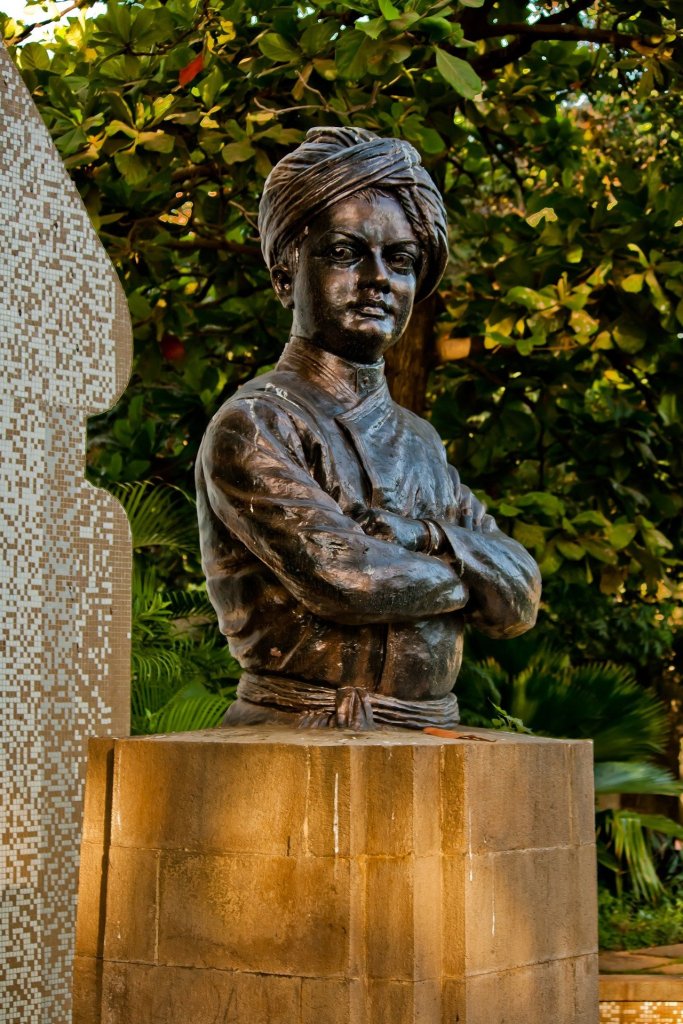
Gopal Lal Villa, the place that witnessed Swami Vivekananda’s last days in Varanasi, stands today in a state of shocking neglect.
The villa, once a grand and peaceful retreat, is now crumbling, and to add to the disgrace, a public toilet has been built right in front of it.
Can there be a greater insult to one of India’s greatest sons, whose teachings and life inspired the nation? Swami Vivekananda dedicated his life to awakening India’s spirit, promoting service, education, and spirituality. How can we allow such disrespect to a place so closely linked to his memory? What message does this send to future generations about valuing our heritage and honoring our great men?
Preserving Gopal Lal Villa is not just about protecting a building; it is about showing respect for our history, our culture, and the ideals that Swamiji stood for.
Swami Vivekananda and Varanasi
Swami Vivekananda’s connection with Varanasi, the eternal city of Lord Shiva, was divine and timeless.
Even before his birth, the sacred spirit of Kashi seemed to embrace him, for this holy city was destined to play a role in his life’s journey.
For detailed and interesting information on this subject, please read my post:
It was here, in the shadow of Lord Shiva’s city, that he spent some of his final days at the beautiful Gopal Lal Villa, leaving behind memories that still echo through the lanes of Kashi.
Varanasi is the city of Lord Shiva, whom Swamiji worshipped with great devotion. Throughout his life, he felt a special bond with this sacred city.
Swamiji last visited Varanasi in 1902, the year of his passing. During this visit, he stayed at Gopal Lal Villa, a beautiful garden house in the Cantonment area.
This villa later became famous in history because it witnessed some of his final days of rest, illness, and deep reflection.
GOPAL LAL VILLA
A painting by Kripa (a young artist) showing how Gopal Lal Villa looked in old times.
The fading remains of Gopal Lal Villa
Gopal Lal Villa in the 19th Century
In the 19th century, many kings and nobles built big houses and garden residences in Varanasi. Some of the most famous ones were:
Kashi Naresh’s Nadesari Kothi
Hathua Naresh’s Kothi
Bettiah’s Kothi
Vijayanagaram King’s Kothi
Goswami Bari (now called Dalmia Bhawan)
For detailed and interesting information on this subject, please read my post:
Among these was Gopal Lal Villa, the garden house of Raja Kali Krishna Thakur. It was a grand bungalow, well-furnished, with parlors, rooms, and gardens all around. The garden was filled with roses and massive trees.
When Swami Vivekananda stayed here, he praised the villa in his letters. He wrote:
“This house is nice — well furnished and has a good many rooms and parlours. There is a big garden all round and beautiful roses and gigantic trees.”
Swamiji’s Stay at Gopal Lal Villa
Swamiji came to Varanasi from Gaya on 4th February 1902. He stayed in Gopal Lal Villa for one month, until 4th March 1902.
Although he came here for rest, he did not stop working for others. Every day, he met Charu Chandra Das (Swami Shubhananda) and Sadashivananda, who had started the Daridra Narayan Seva Samiti.
Swamiji renamed it “Ramakrishna Home of Service.” Later, this became Ramakrishna Hospital (Kaudiya Hospital), which still serves people in Varanasi.
During his stay, he also met Rajarshi Uday Pratap Singh Ju Dev at his house in Durgakund. They discussed important topics about society, reforms, and the upliftment of people. This meeting showed Swamiji’s concern for the future of India, even when his health was failing.
Swamiji also visited the Nepali Temple in Varanasi, dedicated to Lord Shiva. There, he met the priest of the temple, showing his respect and devotion to the holy shrines of the city.
His Health and Letters
Swamiji was not in good health during this time. He often had a fever and difficulty breathing. On 4th March 1902, he wrote a letter to Sister Nivedita, saying that although his health looked steady, it could collapse at any moment.
His words proved true, because only a few months later, on 4th July 1902, he passed away in Belur Math near Kolkata.
His letters from Gopal Lal Villa are very important. They show his thoughts about life, spirituality, health, and service to society. These letters are preserved in The Complete Works of Swami Vivekananda.
The Villa Today
The remains of Gopal Lal Bhawan are located within the L.T. College campus.
Sadly, the condition of Gopal Lal Villa today is very poor. The building has lost its roof, the rooms are broken, and trees have grown on the walls.
Respect Vivekananda – Remove the Toilet!
Instead of preserving this sacred place with dignity, a public toilet has been shamelessly built right in front of it. Can there be a greater insult to one of India’s greatest saints, whose life and teachings awakened the soul of the nation?
Swamiji, who gave India a new identity before the world, deserves monuments of honour, not neglect and humiliation.
Varanasi, the city of Lord Shiva and eternal culture, should protect every memory of Swamiji with devotion. Yet, this act stands as a scar on the conscience of our society. If we cannot respect our saints and heroes, what pride can we have in our heritage? The toilet must be removed, and Gopal Lal Villa must be restored with the honour it rightfully deserves.
The villa is inside the campus of a teacher training college, known as L.T. College, in Orderly Bazaar.
Only two pictures of Swamiji, placed by local people, can be seen at the entrance. There is also a stone slab inside the nearby school, which mentions that Swami Vivekananda stayed here in 1902. But no proper memorial has been made by the government.
Nearby, there is also the ancient Panchu Bir Temple, which is considered sacred. Some people believe that Vinoba Bhave, the Gandhian leader, also stayed in the rooms close to the villa.
Why It Should Be Preserved
Swami Vivekananda is one of the greatest saints of modern India. He taught courage, strength, and service to the poor. His speech in Chicago in 1893 made India proud before the whole world.
The villa where he spent his last visit to Varanasi should not be left in ruins. Varanasi is called the cultural capital of India. Every year, lakhs of people come here. If Gopal Lal Villa is restored and protected, it can become an important place for history, tourism, and spiritual learning.
Surprisingly, the leaders of the nation have ignored this place. Prime Minister Shri Narendra Modi, who is also the M.P. from Varanasi and often speaks about Swamiji, has not taken steps to save this building. The Chief Minister of Uttar Pradesh, himself a sanyasi, has also not acted.
Swami Vivekananda left Gopal Lal Villa in March 1902. Only four months later, on 4th July 1902, he left his body. This makes the villa one of the last places linked with his life.
Today, the villa is almost destroyed, but its memory still lives in Swamiji’s letters, in history, and in the hearts of people who love him.
Watch this video and feel the pain of Gopal Lal Villa — a place that should be a shrine of devotion, not a ruin of neglect.
We must not forget this heritage. Gopal Lal Villa is not just an old house. It is a symbol of Swami Vivekananda’s devotion, his service to society, and his deep connection with Varanasi, the city of Lord Shiva.
If preserved, it can once again inspire the youth of India with Swamiji’s message: “Arise, awake, and stop not till the goal is reached.”
“Dancing mad with joy,
Come, O Mother, come!
For Terror is Thy name!
Death —is in Thy breath
And every shaking step
Destroys a world for e’er.”
“It all came true, every word of it, “he interrupted himself to say.
“Who dares misery love,
Dance in Destruction’s dance,
And hug the form of death—
SWAMI -VIVEKANANDA
Vivekanand was a very lion among man. We preceive his influence still working gigantically. We know not well how, we know not where, in something not yet formed, something leonine, grand intutive uphearing that has entered the soul of India and we say-Behold! Vivekanand still lives, in the souls of the mother and in the souls of the children.
A Journey Through Swami Vivekananda’s Life: The Quest for the 107th Photograph
Swami Vivekananda’s life and legacy continue to inspire millions around the world. In my journey to learn more about him, I set out to accomplish a seemingly small goal: finding the 107th photograph of Swami Vivekananda.
Though I have not succeeded yet, this pursuit has led me to an unexpected treasure trove of knowledge about Swamiji and his profound influence on the general public.
The Collection So Far: 106 Photographs
Over time, I have collected 106 photographs of Swami Vivekananda, each one a window into his life, personality, and mission.
Every image tells a story—of his strength, his spiritual vision, and his deep connection with humanity. The search for the elusive 107th photograph, however, has proven to be a challenge, but it is one I am determined to continue.
A Deeper Understanding of Swamiji
While the 107th photograph remains undiscovered, the journey itself has been transformative.
Along the way, I’ve encountered countless stories and lesser-known facts about Swamiji’s life. From his fearless speeches to his humble interactions with common people, every detail adds a new layer to my understanding of this extraordinary individual.
Varanasi: A City That Shaped Vivekananda
One aspect of Swamiji’s life that particularly stood out during my research was his connection to Varanasi (Banaras).
@This ancient city, with its spiritual energy and rich intellectual culture, left a lasting impression on him.
@Varanasi was the site of significant moments in his life:
@His encounters with scholars and monks.
@The unforgettable lesson to “face fear” during the monkey incident at Durgakund.
@His final days in the serene surroundings of Gopal Lal Villa in 1902.
Despite its importance, surprisingly little has been written about Swami Vivekananda’s deep ties to Varanasi. This city shaped his philosophy in profound ways, and it deserves more attention in discussions of his legacy.
A Commitment to Continue
Though the search for the 107th photograph has yet to bear fruit, I remain committed to uncovering more about Swamiji’s life. His teachings remind us that perseverance is essential, even in the face of challenges.
This journey has become about more than just a photograph; it’s about understanding and sharing the life of a man whose vision continues to guide humanity.
Swami Vivekananda 1891
The Mystery of Swami Vivekananda’s Photograph: Jaipur or Varanasi?
Swami Vivekananda’s life continues to captivate and inspire, and even a single photograph can spark curiosity and debate. Among the many photographs attributed to him, one image has been the subject of much discussion. Two distinct opinions surround this photograph:
@The Jaipur Connection: Many believe this photograph was taken during Swami Vivekananda’s stay in Jaipur.
@The Varanasi Perspective: Some family members of those with whom Swamiji stayed during his time in Varanasi are convinced that the photograph was taken there.
Unraveling the Mystery
This debate highlights not only the richness of Swamiji’s legacy but also the gaps in our collective understanding of his life. Both perspectives have merit, and the truth may lie in untold stories yet to be uncovered.
The Jaipur narrative aligns with Swami Vivekananda’s extensive travels across India, where he was warmly welcomed by kings and commoners alike. Jaipur, known for its vibrant culture, was one such destination where his presence left an indelible mark.
The Varanasi connection draws from the testimony of families with a direct link to Swamiji’s stays in the holy city. Varanasi, a place of deep spiritual significance for Swamiji, holds an enduring place in his journey.
A Window Into Swamiji’s Life
Whether the photograph is from Jaipur or Varanasi, it remains a valuable piece of history—a window into the life of a man who dedicated himself to the upliftment of humanity.
What makes this debate even more fascinating is the way it throws light on the enduring impact of Swamiji’s visits to various cities and the personal connections he formed along the way.
For what is a nation? What is our mother country? it is not a piece of earth, Nor a figure of speech, nor a fiction of the mind .it is a mighty Shakti, composed of the shaktis of all the millions of units that make up the nation, just as Bhawani Mahisha Mardini sprang into being from the Shakti of all the millions of gods assembled in one mass of force and welded into Unity. Sri Aurobindo
Bharat Mata Temple: A Patriotic Landmark Near Varanasi’s Cant Railway Station
The Bharat Mata Temple in Varanasi is about one kilometer from the Cant Railway Station, near Mahatma Gandhi Kashi Vidyapeeth University.
A beautiful campus surrounds the temple, and its walls are adorned with paintings that depict important events from India’s freedom struggle.
A Unique Temple in Varanasi – Dedicated to the Nation
Amid Varanasi’s sacred temples, one stands apart—a shrine to Bharat Mata, our motherland.
Bharat Mata Mandir—a temple that celebrates the spirit of India and honors her as Mother India.
It reminds us of the ancient Indian belief:
“Janani Janmabhoomishcha Swargadapi Gariyasi” (Mother and motherland are greater than heaven.)
This temple echoes the powerful voices and dreams of those who loved India deeply:
The soulful sound of “Vande Mataram,” written by Bankim Chandra Chattopadhyay
The vision and thoughts of Mahatma Gandhi
The revolutionary spirit of Arvind Ghosh and Sachindra Nath Sanyal
And most importantly, the faith, inspiration, and strength of the children of Bharat Mata
The Bharat Mata Mandir is more than a building—it is a symbol of unity, patriotism, and our eternal connection with the motherland.
Here, India is not just seen as a country, but as a sacred mother who nurtures, protects, and guides her people forward.
A Freedom Fighter’s Dream: The Design and Legacy of Bharat Mata Temple
The Bharat Mata Temple in Varanasi stands as a unique symbol of patriotism and national unity. It was the vision of freedom fighter Babu Shiv Prasad Gupta, who designed the temple not as a place of religious worship, but as a tribute to the spirit of India itself.
The temple was inaugurated by Mahatma Gandhi in 1936, making it one of the rare temples in the country.
At the heart of the temple lies its most iconic feature: a relief map of undivided India (Akhand Bharat), carved out of marble.
This detailed map, housed in the central atrium, serves as a votive object and a powerful reminder of India’s geographical and cultural unity before Partition.
No Idol? Myth Busted! How Bharat Mata’s Geographic Form Embodies Divine Worship
Some people mistakenly believe that the Bharat Mata Temple has no idol or representation of any Hindu deity, which is both unfounded and misleading.
In truth, the temple houses a powerful and symbolic representation of Mother India in her geographical form—a detailed relief map of undivided India carved in marble.
Just as Lord Shiva is worshipped in the form of a Shivalinga in many ancient Hindu temples, Bharat Mata is revered here in the form of her sacred land.
This unique depiction reflects the deep spiritual connection Indians have with their country, viewing it not just as a piece of land, but as a divine mother figure.
The Vision Behind Bharat Mata Mandir – In the Words of the Founder
Om Vande Mataram
The inspiration for creating a relief map of Bharat Mata came to me quite unexpectedly.
In the winter of Samvat 1970 (1913 AD), while returning from the Karachi Congress, I had the chance to visit Mumbai, and from there, I traveled to Pune. During my visit, I went to see the widows’ home run by Shriman Ghondo Keshav Karne.
There, I came across a relief map of India drawn on the ground using clay. The mountains and rivers were sculpted in raised and lowered sections, and the map appeared so lifelike and beautiful that the thought came to me: “A similar map should be created in Kashi.”
At first, this was just a fleeting idea. But soon after, I had the opportunity to travel to London, where I visited the British Museum and saw many such topographical maps of various countries.
The memory of the clay map I had seen in Pune became stronger, and the desire to create a durable, artistic map of India continued to grow within me.
After discussions with respected elders and friends, it was decided that the map should be carved from marble.
This would not only ensure longevity and beauty but would also make it a worthy representation of Bharat Mata, our revered motherland.
The search for the right artist and sculptor began. After much effort, Shri Durga Prasad ji of Kashi accepted the responsibility and, with great dedication and talent, brought the vision to life.
The work began in Vikram Samvat 1975 (1918 AD) and, after 5–6 years of painstaking effort, the map was finally completed.
Yet, due to several unexpected delays and challenges, it took time for the map to be unveiled to the public.
Eventually, the foundation stone of the Bharat Mata Temple—the home of this marble relief map—was laid by Shri Bhagwandas ji on Chaitra Shukla Pratipada, Sunday, Samvat 1984.
After the completion of 24 Lakshya Gayatri Purashcharana, the first darshan ceremony was held on Mahanavami (Ashwin Shukla, Samvat 1983), during which Mahatma Mohandas Karamchand Gandhi recited the four Vedas and offered Purnahuti with his own hands.
The temple was finally opened to the general public on the auspicious day of Vijaya Dashami, Samvat 1983.
Architecture and Design: Where History Meets Craftsmanship
The Bharat Mata Temple is built in a square-shaped layout amidst a peaceful garden, offering a tranquil and inspiring atmosphere.
The structure uses Chunar sandstone, a material renowned for its strength and historical significance, often found in North India’s ancient monuments.
Following Varanasi’s traditional architectural style, the temple is built on a high stone platform, a design element that echoes the construction of ancient Hindu temples and Buddhist stupas in the region.
Visitors ascend via stone staircases to reach the platform, where they are welcomed by the temple’s impressive facade.
Bharat Mata Mandir (Mother India Temple) Where Spirituality Meets Patriotism
The main front features three doors and two windows, while the other sides include five large windows each, allowing natural light and air to fill the space.
While the structure has three doors at the entrance, typically only the central one is open to the public.
Above the entrance, a finely carved stone frame with intricate Hindu motifs reflects the exceptional artistry of ancient Indian craftsmen.
Where is the Bharat Mata Mandir Located?
The Bharat Mata Temple in Varanasi is located about a kilometer from the Cantt Railway Station, near Mahatma Gandhi Kashi Vidyapeeth University.
The temple is surrounded by a beautiful campus, with its walls adorned with paintings depicting significant events from India’s freedom struggle.
A Freedom Fighter’s Dream: The Design and Legacy of Bharat Mata Temple
The building was designed by freedom fighter Babu Shiv Prasad Gupta and was inaugurated by Mahatma Gandhi in 1936. The central atrium houses a map of undivided India (Akhand Bharat) carved in marble as a votive object.
Some people believe that there isno idol of any Hindu deityinstalled in this temple, which is completely baseless and ridiculous.
In this temple, Mother India is depicted in geographical form.
Just as Lord Shiva is represented in the form of a Shivalinga in many ancient Hindu temples, Mother India is depicted in a geographical form in the Bharat Mata Mandir.
The main building of Bharat Mata Mandir
Bharat Mata Mandir is a square-shaped building located within a garden. The temple’s outer walls are predominantly constructed using Chunar sandstone, which adds to its aesthetic and historical significance.
The temple is situated on a High stone platform, a design tradition that has been prevalent in Varanasi for thousands of years.
This architectural practice of building structures on solid stone platforms is deeply rooted in the region’s history. Notably, many ancient Hindu and Buddhist stupas in Varanasi are also built on similar stone platforms, showcasing the continuity of this architectural style over millennia.
The main building of Bharat Mata Mandir features three doors and two windows on its front façade, while the other three sides are adorned with five life-size windows.
The temple is accessed via stone staircases on two sides, which lead up to the high stone platform.
Upon ascending these stairs, visitors find themselves standing before the temple’s entrance.
The entrance consists of three doors, though two of these are typically kept closed. Above the doors, a stone door frame showcases intricate carvings that reflect the exquisite craftsmanship of ancient Hindu art. These artistic details add to the temple’s spiritual and historical ambiance.
“We do not consider anyone else as mother, Mother and motherland are superior even to heaven.”
BANKIMCHANDRA-ANANDAMATH
Bharat Mata (Mother India) symbolizes India as a motherland, embodying the country’s civilization, culture, history, and people.
The concept of Bharat Mata is rooted in the idea that the land of India nurtures and protects its citizens like a mother, providing for them and guiding them through life’s challenges.
This concept reflects the deep emotional and spiritual connection that Indians have with their country, where the nation itself is revered as a mother figure.
Bharat Mata Ki Jai translates to “Victory to Mother India” and is a slogan expressing patriotism and pride in the nation. It is a way of showing reverence and respect for the motherland, and it became especially significant during India’s freedom struggle when it was used as a call for unity and independence.
In the City of Temples, Bharat Mata Temple Stands as a Monument to National Pride
The Bharat Mata Temple in Varanasi is located about a kilometer from the Cantt Railway Station, near Mahatma Gandhi Kashi Vidyapeeth University.
The temple is surrounded by a beautiful campus, with its walls adorned with paintings depicting significant events from India’s freedom struggle.
Varanasi is one of the oldest living cities in the world and also the holiest city of Hindus.
It is also called the City of Temples. Temples have been built here at every stage of India’s history. According to Islamic philosophy in the days of Islamic imperialism, many ancient temples were demolished due to the prohibition of idol worship, but new temples were being built by Hindus as soon as they got the chance, due to this the importance of this city always remained in Hindu culture.
Even today there are countless temples here. Many temples are very unique and bizarre -one such temple is ——
Bharat Mata Temple. (Mother India) In this temple, the country of India is depicted as Bharat Mata.
Bharat Mata Temple: A Sacred Landmark in Varanasi
Plan Your Visit: The Exact Location of Bharat Mata Mandir
The Bharat Mata Temple in Varanasi is located about a kilometer from the Cantt Railway Station, near Mahatma Gandhi Kashi Vidyapeeth University.
The temple is surrounded by a beautiful campus, with its walls adorned with paintings depicting significant events from India’s freedom struggle.
The campus also houses the Fine Arts Department of the University, attracting many students to the area. The temple itself is a two-story sandstone structure, and an information plate provides key details about its history and significance.
BHARAT MATA MANDIR
The building was designed by freedom fighter Babu Shiv Prasad Gupta and was inaugurated by Mahatma Gandhi in 1936. The central atrium houses a map of undivided India (Akhand Bharat) carved in marble as a votive object.
The Artistic Legacy of Bharat Mata Mandir’s Relief Map
The main building is double-storied and square in plan. The map comprises 762 square pieces of marble measuring 11″x11″ Bach was built by 30 Sculptors and 25 masons.
The relief map sunken in the floor can be seen from the first-floor circumambulatory passage. It measures 950 m x 920 m at a scale of 1:405500 (1 inch being equal to 6.4 miles). The temple building is situated at a slight height, for which some stairs have to be climbed.
Preserving Heritage: The National Song and Ancient Symbols at Bharat Mata Temple
“Vande Mataram” (Rashtra-Geet) is inscribed on both sides of the main door of the Bharat Mata Temple.
The Sacred Symbols of Bharat Mata Mandir: A Reflection of India’s Timeless Heritage
The Bharat Mata Mandir stands as a beacon of spirituality and tradition, with its main entrance adorned by the sacred Gayatri Mantra, a timeless hymn invoking wisdom and enlightenment.
This inscription enhances the temple’s spiritual significance, offering a serene welcome to all visitors.
Prominently featured at the temple is the Swastik symbol, an ancient emblem of auspiciousness in Hinduism. This revered icon, rooted in thousands of years of tradition, predates modern ideologies and carries profound cultural and spiritual meanings.
The Swastik has been unearthed in archaeological treasures like Harappa and Mohenjodaro, underscoring its deep connection to India’s ancient civilization.
In an era of diverse interpretations, it is essential to understand these symbols for what they truly are: representations of India’s enduring heritage, spirituality, and values.
Far from political connotations, they embody the soul of a civilization that has celebrated harmony, knowledge, and auspiciousness for millennia.
Sacred Geometric Symbols at Bharat Mata Mandir
Six-Pointed Star (Shatkona)
The six-pointed star, or Shatkona, is a sacred Hindu symbol featuring two interlocking triangles. The upward triangle symbolizes Shiva (Purusha, male energy, and fire), while the downward triangle represents Shakti (Prakriti, female power, and water). Their union signifies the creation of life, embodied by Sanatkumara, whose sacred number is six.
Eight-Pointed Star (Ashthalakshmi)
The eight-pointed star, also known as Ashthalakshmi or the Star of Lakshmi, is associated with the Hindu goddess Lakshmi. Representing wealth, prosperity, and divine abundance, this symbol holds deep spiritual and cultural significance in Hinduism.
Other Symbols Engraved at the Entrance
The temple’s entrance is adorned with other major Hindu symbols, each carrying profound meanings. These carvings beautifully represent India’s spiritual heritage, offering visitors a glimpse into the deep philosophical roots of Hindu culture.
A Learning Experience Beyond Textbooks at Bharat Mata Mandir
As anyone steps through the main gate of Bharat Mata Mandir, a stunning geographical map of Akhand Bharat (undivided India) greets you, meticulously crafted on the floor.
This map, representing pre-partition India, symbolizes the unity and vastness of the nation. It is this unique depiction that gives the temple its name, Bharat Mata Mandir (Mother India).
For schoolchildren, this temple offers a refreshing educational experience beyond the monotony of textbooks and classroom settings.
The captivating map and the temple’s rich historical significance provide an engaging way to learn about India’s geography, culture, and heritage, making it both a place of devotion and a source of knowledge.
A Symbol of Patriotism and Philosophy: Bharat Mata Mandir in Varanasi
Step into a temple like no other—a shrine that radiates the spirit of India’s cultural and philosophical essence.
Bharat Mata Mandir in Varanasi is not just a place of worship; it is a testament to the imagination of Bankim Chandra Chatterjee, whose Vande Mataramstirred the nation. It embodies the sacrifices of countless martyrs and reflects the vision of Mahatma Gandhi, who often invoked Bharat Mata in his letters.
Here, you can feel the reverberations of Swami Vivekananda’s powerful lectures on India’s motherhood and the profound philosophy of Sri Aurobindo Ghosh, who celebrated India as a spiritual beacon for the world.
The temple also echoes the ancient wisdom of Lord Shri Ram’s declaration, Janani Janmabhoomischa Swargadapi Gariyasi—”Mother and Motherland are superior to heaven.”
What makes this temple truly exceptional is its sanctum, which does not enshrine an idol of any deity but instead features a magnificent, intricately carved geographical map of undivided India—Akhand Bharat.
This unique representation reminds every visitor of the unity, diversity, and enduring spirit of the nation.
Gandhi’s ideas have to be freed from the Gandhian mafia only then Gandhi’s ideas will remain meaningful.
Mahatma Gandhi is widely known as the Father of the Nation in India. His leadership, commitment to non-violence and dedication to India’s independence struggle have left a lasting legacy.
His principles of truth, non-violence, and social justice continue to inspire not only Indians but people around the world.
Even after using the internet for about 14-15 years, I used to stay away from social media platforms like Facebook, Twitter, and WhatsApp. But two years ago, I created an account on social media due to pressure from my friends.
Last year, on Gandhi Jayanti, I was shocked to see that social media was filled with vulgar jokes about Gandhi Ji. It made me think a lot and left me amazed at the disrespect.
MAHATMA GANDHI
The complex relationship between Mahatma Gandhi’s ideas and the current sentiment among the younger generation in India can be seen through various lenses.
Firstly, it’s important to recognize that Gandhi’s values—non-violence, restraint, brotherhood, and his vision of Ram Rajya—were deeply rooted in his quest for social harmony and political independence.
These principles have stood the test of time and continue to resonate with many. However, as the world and India itself have evolved, there has been a shift in the way these ideals are perceived by different generations.
For the younger generation, there are several reasons why Gandhi's popularity might be challenged, despite his monumental contributions to India's independence:
Changing Nationalism: The rise of more assertive nationalism in recent times, marked by a desire for a stronger, more self-reliant India, has led to a shift away from Gandhi’s ideas of passive resistance.
Many of today’s youth view assertive action, military strength, and national pride as more important than the philosophy of non-violence.
This shift, particularly in the context of India’s growing global influence, contrasts with Gandhi’s emphasis on peace and restraint.
Disillusionment with Politics: The association of Gandhi’s legacy with the political establishment, particularly the Nehru-Gandhi family, has led some younger Indians to question the relevance of his ideas in today’s context.
The perception that Gandhi’s legacy has been used or distorted by politicians for their gain has also affected his image, leading to feelings of disillusionment among those who feel disconnected from his philosophy.
Perception of Weakness: Some critics argue that Gandhi’s stance on non-violence made India vulnerable in certain historical moments, and this perception is often magnified in the present scenario where youth, facing contemporary challenges, might desire stronger, more direct solutions. Nationalism today often ties itself with pride in military strength and assertive diplomacy, contrasting sharply with Gandhi’s non-confrontational methods.
Economic and Technological Shifts: The focus on economic development, technological growth, and global competitiveness in India’s current narrative can sometimes overshadow Gandhi’s ideas about simple living, self-reliance, and rural empowerment.
The Appeal of Strong Leadership: The growing preference for strong leadership and decisive action in India contrasts with Gandhi’s emphasis on dialogue, gradual change, and non-violence.
As the country faces new challenges, some may feel that Gandhi’s methods of struggle no longer align with the political or social realities of the 21st century.
The younger generation may be more inclined towards rapid modernization, and the slow, deliberate pace of Gandhi’s ideas might seem out of touch with these aspirations.
The growing anger towards the Gandhi family and the Congress party in India has, unfortunately, been linked to Mahatma Gandhi's legacy.
Many people believe that the present Gandhi family, which claims to have inherited Mahatma Gandhi’s political legacy, is responsible for much of the country’s current struggles. They argue that this family was imposed on India due to Mahatma Gandhi’s influence, but rather than following his principles of simplicity, non-violence, and service to the nation, the family’s political actions have often seemed disconnected from those ideals.
This perception has fueled resentment, with a significant section of the population holding the Gandhi family accountable for the country’s political and social turmoil, which has indirectly contributed to the diminishing respect for Mahatma Gandhi’s legacy.
It is evident that in India, especially among the youth, there is no inherent resentment towards Gandhi and his ideals. However, the politicians who have built their petty political careers under the guise of Gandhi’s name have tarnished his legacy through their actions.
The principles of truth, non-violence, and service to the nation that Gandhi stood for have been compromised by those seeking personal gain, leading to a distorted view of his legacy. The disillusionment is not with Gandhi himself but with those who have misused his name for their agendas.