
Introduction
Varanasi, also called Kashi or Banaras, is the heart of Sanatan Dharma. For thousands of years, this sacred city has been the spiritual capital of India.
All the sects, traditions, and paths of Hinduism flow here like rivers meeting the holy Ganga. Jainism and Buddhism, too, found deep roots here, making it a spiritual center for the whole world.
No one can count exactly how many temples once stood here before the invasions.
Many were destroyed, many buried, and many rebuilt. Yet, the devotion of Hindus never faded.
Even today, Varanasi shines with countless temples, each telling a story—some of power, some of struggle, and some of divine grace.
In this post, I will share with you the 9 most famous temples of Varanasi. I have not gone into too much detail here. If you wish to explore any temple in depth, I have linked my other posts for further reading.
Now, let us begin this sacred journey—temple by temple.
(I)
Markandeya Mahadev Temple – Where Shiva Saved His Devotee

Main Gate of Markandeya Mahadev Temple
मार्कण्डेयस्य राजेन्द्रतीर्थमासाद्य दुर्लभम् ।
गोमतीगङ्गयोश्चैव सङ्गमे लोकविश्रुते॥
(MAHABHARAT -PAGE 241)

Markandeya Tirtha is situated at the confluence of Ganga-Gomti
About 35 km from Varanasi City, in Kaithi village, stands the Markandeya Mahadev Temple, one of the oldest temples mentioned even in the Mahabharata.
It is located at the holy confluence of the rivers Ganga and Gomti. In India, confluences are seen as divine, and this place is called Markandeya Tirtha.
The Legend of Rishi Markandeya
When Rishi Markandeya was born, astrologers predicted he would live only for 14 years.
His parents, heartbroken, prayed to Lord Shiva. On his 14th birthday, when Yamraj (the God of Death) came to take his life, Markandeya was deep in meditation, hugging a Shiva Lingam.
Lord Shiva appeared, stopped Yamraj, and blessed Markandeya with long life and immortality.
From then on, Shiva became famous as “Kalantaka” – the conqueror of death.
Why This Temple is Special
- One of the oldest temples of Sanatan Dharma.
- Mentioned in the Mahabharata.
- Built at a holy sangam (confluence) of rivers.
- A powerful place to pray for protection and long life.
This temple is not just stone and walls. It is the living memory of the bond between a devotee and his Lord.

Shiva (Mahadev) defends his devotee ~ Markandey, from Yama(the god of death), Ravi Varma Press, 1910.
(II)
Vishwanath Temple – The Soul of Varanasi

Har Har Mahadev!
When people think about Varanasi, the first temple that comes to mind is the Kashi Vishwanath Temple.
It is dedicated to Lord Shiva, who is called Vishwanath, which means “Lord of the Universe.”
Shiva here is worshipped as the one who protects the world, gives harmony to life, and showers endless compassion.
This temple is not only the most famous shrine of Varanasi but also a symbol of the faith and strength of Hindus.
A Temple That Refused to Die
From the 11th century to the 17th century, the Vishwanath Temple was attacked and destroyed many times by invaders. But every time it was demolished, the people of Kashi rose again and rebuilt it.
This cycle of destruction and rebuilding makes the temple a shining example of the courage and resilience of Sanatan Dharma.
Finally, in 1777–1780, Maharani Ahilyabai Holkar of Indore rebuilt the temple in its present form. Later, great kings and rulers added more beauty to it:
- Maharaja Ranjit Singh of Punjab donated gold to cover the main dome.
- Maharani Baijabai of Gwalior built a pavilion.
- The Maharaja of Nepal placed a huge statue of Nandi (Shiva’s bull) in the temple complex.
Because of their devotion, the temple today looks grand and divine.
Shri Kashi Vishwanath Dham Project

In recent years, the temple has been given a new life through the Shri Kashi Vishwanath Dham Project.
This project, supported by the Government of India, has made the temple area much larger, cleaner, and easier for devotees to visit.
Now, lakhs of pilgrims from India and abroad come here every year to take the blessings of Baba Vishwanath.
The new Dham connects the temple directly to the holy river Ganga, creating a spiritual experience that devotees will never forget.
Why You Must Visit

Shri Kashi Vishwanath Dham
If you are in Varanasi, visiting the Kashi Vishwanath Temple is a must.
It is not just a temple – it is the heart of Varanasi and a living story of faith, struggle, and victory of devotion.
When you hear people chanting “Har Har Mahadev” here, you feel the power of Sanatan Dharma flowing through every corner of the city.
(III)
MOOLGANDH KUTI VIHARA OR MULGANDHKUTI VIHAR

Ruins of Mulgandha Kuti Vihar

Ruins of Mulgandha Kuti Vihar were found at the Sarnath excavation in 1905, behind the Lion Capital
The Ruins of Mulgandha Kuti Vihar – A Place Where Buddha Meditated
The Mulgandha Kuti Vihar ruins in Sarnath are very special because they take us back to the time of Gautam Buddha.
It is believed that after giving his first sermon in Sarnath around 600 BCE, Buddha stayed here and spent time in meditation.
Later, around 250 BCE, the great emperor Ashoka built a grand temple at this site to honor Buddha’s teachings.
Xuanzang’s Visit
Many years later, the Chinese traveler Xuanzang (Hiuen Tsang) came to Sarnath.
He described Mulgandha Kuti Vihar as a magnificent temple filled with beauty and devotion. His writings help us imagine how grand and important the temple once was for Buddhists across the world.
Destruction and Ruins
Sadly, in 1194 CE, invaders destroyed this temple. But even in ruins, the site still tells its story. The broken walls and remains remind visitors of its past glory and the deep history of Buddhism in India.
When people walk through the ruins today, they can almost feel the presence of Buddha and imagine the great temple that once stood there.
Why It Matters
The Mulgandha Kuti Vihar ruins are not just stones – they are a living memory of Buddha’s life and meditation. They show the strength of Buddhist traditions and India’s rich spiritual heritage that has survived for thousands of years.
NEW MULGANDH KUTI VIHAR

The new Mulgandha Kuti Vihar, Sarnath
The New Mulgandha Kuti Vihar: A Modern Tribute to an Ancient Legacy
In 1931, the Mahabodhi Society constructed a new Mulgandha Kuti Vihar temple in Sarnath, inspired by the original ancient temple that once stood in its place. This modern temple serves as a spiritual successor, honoring the legacy of the original structure and preserving the significance of the site where Gautam Buddha once meditated.

The golden statue of Buddha located in Mulgandha Kuti Vihar
Features of the New Temple
The new Mulgandha Kuti Vihar temple is a prominent Buddhist temple in Sarnath and a major attraction for devotees and tourists alike. Its interior houses a golden statue of the Buddha, exuding serenity and divinity.
The walls of the temple are adorned with large, intricate paintings depicting key events from Buddha’s life, such as his enlightenment and first sermon. These murals offer visitors a visual narrative of the Buddha’s journey and teachings.

Paintings made on the inner walls of the temple
(IV)
The Ancient Durga Temple of Varanasi: A Timeless Heritage

Sacred tank and pagodas near Benares
This watercolour, dated circa 1808, belongs to a series that was engraved and published as A Picturesque Tour along the River Ganges and Jumna in 1824.
The Durga Temple is one of the oldest and most revered temples in Varanasi, steeped in history, legend, and spiritual devotion.
It finds mention in the ancient text Kashi Khanda, which underscores its deep-rooted connection to the sacred traditions of Kashi.
In 1760, the Queen of Nadia from Bengal reconstructed the temple, ensuring its preservation for future generations while maintaining its religious sanctity and historical legacy.

Durga Kund shri Durga temple
The Two Parts of the Temple Complex
The Durga Temple complex consists of two integral sections that together embody both architectural beauty and spiritual depth.
1) Durga Mandir
The main shrine, dedicated to Goddess Durga, stands as a striking example of North Indian temple architecture.
Inside, the sacred idol of Durga is worshipped as the divine embodiment of power and protection.
Throughout the year, especially during Navratri, the temple draws countless pilgrims who come to seek the goddess’s blessings.
2) Durga Kund
Adjacent to the temple lies the Durga Kund, a large sacred water tank that enhances the spiritual atmosphere of the complex.
The Kund holds immense ritual significance, believed to amplify the sanctity of the prayers offered to the goddess.
Why Durga Kund is Known as the “Monkey Temple” Among Western Visitors

THE PRINCE OF WALES VISITING THE MONKEY TEMPLE, BENARES -THE GRAPHIC 1876.
For centuries, monkeys roamed freely around the Durga Temple premises. Their abundance fascinated foreign travelers, who began referring to the shrine as the “Monkey Temple.”
Though the number of monkeys has declined in recent times, the name continues to be popular among Western tourists, preserving a curious colonial-era association.
For more details, read the full article:
(V)
The Bharat Mata Temple: A Tribute to the Motherland

Bharat Mata Temple Varanasi
The Bharat Mata Temple stands out as one of Varanasi’s most unique landmarks, blending nationalism, art, and devotion.
It was designed by freedom fighter Babu Shiv Prasad Gupta and inaugurated by Mahatma Gandhi in 1936—a reflection of the spirit of India’s independence movement.

A Temple Without an Idol
Unlike traditional Hindu temples, the Bharat Mata Temple does not enshrine any deity.
Instead, its sanctum houses a massive relief map of undivided India (Akhand Bharat) carved in marble, symbolizing the unity and integrity of the nation.
Architectural and Artistic Details
The marble map comprises 762 square pieces, each measuring 11″ × 11″.
The relief map covers an area of 950 m × 920 m, constructed on a scale of 1:405,500 (where 1 inch represents 6.4 miles).
Visitors can admire the intricate geographical details of the subcontinent from the circumambulatory passage on the first floor.
The two-storied, square-shaped design of the temple gives it a distinctive architectural identity—simple yet deeply symbolic of India’s cultural and territorial unity.
(VI)
Adi Keshav Temple: The Ancient Heart of Varanasi
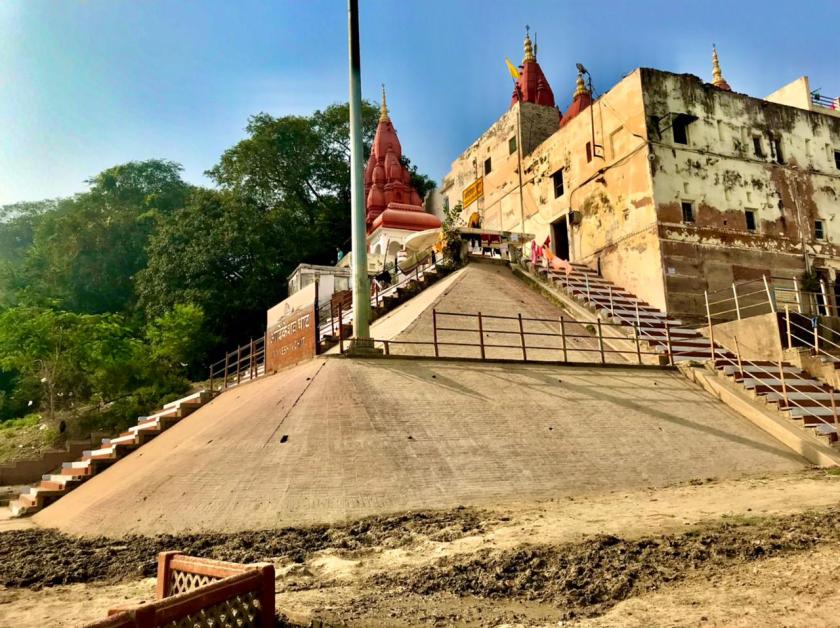
Adi Keshav temple
Among the countless temples that make Varanasi the spiritual capital of India, Adi Keshav Temple holds a very special place.
It is not only one of the oldest temples in Kashi but also stands at a location considered the birthplace of the city itself — the sacred confluence of the Ganga and Varuna rivers.
This site, known as Adi Keshav Ghat, is believed to mark the very heart of ancient Kashi, where Lord Vishnu is said to have first appeared to establish the city’s divine energy.
According to ancient scriptures, this is where Lord Vishnu, in his form as Adi Keshav, first set foot in Kashi.
The temple, therefore, represents the Vishnu aspect of creation, balancing the city’s deep connection with Lord Shiva, who symbolizes destruction and transformation. Together, Shiva and Vishnu make Kashi a perfect symbol of the eternal cycle of life.
A Journey Through Ancient Kashi

Watercolor painting of temples near Rajghat in Varanasi. From ‘Views by Seeta Ram from Patna to Benares’. (DATE: 1814). This idealized view shows a group of temples at Rajghat, at the confluence of the river Barna (Varuna) with the Ganges, where principally the Adi Keshava and Sangamesvara temples are located.
The history of Adi Keshav Temple reaches back thousands of years.
Excavations at nearby Rajghat have revealed remains of settlements from around 2000 B.C., proving that this area has been continuously inhabited for over four millennia. This makes it one of the oldest living sites in the world and a key part of Varanasi’s temple heritage.
In early times, Adi Keshav Temple was one of the most famous shrines in Kashi, visited by countless pilgrims. Unfortunately, it was destroyed in 1194 A.D. during the Islamic invasion led by Qutb-ud-din Aibak after the fall of Raja Jayachandra.
Centuries later, in 1807, the Scindias of Gwalior rebuilt the temple, restoring its lost beauty and sacredness.

Adi Keshav Temple Today
Today, Adi Keshav Temple remains a peaceful and holy destination for devotees and travelers alike.
The calm waters of the Ganga and Varuna create a beautiful setting for meditation and prayer.
Nearby, the newly developed Khidkiya Ghat (Namo-Ghat), located about 1.5 kilometers from the temple, has become a popular stop for spiritual tourism in Varanasi. Visitors can reach the temple easily by foot, boat, or vehicle.
For anyone exploring the ancient temples of Kashi, a visit to Adi Keshav Temple offers a living connection to the origins of Varanasi’s eternal faith and heritage.
accessible and appealing to visitors worldwide.
(VII)
Maa Annapurna Temple – The Goddess Who Feeds the World

A Preacher Expounding The Poorans. In The Temple of Unn Poorna, Benares. Lithograph by James Prinsep (1835). British Library.
In Varanasi, very close to the Kashi Vishwanath Temple, stands another sacred shrine — the Maa Annapurna Temple.
The name Annapurna means “The Mother Who Provides Food.”
She is worshipped as the Goddess of Nourishment and Abundance, the divine mother who makes sure that no one in the world goes hungry.
The temple was built by Vishnu Pant Gajade, and it carries a deep spiritual message — that sharing food is one of the greatest forms of worship.
Inside the temple, Maa Annapurna is shown in a kitchen setting, holding a bowl of food, symbolizing her love and care for all living beings.
This simple yet beautiful scene reminds everyone that feeding others is a sacred duty.
The idol of Maa Annapurna Devi is placed on a silver throne, shining with grace and peace. Alongside her are the idols of Mata Parvati, Mata Kali, and Lord Shiva, representing the unity of divine power in different forms.
A Unique Temple Tradition
The temple remains open all year, but its most special time is during the four days between Dhanteras and Annakoot (around Diwali).
During these days, devotees get a rare chance to see the golden idol of Maa Annapurna. Thousands of pilgrims gather to take her blessings, offering food, sweets, and prayers. The entire temple glows with devotion and joy.
The Ancient Legend

Mother Annapurna donated food to Lord Shiva
According to an old story, long ago, there was a terrible famine on Earth.
People were starving and prayed to Lord Shiva for help. Moved by their suffering, Maa Parvati took the form of Maa Annapurna, the goddess of food. She came down to Earth with Lord Shiva and began to cook and serve food.
Lord Shiva distributed the food among people, ending the famine and bringing peace and happiness back to the world.
This story teaches that food is divine, and those who share it perform the greatest act of kindness.
The Maa Annapurna Temple in Varanasi keeps this message alive even today. It stands as a reminder that in every meal shared, in every hand that gives, the Mother Goddess lives on — feeding, caring, and protecting her children.
(VIII)
Sankat Mochan Temple – The Temple of Lord Hanuman and Faith

Main Gate of Sankat Mochan Temple
The Sankat Mochan Temple is one of the most famous and historic temples of Varanasi.
It is dedicated to Lord Hanuman, the beloved devotee of Lord Rama, who is worshipped as the remover of all troubles.
The name Sankat Mochan itself means “one who removes sorrow and obstacles.”
This temple was founded about 400 years ago by the great saint and poet Goswami Tulsidas Ji.
Born in 1511, Tulsidas Ji is remembered as one of the greatest figures in Hindi literature. His most famous work, the Ramcharitmanas, brought the story of Lord Rama to the hearts of ordinary people through simple and beautiful Hindi verses.
Tulsidas Ji and the Temple
It is said that Goswami Tulsidas Ji once had a divine vision of Lord Hanuman at this very place.
Deeply moved by this holy experience, he built the Sankat Mochan Temple in honor of the Lord. The temple soon became a center of faith, devotion, and inspiration for countless devotees.
During difficult times in Indian history, Tulsidas Ji’s writings gave people courage, hope, and faith. Through his poetry, he reminded everyone of the strength of truth, devotion, and dharma (righteousness). His efforts helped revive Hindu culture when it faced challenges and inspired generations to come.
Temple Atmosphere and Traditions
The temple is located near the Assi area of Varanasi, surrounded by greenery and peace.
The moment you enter the temple, you hear the rhythmic chanting of Hanuman Chalisa, written by Tulsidas Ji himself. The air feels filled with devotion, and many devotees offer sweets, flowers, and marigold garlands to Lord Hanuman.
Every Tuesday and Saturday, the temple becomes especially crowded, as these days are considered sacred for Hanuman worship.
The annual Hanuman Jayanti festival is celebrated with great joy, with thousands of devotees visiting from all over India.
The Sankat Mochan Temple is not just a place of worship—it is a symbol of faith, devotion, and the unbreakable connection between Lord Hanuman and Goswami Tulsidas Ji.
Visiting this temple is said to bring peace, courage, and protection from all troubles, making it one of the most loved temples in Varanasi.
(IX)
Vishwanath Temple at Banaras Hindu University – The New Vishwanath Mandir

The main gate of the Vishwanath temple at B.H.U
The Vishwanath Temple at Banaras Hindu University (BHU) is one of the most beautiful and important temples in Varanasi. It is often called the “Naya Vishwanath Mandir”, which means New Vishwanath Temple.
The temple stands proudly inside the peaceful and green campus of Banaras Hindu University. Its tall spires can be seen from a long distance, shining brightly in the sunlight.
This grand temple is a replica of the original Vishwanath Temple, which was rebuilt around 1585 CE by Narayan Bhatt, with the help of Raja Todarmal, a minister of the Mughal emperor Akbar. The modern temple inside BHU keeps that ancient design and spirit alive.

A bird’s eye view of the BHU Vishwanath Mandir.
A Gift from the Birla Family
The construction of this temple was made possible by the famous Birla family, who have built many beautiful temples all over India. Because of their contribution, this temple is also known as the Birla Mandir of Varanasi.
The work on the temple began in the 1930s and continued for almost 35 years. Built mainly from white marble, the temple’s two stories house idols of several Hindu deities, with Lord Vishwanath (Shiva) as the main deity.
The temple’s design beautifully combines simplicity and grandeur. It stands tall as one of the highest temple structures in India, symbolizing faith and devotion reaching up to the heavens.
A Symbol of Faith and Strength
The Vishwanath Temple of BHU is not just a place for prayer. It represents the strength and survival of Hindu culture through centuries of challenges. Even when ancient temples were destroyed during difficult times, people never gave up their faith.
By rebuilding this temple, they showed the world that the spirit of Sanatan Dharma (eternal truth) cannot be erased. Every wall and sculpture in this temple seems to tell the story of courage, devotion, and the unbroken continuity of India’s spiritual heritage.
Visitors from all over the world come here to experience peace and spirituality. Standing before this magnificent temple, one can feel both history and faith alive in every stone.


