Ashoka Pillar of Sarnath gives a wonderful opportunity to understand ancient Indian history, every person who wants to understand Indian history must see this divine artwork at least once in their lifetime.
Prerequisite Knowledge
The Ashoka Pillar at Sarnath is divided into three major parts:
The Pillar
The Lion Capital
The 32-Spoked Wheel
Importantly, there were two types of wheelsassociated with the pillar:
24-spoked wheel – engraved on the abacus of the Lion Capital.
32-spoked wheel – once placed on the very top of the Lion Capital (fragments found in excavations, preserved in the Sarnath Museum).
The pillar was built around 250 BCE at the site where the Buddha gave his first sermon. The Chinese traveler Xuanzang, visiting in the 7th century CE, described the pillar as “smooth as jade and reflective as a mirror.”
This diagram provides a rough idea of what the pillar might have looked like when Xuanzang visited India during the reign of Harsha Varman, also known as Harshavardhana.
A. The Pillar
The fragments of the Ashoka Pillar are preserved in a glass showcase at Sarnath.
Frequently Asked Questions about the Ashoka Pillar
When was the Ashoka Pillar built?
What was the purpose of establishing the Ashoka Pillar at Sarnath?
In which language is the warning of Emperor Ashoka written?
Who discovered the Ashoka Pillar at Sarnath?
When and how were the Ashoka Pillar, the Lion Capital, and the 32-spoked wheel discovered?
What is the Ashoka Pillar made of?
Is the description of the Ashoka Pillar found in history?
1. Built around 250 BCE by Emperor Ashoka at Sarnath, the site of Buddha’s first sermon.
2. Purpose: To warn monks and nuns against divisive tendencies within Buddhism.
3. Inscription language: Prakrit, written in Brahmi script.
4. Discovery: Excavated in 1904–1905 near Dhamek Stupa.
5. Discoverer: F. O. Ortel led the archaeological excavations.
6. Material: Made of Chunar sandstone, 40 km from Varanasi.
7. Historical testimony: Xuanzang (627–643 CE) praised its brilliance, calling it a shining pillar “over 70 feet tall.”
The Ashoka Pillar at Sarnath stands as one of the finest examples of Mauryan craftsmanship and imperial vision. Built around 250 BCE by Emperor Ashoka, it was erected at the sacred site where the Buddha delivered his first sermon.
More than a monument, the pillar carried a moral purpose: to warn monks and nuns against divisions within the Buddhist community and to uphold the unity of the Dhamma.
The inscription, written in Prakrit using the Brahmi script, still echoes this message today.
Carved from polished Chunar sandstone, the pillar reflects the sophistication of Mauryan artistry, boasting a smooth, mirror-like finish.
During his travels in the 7th century CE, the Chinese pilgrim Xuanzang described it as rising over seventy feet high, “smooth as jade and reflective as a mirror,” a testimony to its grandeur.
Rediscovered during the 1904–1905 excavations led by F. O. Ortel, the pillar continues to inspire awe and reverence.
B. The Lion Capital
Lion Capital was found in the archaeological excavation of Sarnath in 1905.
Frequently Asked Questions about theLion Capital
Where is the Lion Capital currently kept?
What do the 4 Asiatic lions of the Lion Capital roaring in all four directions symbolize?
Why are the four lions shown in an aggressive posture in the Lion Capital?
When was the Lion Capital accepted as the National Emblem of India?
Why did the committee choose the Lion Capital as the national symbol of India?
How is the Lion Capital a symbol of India’s glorious history and culture?
Which animals are depicted on the abacus at the base of the Lion Capital?
How many wheels are there on the abacus?
What do the animals on the Lion Capital represent?
What do the four wheels with 24 spokes engraved between the animals on the abacus symbolize?
8. Current location: Archaeological Museum, Sarnath.
9. Four lions: Facing four directions, symbolizing the spread of Buddha’s teachings.
1O. Aggressive posture: Reflects Ashoka’s warning and authority.
11. National emblem: Adopted as India’s emblem on 26 January 1950.
12. Chosen as a symbol: Reflected peace, coexistence, and India’s cultural depth.
13. Cultural significance: Witness to India’s history, a masterpiece of Mauryan art.
14. Animals on the abacus: Lion, bull, horse, elephant.
15. Wheels on the abacus: Four wheels with 24 spokes, between the animals.
16. Symbolism of animals:
Lion → Shakyasimha (lion of the Shakya clan)
Elephant → Buddha’s conception dream (Queen Maya)
Horse → Royal power & Buddha’s renunciation
Bull → Buddha’s birth sign (Taurus)
17. 24-spoked wheel meaning: Represents the twenty-four teachings of Buddhism; also appears on India’s national flag.
The Lion Capital of Ashoka, now preserved in the Archaeological Museum at Sarnath, is widely regarded as the finest achievement of Mauryan sculpture.
Carved from a single block of polished Chunar sandstone, it features four majestic lions seated back-to-back, facing the four cardinal directions.
This design symbolizes the universal spread of the Buddha’s teachings. Their assertive posture also reflects Emperor Ashoka’s authority and reinforces the warning inscribed on the pillar below.
The abacus at the base carries rich symbolism: a lion, a bull, a horse, and an elephant—each linked to key moments in Buddha’s life and teachings. Between these animals are four wheels, each with twenty-four spokes, representing the eternal cycle of the Dharma.
This same wheel later inspired the Ashoka Chakra on India’s national flag. Adopted as India’s national emblem on 26 January 1950, the Lion Capital embodies peace, coexistence, and the cultural continuity of India’s timeless heritage.
C. WHEEL OF THE MORAL LAW (32-spoke wheel )
Frequently Asked Questions about theWHEEL OF THE MORAL LAW
18. Where is the thirty-two-spoked wheel kept at present?
19. What does the wheel with 32 spokes represent?
20. How does the Ashoka Pillar reflect the tendencies of the artists of that period?
Present location: Fragments preserved at Sarnath Museum.
Meaning: Represents 32 Mahapurush Lakshan (characteristics of great beings) in Buddhist literature.
Artistic significance: The pillar reflects the high artistic skills and spiritual symbolism of Mauryan craftsmanship.
The fragments of the 32-spoked wheel of the Ashoka Pillar are today preserved in the Sarnath Museum.
Though only remains survive, their meaning is profound. In Buddhist literature, this wheel represents the 32 Mahapurush Lakshan, the noble characteristics of great beings like the Buddha.
It is not just a broken piece of stone but a symbol of deep spiritual wisdom. The design also highlights the artistic brilliance of Mauryan craftsmen, who blended art with philosophy. Even in its incomplete form, the wheel continues to inspire, reminding us of India’s ancient tradition where faith, art, and knowledge were one.
WHEN I LOOKED AT THE KINGS OF TREES,” I KNEW THAT EVEN NOW I WAS LOOKING AT THE SELF – EXISTENT MASTER”. (ASHOKA )
The Sacred Courtyard of Awakening :
The Bodhi Tree Complex in Sarnath is a sacred place built around a branch of the original Bodhi Tree under which Buddha attained enlightenment.
It includes Buddha’s statues, images of his disciples, a large prayer bell, and meditation spaces. Monks and visitors gather here for prayers and rituals.
THE BODHI TREE SARNATH
The Bodhi Tree is the most important part of the Bodhi Complex. More than just a tree, it has served as a symbol of enlightenment, peace, and continuity through the centuries.
The Bodhi Tree was planted in Sarnath because, after getting enlightenment under this sacred tree in Bodh Gaya, Buddha came to Sarnath and gave his first sermon. It is said that here he planted the seed of the Tree of Knowledge. To remember this great event, the tree was planted again in Sarnath.
The Journey of the Bodhi Tree
It was under this sacred tree at Bodh Gaya that Prince Siddhartha Gautama, later known as the Buddha, attained enlightenment. This moment not only transformed his life but also laid the foundation for Buddhism, a tradition that would go on to influence millions worldwide.
The Bodhi Tree soon became more than a religious symbol; it was woven into the politics and culture of ancient India.
The Mauryan Emperor Ashoka, deeply moved by Buddhist teachings, used the tree as a powerful emblem in spreading Buddhism across Asia. In the 3rd century BCE, a branch of the tree was carried by Ashoka’s daughter, Sanghamitra, to Sri Lanka, where it still thrives today as a sacred object of worship.
Centuries later, in 1931, another branch was brought from Sri Lanka and planted in Sarnath, where Buddha delivered his first sermon.
Thus, the Bodhi Tree endures not merely as flora, but as a living witness to two and a half millennia of Indian religion, politics, and cultural memory.
Sarnath – The Eternal Connection
Sarnath has always been more than just a location. It is a symbol of India’s ability to give birth to ideas that change the world. Just as Varanasi is the eternal city of Hinduism, Sarnath is the eternal place of Buddhism.
Here, under the Bodhi Tree Complex, you can see life-size statues of Buddha with his disciples, reminding us of the day when five seekers became the first to receive the Dharma.
Here, you can feel the continuity of history—from Ashoka, who raised the great pillar with its Lion Capital, to Xuanzang, the Chinese traveler who described the magnificence of Sarnath in the 7th century, to the Dalai Lama, who blessed the complex in 1999.
The Bodhi Tree Complex: A gift of peace for the new millennium.
The Bodhi Tree Complex
The Bodhi Tree Complex is now a vibrant spiritual hub in Sarnath. It is more than just a tree—it is a sacred courtyard filled with symbols of Buddha’s teachings.
A life-size statue of Buddha delivering his first sermon.
Sculptures of his five disciples—Kondanna, Vappa, Bhaddiya, Mahanama, and Assaji.
28 statues of past Buddhas, representing those who also attained enlightenment under the sacred tree.
A giant sacred prayer bell, weighing nearly 2000 kg, is engraved with Buddhist scriptures.
A granite plate inscribed with the Dhammacakkappavattana Sutta, the sermon that began Buddhism’s journey.
The complex was expanded in 1999, and the 14th Dalai Lama himself inaugurated it, calling it a gift of peace for the new millennium.
Bodhi Tree ComplexEntrance
*
In the Bodhi Tree Complex at Sarnath, there is a big life-size statue of Buddha giving his very first sermon. Around him are beautiful sculptures of his five disciples—Kondanna, Vappa, Bhaddiya, Mahanama, and Assaji.
These statues remind us of the important moment when Buddha shared his wisdom with his followers for the very first time. It shows the beginning of his teachings, which later spread to many parts of the world.
In the Bodhi Tree Complex, there is a granite plate with the Dhammacakkappavattana Sutta written on it. This was the first sermon given by Buddha, and it marked the beginning of Buddhism’s journey. The plate reminds visitors of the great moment when Buddha first shared his teachings with the world.
The Giant Sacred Prayer Bell
Every monastery in Buddhist tradition had a bell to guide monks and nuns in their daily routines. Following that tradition, the Bodhi Tree Complex has a giant bell, made of mixed metals and weighing almost 2000 kilograms.
Its sound can be heard up to four kilometers away. Engraved with sacred texts, the bell is not just an object but a living voice of Buddhism in Sarnath. Its ringing spreads the message of Dharma across the holy land of Varanasi.
Around the Bodhi Tree, there are 28 statues of the Buddha, ranging from Tarakan Buddha to Gautama Buddha.
Monks believe these statues are very holy. They walk slowly around the tree, praying and showing respect. This walking around the tree is called circumambulation, and it is an important part of their worship.
If you want to feel history breathing, visit the Bodhi Tree Complex in the evening. As the sun sets, monks wrapped in saffron robes begin their slow circumambulation of the sacred tree.
Oil lamps flicker near small Buddha statues, and the air fills with the sound of mantras chanted in Pali, the very language in which Buddha himself spoke.
At first, the words may seem unfamiliar—it is not Sanskrit, nor modern Hindi—but soon the rhythm and devotion touch something deeper than meaning.
Over 2,600 years ago, the Buddha chose Pali, the language of ordinary people, instead of Sanskrit, which was reserved for the elite. This choice made his teachings accessible to all, breaking barriers of caste and privilege.
Even though Pali is no longer a spoken language, it lives on in texts, universities, and in the voices of monks at Sarnath.
To hear the Dhammacakkappavattana Sutta in Pali, at the very place where it was first spoken, is more than a ritual—it is like standing in that ancient Deer Park, witnessing the first turning of the Wheel of Dharma.
Why the Bodhi Tree Complex Matters Today
We live in an age of restlessness, division, and noise. The Bodhi Tree Complex is not just a tourist spot; it is a reminder. A reminder that 2600 years ago, a man sat under a tree and found peace—not in war or wealth, but in wisdom.
The lamps lit by monks in the evening are not just rituals; they are symbols. They say to us: peace is possible, harmony is possible, awakening is possible.
Buddha’s message was never meant for one caste, one region, or one religion. It was a message for humanity. That is why the Bodhi Tree Complex in Sarnath is not just for Buddhists—it is for everyone who seeks meaning beyond material life.
The Bodhi Tree Complex at Sarnath is a bridge across time. From the original enlightenment tree at Bodh Gaya, to Sanghamitra’s branch in Sri Lanka, to Anagarika Dharmapala’s planting in Sarnath—it is a journey of faith, resilience, and universal compassion.
When you stand before the Bodhi Tree in Sarnath, you are not just standing before a tree. You are standing at the crossroads of history, where Buddha’s first words still echo, where Ashoka’s vision still inspires, and where the chant of monks still carries the ancient language of Pali.
In the heart of Hinduism’s holiest city, this complex stands as proof of India’s true strength—unity in diversity, respect for all paths, and an eternal search for truth.
Varanasi, the holiest city of Hindus, is also called the city of temples. There are countless temples in this city. Each temple has its own importance, history, and specialty, it is not possible to give information about all these in a single post, so I have tried to give information about nine important temples.
Introduction
Varanasi, also called Kashi or Banaras, is the heart of Sanatan Dharma. For thousands of years, this sacred city has been the spiritual capital of India.
All the sects, traditions, and paths of Hinduism flow here like rivers meeting the holy Ganga. Jainism and Buddhism, too, found deep roots here, making it a spiritual center for the whole world.
No one can count exactly how many temples once stood here before the invasions.
Many were destroyed, many buried, and many rebuilt. Yet, the devotion of Hindus never faded.
Even today, Varanasi shines with countless temples, each telling a story—some of power, some of struggle, and some of divine grace.
In this post, I will share with you the 9 most famous temples of Varanasi. I have not gone into too much detail here. If you wish to explore any temple in depth, I have linked my other posts for further reading.
Now, let us begin this sacred journey—temple by temple.
(I)
Markandeya Mahadev Temple – Where Shiva Saved His Devotee
Main Gate of Markandeya Mahadev Temple
मार्कण्डेयस्य राजेन्द्रतीर्थमासाद्य दुर्लभम् ।
गोमतीगङ्गयोश्चैव सङ्गमे लोकविश्रुते॥
(MAHABHARAT -PAGE 241)
Markandeya Tirtha is situated at the confluence of Ganga-Gomti
About 35 km from Varanasi City, in Kaithi village, stands the Markandeya Mahadev Temple, one of the oldest temples mentioned even in the Mahabharata.
It is located at the holy confluence of the rivers Ganga and Gomti. In India, confluences are seen as divine, and this place is called Markandeya Tirtha.
The Legend of Rishi Markandeya
When Rishi Markandeya was born, astrologers predicted he would live only for 14 years.
His parents, heartbroken, prayed to Lord Shiva. On his 14th birthday, when Yamraj (the God of Death) came to take his life, Markandeya was deep in meditation, hugging a Shiva Lingam.
Lord Shiva appeared, stopped Yamraj, and blessed Markandeya with long life and immortality.
From then on, Shiva became famous as “Kalantaka” – the conqueror of death.
Why This Temple is Special
One of the oldest temples of Sanatan Dharma.
Mentioned in the Mahabharata.
Built at a holy sangam (confluence) of rivers.
A powerful place to pray for protection and long life.
This temple is not just stone and walls. It is the living memory of the bond between a devotee and his Lord.
Shiva (Mahadev) defends his devotee ~ Markandey, from Yama(the god of death), Ravi Varma Press, 1910.
(II)
Vishwanath Temple – The Soul of Varanasi
Har Har Mahadev!
When people think about Varanasi, the first temple that comes to mind is the Kashi Vishwanath Temple.
It is dedicated to Lord Shiva, who is called Vishwanath, which means “Lord of the Universe.”
Shiva here is worshipped as the one who protects the world, gives harmony to life, and showers endless compassion.
This temple is not only the most famous shrine of Varanasi but also a symbol of the faith and strength of Hindus.
A Temple That Refused to Die
From the 11th century to the 17th century, the Vishwanath Temple was attacked and destroyed many times by invaders. But every time it was demolished, the people of Kashi rose again and rebuilt it.
This cycle of destruction and rebuilding makes the temple a shining example of the courage and resilience of Sanatan Dharma.
Finally, in 1777–1780, Maharani Ahilyabai Holkar of Indore rebuilt the temple in its present form. Later, great kings and rulers added more beauty to it:
Maharaja Ranjit Singh of Punjab donated gold to cover the main dome.
Maharani Baijabai of Gwalior built a pavilion.
The Maharaja of Nepal placed a huge statue of Nandi (Shiva’s bull) in the temple complex.
Because of their devotion, the temple today looks grand and divine.
Shri Kashi Vishwanath Dham Project
In recent years, the temple has been given a new life through the Shri Kashi Vishwanath Dham Project.
This project, supported by the Government of India, has made the temple area much larger, cleaner, and easier for devotees to visit.
Now, lakhs of pilgrims from India and abroad come here every year to take the blessings of Baba Vishwanath.
The new Dham connects the temple directly to the holy river Ganga, creating a spiritual experience that devotees will never forget.
Why You Must Visit
Shri Kashi Vishwanath Dham
If you are in Varanasi, visiting the Kashi Vishwanath Temple is a must.
It is not just a temple – it is the heart of Varanasi and a living story of faith, struggle, and victory of devotion.
When you hear people chanting “Har Har Mahadev” here, you feel the power of Sanatan Dharma flowing through every corner of the city.
(III)
MOOLGANDH KUTI VIHARA OR MULGANDHKUTI VIHAR
Ruins of Mulgandha Kuti Vihar
Ruins of Mulgandha Kuti Vihar were found at the Sarnath excavation in 1905, behind the Lion Capital
The Ruins of Mulgandha Kuti Vihar – A Place Where Buddha Meditated
The Mulgandha Kuti Vihar ruins in Sarnath are very special because they take us back to the time of Gautam Buddha.
It is believed that after giving his first sermon in Sarnath around 600 BCE, Buddha stayed here and spent time in meditation.
Later, around 250 BCE, the great emperor Ashoka built a grand temple at this site to honor Buddha’s teachings.
Xuanzang’s Visit
Many years later, the Chinese traveler Xuanzang (Hiuen Tsang) came to Sarnath.
He described Mulgandha Kuti Vihar as a magnificent temple filled with beauty and devotion. His writings help us imagine how grand and important the temple once was for Buddhists across the world.
Destruction and Ruins
Sadly, in 1194 CE, invaders destroyed this temple. But even in ruins, the site still tells its story. The broken walls and remains remind visitors of its past glory and the deep history of Buddhism in India.
When people walk through the ruins today, they can almost feel the presence of Buddha and imagine the great temple that once stood there.
Why It Matters
The Mulgandha Kuti Vihar ruins are not just stones – they are a living memory of Buddha’s life and meditation. They show the strength of Buddhist traditions and India’s rich spiritual heritage that has survived for thousands of years.
NEW MULGANDH KUTI VIHAR
The new Mulgandha Kuti Vihar, Sarnath
The New Mulgandha Kuti Vihar: A Modern Tribute to an Ancient Legacy
In 1931, the Mahabodhi Society constructed a new Mulgandha Kuti Vihar temple in Sarnath, inspired by the original ancient temple that once stood in its place. This modern temple serves as a spiritual successor, honoring the legacy of the original structure and preserving the significance of the site where Gautam Buddha once meditated.
The golden statue of Buddha located in Mulgandha Kuti Vihar
Features of the New Temple
The new Mulgandha Kuti Vihar temple is a prominent Buddhist temple in Sarnath and a major attraction for devotees and tourists alike. Its interior houses a golden statue of the Buddha, exuding serenity and divinity.
The walls of the temple are adorned with large, intricate paintings depicting key events from Buddha’s life, such as his enlightenment and first sermon. These murals offer visitors a visual narrative of the Buddha’s journey and teachings.
Paintings made on the inner walls of the temple
(IV)
The Ancient Durga Temple of Varanasi: A Timeless Heritage
Sacred tank and pagodas near Benares
This watercolour, dated circa 1808, belongs to a series that was engraved and published as A Picturesque Tour along the River Ganges and Jumna in 1824.
The Durga Temple is one of the oldest and most revered temples in Varanasi, steeped in history, legend, and spiritual devotion.
It finds mention in the ancient text Kashi Khanda, which underscores its deep-rooted connection to the sacred traditions of Kashi.
In 1760, the Queen of Nadia from Bengal reconstructed the temple, ensuring its preservation for future generations while maintaining its religious sanctity and historical legacy.
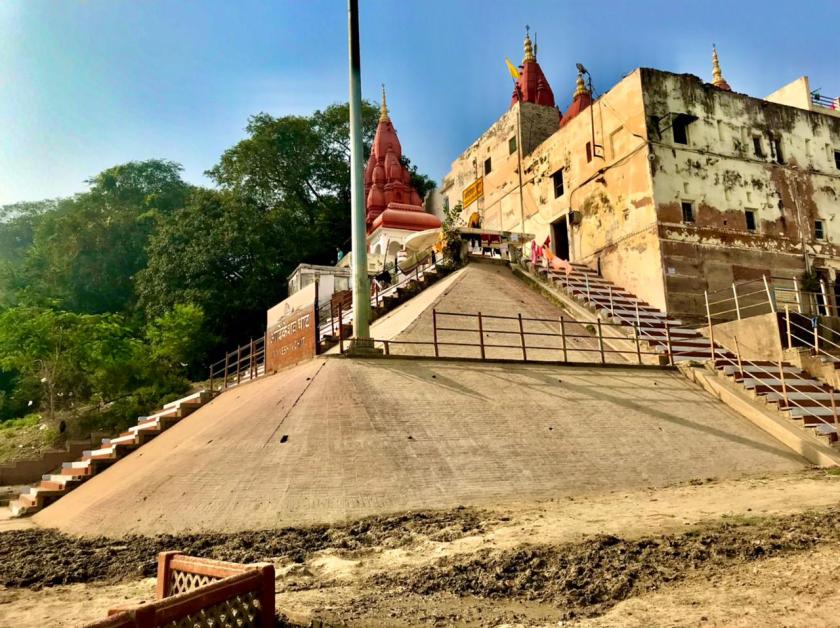
Durga Kund shri Durga temple
The Two Parts of the Temple Complex
The Durga Temple complex consists of two integral sections that together embody both architectural beauty and spiritual depth.
1) Durga Mandir
The main shrine, dedicated to Goddess Durga, stands as a striking example of North Indian temple architecture. Inside, the sacred idol of Durga is worshipped as the divine embodiment of power and protection.
Throughout the year, especially during Navratri, the temple draws countless pilgrims who come to seek the goddess’s blessings.
2) Durga Kund
Adjacent to the temple lies the Durga Kund, a large sacred water tank that enhances the spiritual atmosphere of the complex. The Kund holds immense ritual significance, believed to amplify the sanctity of the prayers offered to the goddess.
Why Durga Kund is Known as the “Monkey Temple” Among Western Visitors
THE PRINCE OF WALES VISITING THE MONKEY TEMPLE, BENARES -THE GRAPHIC 1876.
For centuries, monkeys roamed freely around the Durga Temple premises. Their abundance fascinated foreign travelers, who began referring to the shrine as the “Monkey Temple.”
Though the number of monkeys has declined in recent times, the name continues to be popular among Western tourists, preserving a curious colonial-era association.
The Bharat Mata Temple: A Tribute to the Motherland
Bharat Mata Temple Varanasi
The Bharat Mata Temple stands out as one of Varanasi’s most unique landmarks, blending nationalism, art, and devotion. It was designed by freedom fighter Babu Shiv Prasad Gupta and inaugurated by Mahatma Gandhi in 1936—a reflection of the spirit of India’s independence movement.
Bharat Mata temple
A Temple Without an Idol
Unlike traditional Hindu temples, the Bharat Mata Temple does not enshrine any deity. Instead, its sanctum houses a massive relief map of undivided India (Akhand Bharat) carved in marble, symbolizing the unity and integrity of the nation.
Architectural and Artistic Details
The marble map comprises 762 square pieces, each measuring 11″ × 11″. The relief map covers an area of 950 m × 920 m, constructed on a scale of 1:405,500 (where 1 inch represents 6.4 miles).
Visitors can admire the intricate geographical details of the subcontinent from the circumambulatory passage on the first floor. The two-storied, square-shaped design of the temple gives it a distinctive architectural identity—simple yet deeply symbolic of India’s cultural and territorial unity.
(VI)
Adi Keshav Temple: The Ancient Heart of Varanasi
Adi Keshav temple
Among the countless temples that make Varanasi the spiritual capital of India, Adi Keshav Temple holds a very special place.
It is not only one of the oldest temples in Kashi but also stands at a location considered the birthplace of the city itself — the sacred confluence of the Ganga and Varuna rivers.
This site, known as Adi Keshav Ghat, is believed to mark the very heart of ancient Kashi, where Lord Vishnu is said to have first appeared to establish the city’s divine energy.
According to ancient scriptures, this is where Lord Vishnu, in his form as Adi Keshav, first set foot in Kashi.
The temple, therefore, represents the Vishnu aspect of creation, balancing the city’s deep connection with Lord Shiva, who symbolizes destruction and transformation. Together, Shiva and Vishnu make Kashi a perfect symbol of the eternal cycle of life.
A Journey Through Ancient Kashi
Watercolor painting of temples near Rajghat in Varanasi. From ‘Views by Seeta Ram from Patna to Benares’. (DATE: 1814). This idealized view shows a group of temples at Rajghat, at the confluence of the river Barna (Varuna) with the Ganges, where principally the Adi Keshava and Sangamesvara temples are located.
The history of Adi Keshav Temple reaches back thousands of years.
Excavations at nearby Rajghat have revealed remains of settlements from around 2000 B.C., proving that this area has been continuously inhabited for over four millennia. This makes it one of the oldest living sites in the world and a key part of Varanasi’s temple heritage.
In early times, Adi Keshav Temple was one of the most famous shrines in Kashi, visited by countless pilgrims. Unfortunately, it was destroyed in 1194 A.D. during the Islamic invasion led by Qutb-ud-din Aibak after the fall of Raja Jayachandra.
Centuries later, in 1807, the Scindias of Gwalior rebuilt the temple, restoring its lost beauty and sacredness.
Adi Keshav Temple Today
Today, Adi Keshav Temple remains a peaceful and holy destination for devotees and travelers alike.
The calm waters of the Ganga and Varuna create a beautiful setting for meditation and prayer.
Nearby, the newly developed Khidkiya Ghat (Namo-Ghat), located about 1.5 kilometers from the temple, has become a popular stop for spiritual tourism in Varanasi. Visitors can reach the temple easily by foot, boat, or vehicle.
For anyone exploring the ancient temples of Kashi, a visit to Adi Keshav Temple offers a living connection to the origins of Varanasi’s eternal faith and heritage.
accessible and appealing to visitors worldwide.
(VII)
Maa Annapurna Temple – The Goddess Who Feeds the World
A Preacher Expounding The Poorans. In The Temple of Unn Poorna, Benares. Lithograph by James Prinsep (1835). British Library.
In Varanasi, very close to the Kashi Vishwanath Temple, stands another sacred shrine — the Maa Annapurna Temple.
The name Annapurna means “The Mother Who Provides Food.”
She is worshipped as the Goddess of Nourishment and Abundance, the divine mother who makes sure that no one in the world goes hungry.
The temple was built by Vishnu Pant Gajade, and it carries a deep spiritual message — that sharing food is one of the greatest forms of worship.
Inside the temple, Maa Annapurna is shown in a kitchen setting, holding a bowl of food, symbolizing her love and care for all living beings.
This simple yet beautiful scene reminds everyone that feeding others is a sacred duty.
The idol of Maa Annapurna Devi is placed on a silver throne, shining with grace and peace. Alongside her are the idols of Mata Parvati, Mata Kali, and Lord Shiva, representing the unity of divine power in different forms.
A Unique Temple Tradition
The temple remains open all year, but its most special time is during the four days between Dhanteras and Annakoot (around Diwali).
During these days, devotees get a rare chance to see the golden idol of Maa Annapurna. Thousands of pilgrims gather to take her blessings, offering food, sweets, and prayers. The entire temple glows with devotion and joy.
The Ancient Legend
Mother Annapurna donated food to Lord Shiva
According to an old story, long ago, there was a terrible famine on Earth.
People were starving and prayed to Lord Shiva for help. Moved by their suffering, Maa Parvati took the form of Maa Annapurna, the goddess of food. She came down to Earth with Lord Shiva and began to cook and serve food.
Lord Shiva distributed the food among people, ending the famine and bringing peace and happiness back to the world.
This story teaches that food is divine, and those who share it perform the greatest act of kindness.
The Maa Annapurna Temple in Varanasi keeps this message alive even today. It stands as a reminder that in every meal shared, in every hand that gives, the Mother Goddess lives on — feeding, caring, and protecting her children.
(VIII)
Sankat Mochan Temple – The Temple of Lord Hanuman and Faith
Main Gate of Sankat Mochan Temple
The Sankat Mochan Temple is one of the most famous and historic temples of Varanasi.
It is dedicated to Lord Hanuman, the beloved devotee of Lord Rama, who is worshipped as the remover of all troubles.
The name Sankat Mochan itself means “one who removes sorrow and obstacles.”
This temple was founded about 400 years ago by the great saint and poet Goswami Tulsidas Ji.
Born in 1511, Tulsidas Ji is remembered as one of the greatest figures in Hindi literature. His most famous work, the Ramcharitmanas, brought the story of Lord Rama to the hearts of ordinary people through simple and beautiful Hindi verses.
Tulsidas Ji and the Temple
It is said that Goswami Tulsidas Ji once had a divine vision of Lord Hanuman at this very place.
Deeply moved by this holy experience, he built the Sankat Mochan Temple in honor of the Lord. The temple soon became a center of faith, devotion, and inspiration for countless devotees.
During difficult times in Indian history, Tulsidas Ji’s writings gave people courage, hope, and faith. Through his poetry, he reminded everyone of the strength of truth, devotion, and dharma (righteousness). His efforts helped revive Hindu culture when it faced challenges and inspired generations to come.
Temple Atmosphere and Traditions
The temple is located near the Assi area of Varanasi, surrounded by greenery and peace.
The moment you enter the temple, you hear the rhythmic chanting of Hanuman Chalisa, written by Tulsidas Ji himself. The air feels filled with devotion, and many devotees offer sweets, flowers, and marigold garlands to Lord Hanuman.
Every Tuesday and Saturday, the temple becomes especially crowded, as these days are considered sacred for Hanuman worship.
The annual Hanuman Jayanti festival is celebrated with great joy, with thousands of devotees visiting from all over India.
The Sankat Mochan Temple is not just a place of worship—it is a symbol of faith, devotion, and the unbreakable connection between Lord Hanuman and Goswami Tulsidas Ji.
Visiting this temple is said to bring peace, courage, and protection from all troubles, making it one of the most loved temples in Varanasi.
(IX)
Vishwanath Temple at Banaras Hindu University – The New Vishwanath Mandir
The main gate of the Vishwanath temple at B.H.U
The Vishwanath Temple at Banaras Hindu University (BHU) is one of the most beautiful and important temples in Varanasi. It is often called the “Naya Vishwanath Mandir”, which means New Vishwanath Temple.
The temple stands proudly inside the peaceful and green campus of Banaras Hindu University. Its tall spires can be seen from a long distance, shining brightly in the sunlight.
This grand temple is a replica of the original Vishwanath Temple, which was rebuilt around 1585 CE by Narayan Bhatt, with the help of Raja Todarmal, a minister of the Mughal emperor Akbar. The modern temple inside BHU keeps that ancient design and spirit alive.
A bird’s eye view of the BHU Vishwanath Mandir.
A Gift from the Birla Family
The construction of this temple was made possible by the famous Birla family, who have built many beautiful temples all over India. Because of their contribution, this temple is also known as the Birla Mandir of Varanasi.
The work on the temple began in the 1930s and continued for almost 35 years. Built mainly from white marble, the temple’s two stories house idols of several Hindu deities, with Lord Vishwanath (Shiva) as the main deity.
The temple’s design beautifully combines simplicity and grandeur. It stands tall as one of the highest temple structures in India, symbolizing faith and devotion reaching up to the heavens.
A Symbol of Faith and Strength
The Vishwanath Temple of BHU is not just a place for prayer. It represents the strength and survival of Hindu culture through centuries of challenges. Even when ancient temples were destroyed during difficult times, people never gave up their faith.
By rebuilding this temple, they showed the world that the spirit of Sanatan Dharma (eternal truth) cannot be erased. Every wall and sculpture in this temple seems to tell the story of courage, devotion, and the unbroken continuity of India’s spiritual heritage.
Visitors from all over the world come here to experience peace and spirituality. Standing before this magnificent temple, one can feel both history and faith alive in every stone.
SHE ——THAT IS, THE REAL PERSONAL GOD IN INDIA IS SHE . THIS SHAKTI OF THE BRAHMAN IS ALWAYS IN THE FEMININE GENDER .
Varanasi is home to numerous ancient temples, but the Durgakund Temple stands out. It is not just a place for worship — it is a place that teaches strength, bravery, and respect for women.
This temple reminds us that when wrong things happen, we must stand up for what is right.
Where the Temple Stands
The attached pond, or kund, adds a serene spiritual charm, making the temple an important place of worship in Kashi.
The Durgakund Temple is located in the southern part of Varanasi, near the famous BHU area. Beside the temple lies a big square pond called Durgakund, which adds beauty and calmness to the place. Many people come here every day to pray and feel peace.
The Red Temple of Power
Durga Mandir and Kund 1829 AD (BHARAT KALA BHAWAN)
The temple is made of bright red stone. This color is not chosen just for decoration — red stands for energy, courage, and victory over evil. When you look at the temple, the red color immediately catches your eye and fills you with a feeling of strength.
The architecture follows the Nagara style, a traditional North Indian temple design. The tall tower, or shikhara, rises high toward the sky, showing devotion and faith.
Inside the temple, you will not find a big statue. Instead, the face of the Goddess and her holy footprints are worshipped. This makes the temple unique and different from other temples of Varanasi.
A Temple Mentioned in Ancient Texts
The Durgakund Temple is very old. It is mentioned in Kashi Khand, a part of the Skanda Purana. This means the worship of Goddess Durga here has been happening for many centuries.
The Skanda Purana is one of the largest Mahapuranas, primarily dedicated to Lord Kartikeya (Skanda, Murugan), son of Shiva.
It contains a vast amount of material, including legends, hymns, pilgrimage guides (especially to the Ganga and other holy places), stories of Shiva, Parvati, and other deities, and philosophical discussions.
Later, in the 1700s, Maharani Bhavani Devi of Bengal rebuilt the temple. She wanted a temple that showed the power and importance of Shakti — the divine feminine energy.
The Story of King Subahu and Goddess Durga
A beautiful legend is associated with the temple, as recorded in the Devi Bhagavata Purana.
A long time ago, Kashi had a king named Subahu. His daughter Shashikala fell in love with a prince named Sudarshan. When her father accepted this, some other rulers became angry and attacked Kashi.
Surrounded by danger, King Subahu and Prince Sudarshan prayed to Goddess Durga. The Goddess appeared and protected them by destroying the enemy kings.
To thank her, King Subahu built a temple and a pond at this very place. This is believed to be the origin of the Durgakund Temple.
The Temple Once Called the Monkey Temple
The Prince of Wales visiting the Monkey Temple, Benares. Illustration by The Graphic Newspaper, 5 February 1876. THE GREAT DURGAKUND OR MONKEY TEMPLE OF BENARES
During the 19th century, foreign visitors saw many monkeys living around the temple. British newspapers even published drawings of the temple full of monkeys. Because of this, they started calling it the “Monkey Temple of Benares.”
Even today, some monkeys can still be seen here, sitting on the walls or trees, giving the temple a lively look.
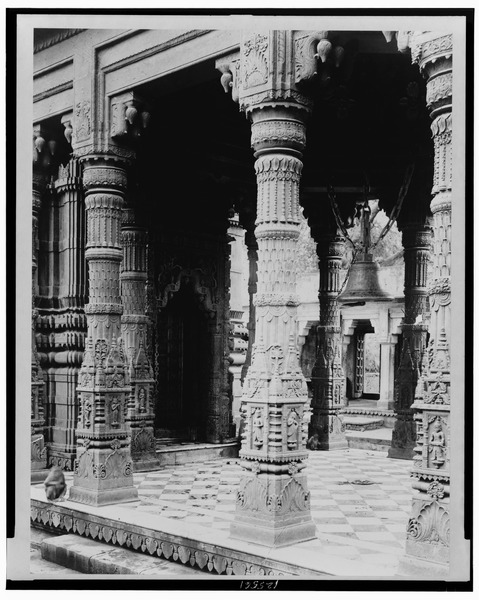
Interior view of the monkey temple at Benares, India, showing elaborately carved columns and doorways. ( between 1890 and 1924)
Swami Vivekananda’s Lesson of Courage
One of the most famous stories of Durgakund Temple is linked to Swami Vivekananda.
When he visited the temple, a group of monkeys started chasing him. As he tried to run, an old monk shouted:
“Stop! Face the monkeys!”
Swamiji stopped and turned around. The monkeys became scared and ran away. From this small incident, he learned an important lesson — running from fear makes it bigger, but facing it makes it disappear.
Later in New York, Swamiji said:
“That was the best lesson I ever learned — the lesson of fearlessness.” This message continues to inspire thousands of visitors.
A Message of Respect for Women
The Durgakund Temple teaches that women are not only gentle and caring — they are powerful protectors too. Goddess Durga represents Shakti, the strength that protects truth and destroys injustice.
The temple’s strong red color reminds everyone that respecting women is not just a duty but a sacred responsibility. In Indian culture, women have always been honored as mothers, teachers, and symbols of knowledge.
A Temple Full of Life Today
Even today, the Durgakund Temple is full of activity. A large Havan Kund inside the temple is used for daily fire rituals. There are also small temples dedicated to Bhaironath, Lakshmi, Saraswati, and Kali.
During Navratri, thousands of people visit the temple. It is decorated with lights, flowers, and red chunri. The whole area becomes bright and joyful.
In the month of Sawan, a big fair is held near the temple. People come to pray, enjoy food, and celebrate with their families.
In this post, I would like to mention some of the major buildings, institutions, Temple built in and around Benares under the East India Company and which are still in existence and which are a major part of the daily life of the people of Banaras from the time of its construction till the present.
EAST INDIA COMPNY RULE AND BANARAS
In 1781, the East India Company took control of Banaras, declaring the rule of the Nawabs and Rajas unsuccessful. The Company appointed magistrates to govern the city.
In 1788, Jonathan Duncan, a young man, was appointed as the Resident and Superintendent of Benares. The East India Company also took control of the mint house from the Raja of Banaras. Starting in 1794, East India Company civil and criminal courts were established in the city.
BITTER MEMORIES OF BANARAS (VARANASI)
Benaras Slaughter
After learning from the “Benaras Rebellion,” Duncan decided not to interfere with the religious practices and rules of the Hindus. In 1781, the people of Banaras rose against Warren Hastings, who had insulted Raja Chet Singh. This uprising became known as the “Benaras Slaughter” among the British because a large number of British soldiers were killed during the rebellion.
By the end of the 18th century, the British decided to establish a Sanskrit college in Banaras. Kashi Nath, the first Acharya (principal) of the Sanskrit College, wrote a letter to the East India Company officials regarding the establishment and functioning of the college.
In 1791, Jonathan Duncan wrote a letter to the officers of the East India Company about establishing the Sanskrit College in Banaras. Although Duncan moved to Bombay in 1795, he remained connected with the Sanskrit College throughout his life.
The college started with eight teachers and about 200 students. Initially, the curriculum focused solely on the rituals, traditions, and religious beliefs of Hinduism, which is why most of the teachers and students at the college were Brahmins.
Expansion of Sanskrit College
In 1846, Dr. J.R. Valentine was appointed as the principal of Sanskrit College. In 1852, the college moved to a new building, and it was renamed Queen’s College.
QUEEN’S COLLEGE BENARES
The new building of Queen’s College was designed by Major Kittu. Built in Gothic style, the structure was made using Chunar sandstone.
In 1870, renowned scholar Bapu Dev Shastri taught Indian astrology to his students at Queen’s College.
SAMPURNANAND SANSKRIT UNIVERSITY
SAMPURNANAND SANSKRIT UNIVERSITY
With the efforts of the then Chief Minister of Uttar Pradesh, Dr. Sampurnanand, the college was upgraded to university status and renamed from “Queen’s College” to “Sanskrit Mahavidyalaya Varanasi.” In 1974, it was again renamed to its current title, Sampurnanand Sanskrit University.
Unlike before, the university now offers a broad curriculum that includes various subjects related to Hindu religion, culture, and civilization. The university also houses a museum and the Saraswati Bhavan Library.
Sampurnanand University Archaeological Museum: Most of the artifacts in the museum were discovered during excavations in Sarnath by Major Kittu.
Sarnath, located about ten kilometers from Varanasi, is a significant Buddhist site where Gautam Buddha gave his first sermon, known as the “Turning of the Dhamma Chakra.”
Saraswati Bhavan Library:
The library holds thousands of manuscripts and rare ancient texts, preserving invaluable knowledge of Indian history and culture.
Note: There is an intermediate college near Sampurnanand University also called Queen’s College. Do not confuse this with the university.
Tomb of Lord Cornwallis
The tomb of Lord Cornwallis is situated in Ghazipur city, which is approximately 84 km from Varanasi.
Lord Cornwallis, known for his significant role in the American Revolution as a Major General, later served as the Governor General of India.
He is often called the “father of civil services” in India due to his major administrative reforms. Cornwallis passed away on 5th October 1805 in Ghazipur, possibly due to smallpox. His tomb was built using British stones and is located in Gorabazar, Ghazipur.
Gorabazar was once a locality where the British bungalows and kothis were situated, which is why it came to be known as “Gorabazar” (meaning “Colony of white people”). This area played a significant role during British colonial rule and remains an important landmark today.
The unfinished monument to the Marquis Cornwallis at Ghazipur
The painting of the Cornwallis tomb under construction was created by Sita Ram, a painter employed by the East India Company.
This artwork, made in 1814-15, depicts the tomb of Lord Cornwallis while it was still in the process of being constructed in Ghazipur.
Sita Ram, who was traveling from Patna to Banaras at the time, captured the scene of the tomb under construction, giving us a rare visual glimpse into the historical site during that period.
His painting is significant not only for its artistic value but also for its documentation of colonial-era architecture and British memorials being built in India.
The painting shows the tomb’s unfinished structure and the labor involved in its construction, providing an insight into the colonial ambition to memorialize figures like Lord Cornwallis.
This work is important as it offers a snapshot of the early 19th-century British presence in India, as well as the artistic style of the time, blending colonial architecture with Indian artistic traditions.
Today, this painting is a crucial historical artifact, preserving a moment in the construction of a key colonial monument and shedding light on the cultural exchange and interactions between British colonial powers and local Indian artists like Sita Ram.
CHUNAR FORT CHUNAR GADH OR CHUNAR GUR
Artist: Hodges, William ( DATE:-1787)
The Chunar Fort is one of the oldest and most historically significant forts in India, with a rich past spanning several centuries.
Chunar Fort
Evidence shows that the fort was once under the control of Vikramaditya, the legendary king of Ujjain in 56 AD, showcasing its deep historical roots. Over time, the fort saw rule from various notable figures, including Prithvi Raj Chauhan.
In 1538, Sher Shah Suri, the founder of the Suri Empire, made this fort his residence, adding a pavilion to the fort during his rule. The fort later came under Mughal control and remained under their authority for a long period, marking its significance during their empire.
After the Battle of Buxar in 1764, the fort fell into the hands of the British.
This Kothi was built by the company(EAST INDIA COMPANY) in Chunar Fort
Warren Hastings, the first Governor-General of India, took refuge in the fort during the rebellion in Banaras, cementing its role in British history. Under British rule, the fort was modernized, and British-style bungalows were constructed within the fort’s walls, blending colonial architecture with the fort’s traditional design.
The fort’s historical importance is clear from its long-standing strategic, military, and political relevance under various rulers. The fort has witnessed the rise and fall of empires and continues to be a reminder of India’s rich and diverse history. This proves why Chunar Fort remains an important historical site, reflecting a blend of ancient, medieval, and colonial influences.
How the East India Company Shaped India’s Landscape Through Architecture
The history of the East India Company’s rule in India marks a pivotal chapter in the nation’s past, shaping both its political and social landscape.
The buildings constructed during this period serve as living symbols of the era’s colonial influence, showcasing architectural styles that blended British and Indian traditions.
These structures are not only important for their historical and architectural value, but also for the stories they tell of India’s struggle, resilience, and transformation during British rule. Many of these buildings, still standing today, continue to serve as witnesses to the significant events and changes that took place during that time, reminding us of India’s complex journey toward independence.
If someone travels to Varanasi from Kolkata or Gaya by train or road, they must cross the river Ganga to enter the city.
Today, crossing the Ganga is easy, thanks to modern bridges. But in the past, it was not so simple—it was a challenging task. Building a bridge over the Ganga was the solution, and the story of how this bridge was constructed is quite interesting.
The Rise of Railways and Bridges in British India
In 1853, the British started rail service in India. After the First War of Independence in 1857, they realized the importance of efficient postal services, telegrams, and railways. To maintain control over such a vast territory, they needed an excellent postal system and reliable transportation.
The British wanted a modern transport system that could allow them to reach any part of India within 24 hours. They believed this was essential to quickly suppress any uprisings. Railways became the obvious solution to this need.
As the railway network expanded, hundreds of bridges were built across the country. Among these, the construction of a railway bridge over the Ganga in Varanasi was completed during this time.
Rajghat Bridge: A Timeless Landmark of Varanasi
Rajghat in Varanasi is home to a monumental bridge built over the Ganga during the British Raj. Remarkably, this bridge remains fully operational and continues to serve as a vital connection.
While locals commonly refer to it as the Rajghat Bridge, its official name has changed several times over the years, reflecting its enduring significance and historical legacy.
The image titled ‘Views of Benares, from the River Side’, captured by Brajo Gopal Bromochary in 1869 offers a rare glimpse into the historic pontoon bridge at Rajghat.
Before the Permanent Bridge: The Temporary Pontoon Bridge at Rajghat
Before the construction of the permanent bridge at Rajghat, a temporary pontoon bridge was used to facilitate crossing the Ganga. This floating bridge was removed during the monsoon season when the river’s water level rose.
A rare photograph taken by Brajo Gopal Bromochary in 1869 captures this temporary bridge, offering a glimpse into the innovative yet challenging engineering solutions of that era.
Rajghat Bridge at present
* SOME INTERESTING FACTS RELATED TO THE RAJGHAT BRIDGE
This is a two-floor bridge and holds the distinction of being the first bridge in the Indian subcontinent with railroad tracks on both the top and bottom levels.
Construction began in 1882 AD and was completed in 1887 AD. The total cost of construction was ₹750,000, a significant amount in the 1880s.
Spanning a length of 1,048.5 meters, this bridge connects Rajghat to Padav across the Ganga River.
Located in the Rajghat area of Varanasi, the bridge has been popularly referred to as “Rajghat Bridge” by residents since its inception and continues to be known by this name today.
THE DUFFERIN BRIDGE
Oudh and Rohilkhand Railway Collaboration: The bridge was constructed collaboratively by engineers from the Oudh (Awadh) and Rohilkhand regions.
The Dufferin Bridge: Inaugurated by Lord Dufferin on 16th December 1887 AD, the bridge was initially named the Dufferin Bridge in his honor.
Malviya Bridge: After India gained independence, on 5th December 1947, the bridge was renamed Malviya Bridge to commemorate the contributions of Madan Mohan Malviya, a prominent freedom fighter and educationist.
The stairs leading from the Kashi railway station down to the ghat take you towards the sacred river Ganges. These stairs are an important part of the pilgrimage route for many visitors to Varanasi, providing access to the ghats where people come to bathe, offer prayers, and perform religious rituals.
The small bridge-like structure, visible in the image, was designed to provide convenient access for rail passengers, allowing them to directly travel from the bridge to the Kashi railway station.
Even today, this bridge remains in use by pedestrians and cyclists, offering a safe and easy passage over the busy area. It serves as a vital link between the railway station and nearby areas, making travel more efficient for local commuters and visitors alike.
During the British Raj, gunmen were stationed at the bridge to ensure its protection. This was a period marked by heightened security concerns, and strategic locations like the bridge were often guarded to maintain order and prevent potential threats or disturbances. The presence of gunmen symbolized the British authority’s efforts to control and safeguard important infrastructure, ensuring smooth operations and deterring any unrest in the area.
DUFFERIN’S BRIDGE
The book “Dufferin’s Bridge”, published in 1887 AD from Banaras, is a rare historical document, with only 50 copies printed. It provides valuable information about the bridge, including detailed plans, maps, and other crucial details related to the structure.
This book is considered an important piece of history as it offers insights into the construction and strategic significance of the bridge during the British era.
The scarcity of copies makes it a collector’s item for historians and researchers interested in colonial-era infrastructure and its impact on the local communities.
BRITISH RAJ AND RAJ GHAT
In 1781, the people of Varanasi rose against the East India Company, leading to the deaths of hundreds of British soldiers, many of whom were killed in areas like Padao and Ramnagar near Raj Ghat.
The British suffered significant losses again during the First War of Indian Independence in 1857. These uprisings taught the British valuable lessons, and they became cautious, avoiding interference in the religious affairs of the Hindus.
However, even with the construction of the bridge, many Hindus were suspicious and unhappy. The Ganges River was revered as the holiest river in Hinduism, and there were concerns that the British might be attempting to humiliate Hindus by constructing a bridge over it. Some believed this act could anger Ganga Maiya (Mother Ganga) and bring about an epidemic.
To mitigate these fears, the British sought the help of the king of Banaras to reassure the public that the construction of the bridge would not harm the sacredness of the Ganges.
The king’s efforts helped quell the protests, and over time, the people of Varanasi accepted the bridge, acknowledging that it would make the journey for pilgrims much easier.
Varanasi, often referred to as the City of Temples, holds an unparalleled position as a spiritual and cultural center for Hindus. With countless temples, both grand and modest, scattered across its sacred landscape, it embodies the essence of devotion and religious practice.
The city’s significance extends beyond its temples. Since ancient times, Varanasi has been a hub for the practice of Yoga and Tantra, traditions deeply rooted in India’s spiritual heritage. However, during the Mughal era, the practice of idol worship and yoga faced suppression. This lull in activity saw a resurgence under the Marathas, who revitalized Hindu traditions by building new temples and fostering a revival of spiritual practices.
Despite the establishment of the East India Company’s dominance over Varanasi in 1781, the city’s rich tradition of temple construction and religious devotion persisted. The uninterrupted building of temples during this period reflects the resilience of Varanasi’s cultural and spiritual identity, even in the face of political changes.
Presently, one notable temple in Varanasi is the Yoga Mandir, located in the Gurudham locality. This temple stands out for its unique and captivating architecture, which beautifully blends spiritual significance with artistic excellence.
The Yoga Mandir serves not only as a place of worship but also as a center for practicing and learning yoga, continuing Varanasi’s ancient traditions of spiritual and physical discipline. Its distinct design and cultural importance make it a prominent landmark in the city, attracting devotees and visitors alike.
RAJA JAI NARAYAN GHOSHAL
The Yoga Mandir in Gurudham, Varanasi, built-in 1814 by Raja Jai Narayan Ghoshal of Khedderpur (Bengal), is not only a temple of architectural brilliance but also a testament to Raja’s visionary efforts to revive and modernize Indian education. Raja Jai Narayan Ghoshal is remembered for his profound foresight during the transformative era of the East India Company’s rule.
Recognizing the stagnation of the traditional Hindu education system, which had been limited to religious teachings and severely impacted during the Mughal period, Raja Jai Narayan Ghoshal sought to bring about educational reform.
Influenced by the modern European education system, he took the initiative to establish the Jai Narayan Ghoshal Vidyalaya in Varanasi in the same year he built the Yoga Mandir. This institution marked a significant step towards introducing contemporary education to the region while preserving the city’s cultural and spiritual heritage.
Raja Jai Narayan Ghoshal’s contributions extended beyond his architectural and educational endeavors. His work reflects a keen understanding of the importance of blending traditional values with modern advancements, making him a key figure in the socio-cultural evolution of Varanasi during the 19th century.
The Yoga Mandir in Gurudham, Varanasi, showcases a stunning example of octagonal architecture, particularly notable when viewed from above.
The design consists of four concentric octagons, each of a different size, symbolizing a layered harmony of form and function. This multi-layered, concentric octagonal design is not only a marvel of architectural ingenuity but also a reflection of the temple’s spiritual essence.
The symbolism of the Octagon:
The octagon has symbolic significance in Hindu architecture. It is often associated with balance and cosmic order, reflecting the eight cardinal and intermediate directions in Vastu Shastra, the traditional Indian science of architecture. This shape might have been favored for religious and spiritual structures due to its alignment with sacred geometry.
Maratha Influence:
During the late 17th and early 18th centuries, the Marathas played a significant role in the cultural and architectural revival of Varanasi. Their patronage led to the construction of numerous temples, dharmshalas, and wells. The octagonal shape might have been a stylistic preference or a design choice rooted in the Marathas’ interpretation of sacred architecture.
Practical and Aesthetic Considerations:
The octagonal shape provides structural stability and an aesthetically pleasing symmetry. For wells, this design could also have been functional, as the shape facilitates easier water retrieval and maintenance.
Regional Traditions: Banaras has a long history of architectural experimentation influenced by various dynasties and patrons. It is possible that the octagonal shape became popular during this period, either as a regional trend or as part of a broader culture.
TEMPLE STRUCTURE
WINGED LION
The influence of Christianity on Raja Jai Narayan Ghoshal, as mentioned in Bishop Haber’s letter, adds a fascinating dimension to the story of the Yoga Mandir in Gurudham, Varanasi.
Ghoshal’s contact with Mr. Kori, a priest in Banaras, seems to have introduced him to Christian teachings, which subtly found expression in the design and ethos of the temple.
The Guru-Dwar of the Yoga Mandir in Gurudham, Varanasi, carries deep symbolic and spiritual meaning, reflecting a blend of Hindu and Christian cultural influences. The gate and its accompanying elements serve as a profound representation of faith, reverence, and integration.
Guru-Dwar:
The main gate, referred to as “Guru-Dwar,” is built into the temple’s octagonal wall and holds great significance in Hindu culture. The term Guru encompasses meanings such as teacher, guide, elder, and one worthy of respect, symbolizing the gateway to spiritual enlightenment and knowledge.
Its placement at one side of the octagonal wall aligns with the temple’s architectural harmony, emphasizing its role as the primary entry to this sacred space.
Winged Lion Statues:
On either side of the Guru-Dwar are statues of a winged lion, a symbol historically associated with Saint Mark the Evangelist, the patron saint of Venice. This heraldic symbol links the temple to Christian iconography, possibly reflecting Raja Jai Narayan Ghoshal’s exposure to European Christian influences through his interactions with Mr. Kori, the priest of Banaras.
The winged lion is often interpreted as a guardian figure, representing strength, courage, and protection, qualities that resonate with the spiritual sanctity of the temple.
Saptapuris and Their Representation:
Within Kashi, localities are named after the other six puris, allowing devotees unable to physically visit these distant cities to symbolically fulfill their pilgrimage by visiting these localities. This reflects a compassionate and practical aspect of Hindu religious practices, emphasizing accessibility to spiritual merits.
The seven other gates of the octagonal wall are named after the Saptapuris, the seven sacred cities of Hinduism:
Kashi (Varanasi)
Ayodhya
Mathura
Maya (Haridwar)
Dwarkadham (Dwarka)
Avantika (Ujjain)
Kanchi (Kanchipuram)
These cities are considered salvific and deeply revered in Hinduism, believed to grant liberation (moksha) to those who visit them.
Jai Narayan Ghoshal supported Western education and had good relations with the Christian missionaries in Varanasi. In the school he founded, subjects like English, British History, and the Bible were included in the curriculum. The cross, a symbol of Christianity, is visible on the gate above.
When entering through the Guru Dwar (main gate), there are two small temples. Each temple has an idol of a Hindu deity. One of the deities is Lord Hanuman (on the left), but I was unable to identify the other deity (on the right).
The design of the three-floor octagonal building of the Yoga Mandir is based on the idea of reaching God through the Guru and then achieving Yoga (a state of spiritual awareness) through God. Many historians believe that the temple’s construction follows the Samkhya philosophy of Kapil Muni.
The stairs leading from the ground floor to the first floor are built to represent the human Kundalini (spine, coiled snake) and Nadis (nerves, blood vessels, and pulse). According to Shaiv Tantra, the power of every person is stored in the Kundalini.
Manuscript painting of a yogin in meditation, showing the chakras and the three main nadis.
First Floor (The Ground Floor):
On the bottom-most floor of the temple, there are 32 stone pillars outside the sanctum and 24 pillars inside it. The building has four doors. This floor has always remained without any idols.
Second Floor:
To reach the second floor, there are narrow pathways, representing the Kundalini (coiled snake), both from the outside and inside. It is believed that an idol of Radha-Krishna was once placed on this floor, but these idols are no longer there.
Third Floor:
The third and final floor of the temple has a circular roof. This floor represents SHUNYA, or space.
A corridor leads forward from the three-story octagonal building, and at the end of the corridor, there is a verandah. The floor of the verandah is made of stone, and on both sides, there are small house-like figures.
The total number of house-like figures is seven. The ceiling of the first and last rooms is circular, while the roofs of the five houses in between are conically shaped.
On the opposite side, there must have been similar figures, but except for one, all the others seem to have been destroyed.
Going a little further, there is a European-styled building, and this is the last structure inside the temple.
The European-styled building.
The unique temple built by Jai Narayan Ghoshal was in very poor condition a few years ago. Due to its religious and spiritual significance, it was declared a monument of national importance in 1987.
In 2007, the Uttar Pradesh State Archaeological Department took over the temple and began its renovation. Since 2016, it has been open to the public. Although the restoration work is still ongoing, the temple’s condition has greatly improved, and the archaeological department deserves significant credit for this.
The Hindu side claims that the old Shiva linga was found from the sanctum sanctorum of the temple. In the drawing of James Prinsep, this part of the temple is depicted as Mahadev. In this article, I have written in detail on this topic below.
HISTORICAL REASON
VISHWANATH TEMPLE OF BANARAS OR VISHVESHVAR TEMPLE is a major reason for the religious struggle that has been going on for centuries between Hindus and Muslims. The army of Muhammad Ghori and Qutbuddin Aibak defeated the king of Banaras a prominent North Indian king of that period ~ Jaichand.According to Islamic belief, no other religion can be practiced under Islamic rule. Idol worship is a crime in Islam and Banaras was the center of idol-worshipping of Hindus for thousands of years.
As a result, all the major Hindu temples of Banaras were demolished and their property was looted by the Muslims.
Some major Hindu temples were demolished and mosques were built at that same place from their rubble. Surprisingly some of the temples which were demolished in 1194 and were converted into mosques, still survive in Banaras though only their leftover remains can be found.For more information about this subject please visit:- https://nithinks.com/2021/12/06/the-search-for-hindus-lost-temples-in-the-city-of-templesvaranasi/
AS SHARIAT LAWS WERE IMPOSED IN THE CITYthe pity-minded Hindu kings of India began to express their loyalty to it. The rule of Banaras was handed over to an Amir (Governer) so that he could suppress paganism and yet satisfy people with his justice.(Justice here refers to Sharia Law)
IBN AL- ATHIR,a Muslim chronicler wrote that after plundering the city of Banaras, the loot was loaded in 1400 camels and sent to Ghazni.
HAR -HAR MAHADEV, HOW HINDUS FOUGHT BACK AND REFUSED TO CONVERT
Soon Banaras recovered from this setback and the Hindus tried to take their temples back. And a BLOODY STRUGGLE BEGAN. The Vindhya hills around Banaras were a great place for guerilla warfare.
According to some Afghan Islamic scholars and Islamic historians, about one lakh fifty thousand Muslims were killed in this conflict by the Hindus.
This anarchy ended only when Islamic rulers accepted religious freedomto Hindus in this way the process of demolishing the temple and rebuilding it continued……………….
Some of the major events during this period
A- IN 1194, ALMOST ALL THE MAJOR TEMPLES OF BANARAS WERE DEMOLISHED. The Vishwanath temple would have been demolished for the first time during this period.
B- PADMASADHU,a monk, built the temple of PADMESHWARin Varanasi in 1296 AD in front of Vishwanath temple in Banaras. This shows that the Vishwanath temple existed at that time, so the Vishwanath temple must have been rebuilt between 1194 AD and 1296 AD.(Fuhrer Sharqi Architecture of Jaunpur )
C- In 1447, the Vishwanath temple was demolished again by Sultan Mahmud Shah of Jaunpur.
D-During the reign of Akbar, with the help of minister RAJA TODARMAL, NARAYAN BHATT once again constructed the Vishwanath temple around 1585 AD.
E- On 18 April 1669, Aurangzeb issued a decree ordering the destruction of the Kashi Vishwanath temple. This decree document is still safely preserved in the Asiatic Society Kolkata.
F- The construction of the temple was once again completed between 1777 AD and 1780 AD by MAHARANI AHILYABAI of Indore.
KHALIFA -TUL ARD
Khalifa-tul Ard, that is, he has been called upon to play the role of being a successor to earth. The earth has its own potentialities. It, too, has been created for a purpose. But man has been sent down as a responsible being and he is here to secure improvement of earth, of making this brown earth of God green. He is here to introduce order and reform, in the light of Heavenly mandate, what has been deformed by Satanic forces.
Muhi-ud-Din Muhammad (Aurangzeb)
Aurangzeb was a staunch Sunni Muslim. Unlike his ancestor Akbar, he was not at all an advocate of Hindu-Muslim unity, nor was he in the mood to give any concession to the Hindus, also unlike Jahangir, he was not at all interested in any kind of building and construction work of gardens, minarets, buildings etc.
Shah Jahan followed Sharia law. Under the guise of this, he tried to break the Vishwanath temple in Banaras, but due to the strong opposition of the Hindus, his army could not break the Vishwanath temple, but then also 63 temples were destroyed in Benares during the reign of Shah Jahan. As a true Muslim, the expansion of Islam was the main goal of Aurangzeb’s life, he resolved to do the unfinished work of his father.
Aurangzeb probably wanted to make all the Muslims of the world as well as the Hindus feel the superiority of Muslim religion over other religions.Soon the Sharia laws were re-imposed on Banaras. Under the Sharia law-:
a.Jizya tax was imposed on Hindus. b. All Hindu schools were closed. c.The name of Banaras was changed to Muhammadabad. d. The Vishwanath temple of Banaras and some other famous temples were demolished.
Saqi Mustad Khan has written extensively on this subject in Maasir-I- Alamgiri.
Demolition of Vishwanath Temple in Banaras
(18th April,1669) , it reached the ear of His Majesty, the protector of the faith, that in the provinces of Thatta, Multan, and Benares, but especially in the latter, foolish Brahmans were in the habit of expounding frivolous books in their schools, and that students and learners, Musulmans as well as Hindus, went there, even from long distances, led by a desire to become acquainted with the wicked sciences they taught. The “Director of the Faith’’ consequently issued orders to all the governors of provinces to destroy with a willing hand the schools and temples of the infidels ; and they were strictly enjoined to put an entire stop to the teaching and practicing of idolatrous forms of worship. On the 15th i Rabi’u-l akhir it was reported to his religious Majesty, leader of the Unitarians, that, in obedience to order, the Government officers had destroyed the temple of Bishnath at Benares.
The Presently disputed mosque. I have deliberately selected the black and white images so that the walls of the old temple which are currently being painted with lime are clearly visible.
Aurangzeb also wanted to break the order of Hindus repeatedly taking back their temples, To carry out his plan, Aurangzeb took some cruel decisions and implemented them.
As per the orders of Aurangzeb, the Vishwanath temple in Banaras was demolished, the sanctum sanctorum (the holiest part of the temple where the idol of God is installed)was also demolished and leveled and a mosque was constructed at the same place from its rubble.
2. After the construction of the mosque on the main part of the temple, a Islamic graveyard was also constructed in the courtyard of the temple. It can be clearly seen in the drawing of James Princip. Generally, in Hindu belief, temples are never built at such a place where the rituals related to the dead person have been completed. In future, Hindus cannot build any temple at this holy place, undoubtedly this must have been the intention behind the construction of this graveyard.
3. Aurangzeb’s intention was not only to destroy the most sacred temple of Hindus, but he also wanted to humiliate Hindus forever.For this a part of the temple was deliberately left out so that the Hindus always felt inferior, and the feeling of a conqueror remained among the Muslims.
The wall of the ancient temple is clearly depicted in the book Benares illustrated, in a series of drawings written by James Prinsep, published in 1833.
This can be better understood from James Prinsep’s drawings. In the temple courtyard, the place where the mosque was built is shown point-wise. This place is still in the possession of Muslims due to the construction of the mosque.
THE MARATHAS
After Aurangzeb’s death, the Mughal Dynasty got weakened due to struggles for inheritance of the throne, several governors proclaiming themselves independent rulers, and most importantly the Marathas and Sikhs challenging the Mughal Empire. The politics of India in the eighteenth century was very similar to the politics of the seventeenth century in Germany. The old dynasties were subsiding and the struggle for the throne to fill their place was at its peak. Soon Banaras overcome the shock it got from Aurungzeb’s side and the Hindu Maratha rulers came to dominate Banaras.
Maratha’s also got the Mughal rulers of that time to write an assurance to compensate for the destruction of the Vishwanath temple by Aurangzeb in Banaras.
Malla Rao thought of demolishing the Gyanvapi mosque and building a temple on it, but due to the dilemma of the Pandits of Banaras, this work was postponed. Because of the struggle to inherit the throne in the country, the Marathas couldn’t even pay much attention to it.
In 1781, the East India Company’s dominance over Banaras was established. The East India Company’s effort was to avoid Hindu-Muslim conflict as much as possible. In the year 1777-80, the temple was rebuilt again by the Maharani Devi Ahilyabai Holkar of Indore. The disputed site (the mosque built by Aurangzeb was left intact) still remains in the same condition presently.
In 1809, a Hindu-Muslim riot had also taken place over the Vishwanath temple, which got controlled with great difficulty, hundreds of people died in this riot.
Mr. Watson, the Magistrate of Banarasat that time wanted an end to this quarrel and therefore requested the officers of the Company toHANDOVER THIS PLACE TO HINDUS.
Unfortunately, doing this was not possible in the future due to the complex political conditions of India in those days. Later, learning from the revolution of 1857, the British focused on maintaining the status quo in the Hindu-Muslim religious dispute, due to which the Vishwanath temple dispute still continued.
The area inside the red boundary in this picture is still occupied by the mosque.This is the reason for the present Hindu-Muslim tension. The present courtyard of Kashi Vishwanath temple has been expanded. It has been expanded from three thousand square feet to five lakh square feet, but the disputed structure of the mosque remains the same.
INFORMATION OBTAINED FROM THE SURVEY
A. Hindu artworks on the walls, and statues of some Hindu Gods and Goddesses have been found in the survey of the mosque.
B. A dome of the mosque rests on the top of the temple.
The place indicated by the arrow is the sacred pond described by James Prinsep. Presently, Muslims use this pond for Wuzu. Wuzu is an Islamic process.
C. In the survey, a small pond was found in the mosque’s courtyard, and a Shivling was also found inside the pond. This is not at all a fact of utter surprise because James Prinsep has described this pond very clearly in his book ‘Benares Illustrated in a Series of Drawings’.
The principal lingam of Mahadeo stood in an ornamented reservoir in the centre,(center) having a drain below to carry off the Ganges water continually poured over it by day and night. Mundip signifies vestibule: Dundpan and Dwarpal are respectively the staff-bearer and door-keeper. The latter situation is held by Kal Bhyro, the offspring of Shiva’s rage; the former appointment was conferred upon Hurikeshu, a Yukshu, or one of the attendants upon the Deity of riches, in reward for his having abandoned the sports of youth to devote himself to ascetic meditation at Kashi. Tarakeswur and Manikeswur are two inferior lingums of Shiva.
To a large extent, it is possible that this is the holy pond of the Hindus as described by James. Presently, Muslims use this pond for Wuzu. Wuzu is an Islamic process. Cleaning the body before offering Namaz includes washing hands, mouth, head, feet, and inner part of the nose. I think a few more ancient mysteries can be uncovered by examining this holy pond.
One thing is clear the scientific analysis of the ancient Vishwanath temple done by James in 1831 is still unmatched.There is no difference between the conclusion of James and the condition of the Vishwanath temple today.
AT LAST, WE ARE THE FREE PEOPLE
“Doublethink means the power of holding two contradictory beliefs in one’s mind simultaneously, and accepting both of them.” GEORGE ORWELL
With the independence of India, India got a new constitution and there was also hope of a solution to this issue. After independence, instead of handing over their holy place to Hindus through a new law, the Congress party made it more controversial.Nehru, who believed in the communist ideology, felt that Hindu political parties could take advantage of this problem in elections, so it would be right to keep the temple-mosque dispute entangled in the cumbersome court proceedings. According to a section of the law,the status quo before 15 August 1947 in a religious dispute shall be maintained. It was the political compulsion of Nehru and Congress to maintain the Hindu-Muslim dispute over Vishwanath temple otherwise it might have got resolved years before.
Presently, this disputed mosque near Vishwanath temple is a living example of Islamic imperialism. Hardly any Muslim goes to this mosque to offer prayers,but this disputed temple definitely knocks the eyes of every Hindu. Most of the foreign travel writers who have visited this place in the sixteenth century and after believed thatTHIS PLACE SHOULD BE HANDED OVER TO THE HINDUS.These foreign travel writers have explained their side in detail in their writing.Any person who looks at this disputed mosque objectively rather than from a religious point of view will come to the conclusion that no doubt this place should be handed over to the Hindus. After all it was built by demolishing their ancient temple.
National and Saffron Flags: A Symbol of India-Nepal Shared Heritage.
A country’s national flag is not just a piece of cloth; it represents its culture, history, and traditions.
When the Prime Minister of Nepal visited Varanasi, common people lined the streets, holding the national flags of both India and Nepal. Interestingly, some also carried saffron flags, a symbol of Hinduism.
This gesture highlighted the deep cultural and civilizational ties between India and Nepal. Perhaps some expressed this shared heritage and unity by hoisting the saffron flag.
Nepal’s Prime Minister Sher Bahadur Deuba and his wife, Arju Rana, visited Varanasi, India’s cultural capital. Varanasi is a sacred city for Hindus worldwide, and every Hindu wishes to see Kashi at least once in their lifetime.
After offering prayers at the Vishwanath Temple, the Prime Minister of Nepal wrote in the visitor’s book—
“We are Blessed in this birth to have Baba’s darshan. We thank the Prime Minister of India, Narendra Modi and the Chief Minister of Uttar Pradesh, YogiAdityanath for this.”
Nepal’s Prime Minister Sher Bahadur Deuba also offered prayers at the famous temples of Kaal Bhairav and Pashupatinath in Banaras.
Pashupatinath in Varanasi: A Testament to Shared Hindu Traditions
Lord Shiva is also known as Pashupatinath, and the Pashupatinath Temple in Varanasi is a replica of the famous Pashupatinath Temple in Nepal.
It was built by the Maharaja of Nepal and is also known as Nepali Mandir or Kath Mandir. “Kath” means wood, and since a significant amount of wood was used in its construction, it is called the Kath Temple.
The temple’s management and conservation are overseen by the Government of Nepal.
Nepal-Kashi Connection: The Legacy of Nandi at Vishwanath Temple
A painting from the early eighteenth century depicts a grand Nandi statue in the courtyard of the Vishwanath Temple, built by the Maharaja of Nepal.
This majestic statue stands as a testament to the deep cultural and religious ties between India and Nepal. Nandi, the sacred bull and vehicle of Lord Shiva, symbolizes strength, devotion, and unwavering faith.
It reflects the spiritual essence of Kashi and its timeless connection with Nepal’s devotion to Shiva.
The famous Vishwanath Temple in Banaras was destroyed by the Mughal ruler Aurangzeb, who built the Gyanvapi Mosque in its place. Later, Maharani Ahilyabai Holkar of Indore rebuilt the temple between 1777 and 1780 AD. The Maharaja of Nepal placed a large Nandi statue in the temple’s courtyard.
Nepal & India’s Relations Through the Corridor of History
The Divine Bond of Lord Ram and Mata Sita Across India and Nepal
SHRI RAM AND MATA SITA
According to Hindu tradition, Shri Ram was a resident of Ayodhya, while his wife, Mata Sita, belonged to the ancient Videha kingdom, which today includes parts of Mithila within Nepal.
This deep-rooted connection between India and Nepal is not just geographical but also cultural, historical, and spiritual, strengthening the timeless bond between the two nations.
From Lumbini to Kushinagar: The Spiritual Bond Between India and Nepal
Nepal holds a special place in the life of Gautam Buddha. Born in Lumbini, located in present-day Nepal, Buddha’s teachings and enlightenment shaped not only Nepalese culture but also deeply influenced the spiritual and philosophical landscape of India and beyond.
Four major pilgrimage sites of Buddhism, including Lumbini (the birthplace of Buddha), Bodh Gaya, Sarnath, and Kushinagar, lie across the borders of India and Nepal, signifying the intertwined spiritual journey of the two countries.
India and Nepal: United by History, Religion, and Sacred Traditions
The cultural and religious ties extend beyond mythology to the very core of both nations’ identities.
The Pashupatinath Temple in Kathmandu, Nepal, dedicated to Lord Shiva, mirrors India’s religious and cultural ethos, while the shared reverence for various Hindu and Buddhist traditions further unites India and Nepal.
The intertwined history, sacred sites, and mutual respect for religious values create an everlasting bond between the two nations, transcending geographical and political boundaries.
Together, India and Nepal represent a shared spiritual legacy, one that continues to strengthen their relationship and serves as a testament to the centuries-old cultural and religious ties that have flourished across their borders.
James Prinsep was fondly known by this name among the people of Benaras, the city he loved the most.
Sahib” is an Arabic word that is commonly used in India to show respect. Even today, people address government officials by calling them “sahib.” During the British Raj, British officers were also called sahib.
One such British officer was James Prinsep. Even today, Indians remember his name with great respect.
By William Wyon, sculpture,1840 or later
BIOGRAPHY:-
JAMES PRINSEP WAS BORN ON 20TH AUGUST 1799 IN BRISTOL, ENGLAND.
While in school, he was a brilliant student. James wanted to become an architect and started training for it. However, spending long hours studying fine details on maps affected his eyesight, forcing him to give up his architectural studies. His family was worried about his future.
One day, a friend of his father who worked at India House informed them that the East India Company needed an assistant numismatist in Bengal. He suggested that James could get the job if he gained the necessary qualifications. Finding this opportunity suitable, James began his training in numismatics in 1817.
A Scholar’s Journey: James Prinsep’s Arrival in India
In the first half of 1818, James received a certificate of proficiency from the Royal Mint. Around the same time, his younger brother Thomas also completed his probationary period with the Bengal Engineers. On May 26, 1819, both brothers left England for India.
After a long journey of about four months, they arrived in Calcutta on September 15, where they were welcomed by their elder brother, Henry Thoby, who was already well-established in the city.
Entering the Sacred City: James Prinsep’s First Steps in Benares.
At that time, the British government had decided to establish two additional mints alongside the existing one in Calcutta, with one of them being set up in Benares. In 1820, the renowned scholar Horace Heyman Wilson, who had been overseeing the mint in Benares, returned to Calcutta and reported that the mint was ready for operations. Following Wilson’s return, James was appointed as the head of the Benares mint and was sent there to take charge.
JAMES PRINSEP REACHED BENARES ON 26TH NOVEMBER 1820. No one would have imagined that this young British officer is going to do an incomparable amount of job in contributing to the history of India.
History of India especially ancient India history can never forget the contribution of James. Soon Princip fell in love with this ancient city. His letters show that he was very keen on the scientific study of this city and soon he got involved in this work with full engrossment.
From Archaeology to Engineering: James Prinsep’s Legacy of Innovation.
James Prinsep was a rare genius, skilled in many fields. He was a journalist, engineer, scientist, chemist, actor, singer, inventor, painter, writer, epigraphist, archaeologist, statistist, and town planning specialist. Very few people in history have been this talented in such a large no. of fields.
James Prinsep: A Life Cut Short, But His Art Endures
This photo was likely taken a little before Prinsep returned to England from India. The spots near his eyes show that his health was getting worse.
James Prinsep’s life was tragically short; he passed away at the young age of forty. He spent nearly a decade in Banaras, dedicating himself to extensive work that left an indelible mark on the city.
After resigning from his position due to illness, he returned to England, but his health continued to decline.
The sorrowful news of his passing reached India on April 22, 1840.
Prinsep contributed so much to Banaras that even an entire book would fall short of documenting his accomplishments. It is impossible to summarize his vast body of work in a single post.
James Prinsep’s sketches are more than just artistic representations; they are historical documents that preserve the essence of Varanasi during his time.
His detailed observations not only reflect the architecture and daily life but also offer insights into the cultural and social fabric of the city. By blending art with history, Prinsep created a legacy that continues to enrich our understanding of Varanasi’s heritage.
Experiencing James Prinsep’s Amazing Work in Varanasi – My Journey
The best way to truly feel the incredible work done by James Prinsep in Varanasi, almost 200 years ago, is to explore the city on foot or by boat along the sacred Ganges. This has been my personal experience.
Map of the confluence of the Barna (Varuna) and Ganges rivers with temples and the old fort on the left and brick kiln on the right, Benares,” watercolor with pen and ink, by the Anglo-Indian scholar, antiquarian and mint assay master James Prinsep. Dated 1825. Courtesy of the British Library London.
Varanasi, the holiest city for Hindus, lies between the rivers Varuna and Assi. As you walk along the riverbank or take a boat ride, you can not only see Prinsep’s contributions but also feel them. The bridges, water systems, drains, and buildings he built continue to serve the people, making their lives easier even today.
There is hardly a major ghat in Varanasi that James Prinsep did not sketch or write about. Traveling from the Varuna-Ganga Sangam, the first ghat of Varanasi, to the last, Assi Ghat, offers glimpses of his remarkable legacy.
However, if you think that walking along the Ganga for miles or taking a boat ride is enough to witness all of Prinsep’s contributions, you would be mistaken—there is much more left to discover.
By Road:
At the outskirts of Varanasi lies Sarnath, the place where Gautam Buddha gave his first sermon. Here, the great Emperor Ashoka erected his famous pillar, inscribed with messages in the ancient Brahmi script.
It was James Prinsep who first deciphered this script, unlocking the wisdom of the past.
Moving towards the heart of the city from Sarnath, the Nadesar area still houses several buildings that bear witness to Prinsep’s contributions. His touch can be seen in the construction of St. Mary’s Church, the Banaras Mint, and the grand mansion of the King of Banaras.
Throughout history, cities have often been named after kings and conquerors but rarely has a single person contributed so much to improve the lives of a city’s people in such a short time. Saying that James Prinsep has left his indelible mark on every inch of Varanasi would not be an exaggeration at all.
James Prinsep will forever hold a special place in the hearts of the people of Varanasi. His legacy is not just etched in stone and paper but lives on in the very soul of the city.