The Young Gandhi’s Visit to Varanasi: An Account of the Sacred Kashi Vishwanath Temple
“After the ritual was finished, I went to the Kashi Vishwanath temple for darshan, but I was deeply disappointed by what I saw. The approach to the temple was through a narrow, slippery lane, and there was noise everywhere—pilgrims, shopkeepers, and swarming flies.
The atmosphere that should have been peaceful and spiritual was missing. Instead, it felt more like a marketplace.
Inside the temple, the entrance was surrounded by a pile of rotten flowers, and the floor, although made of fine marble, was marred by dirty rupees left by some devotees.
I was hoping for a serene, holy space, but instead, I found a chaotic, noisy environment. The temple authorities should have worked to create a calm, pure atmosphere, but instead, I only found distractions and discomfort.”
Gandhi was deeply disappointed by the state of the temple, feeling that it was not maintained well and lacked the serene environment that should have surrounded such an important place.
Vishwanath Gali: Capturing the Chaos Gandhi Described in 1902
BENARES HOLY COW FLOWERS FAIR (FROM JOURNEY TO INDIA )
The painting “Vishwanath Gali” by Jan Ciągliński, created in 1907 and housed at the National Museum in Warsaw, vividly depicts the scene Mahatma Gandhi described in 1902.
It shows a crowded, narrow street next to the Vishwanath Temple, where devotees are gathered, and some vendors are selling flowers. This painting captures the same issues Gandhi observed during his visit, such as the congested space and the hustle and bustle surrounding the sacred site.
Navigating the Chaos: A Banarasi’s Perspective on Temple Visits
Like many visitors, I have witnessed the challenges around the temples, such as the noisy streets filled with shopkeepers and crowds of people, which create a suffocating atmosphere due to the limited space.
During major religious festivals, when people come to bathe in the Ganges and visit the temples, the situation worsens. Long queues and complicated procedures make the darshan experience tiring and often less spiritual.
The streets around the Kashi Vishwanath Temple and other areas in Varanasi are slippery due to several factors:
Since ancient times, the area adjacent to the Ganges has been regarded as the holiest part of Varanasi. The Ganges river itself is considered sacred in Hinduism, and as a result, a long line of temples has been built in this limited space along its banks.
This historic area of the city has been densely populated for centuries, serving not only as a hub for residents but also attracting devotees and individuals involved in various occupations.
With the constant influx of people, both locals and pilgrims, the narrow streets of Varanasi have always been crowded. The area has evolved organically over time, with its infrastructure and layout shaped by the historical, spiritual, and social dynamics of the city.
These narrow streets, which have been in place for centuries, were not designed to accommodate the large number of visitors and the bustling activities that occur today, which is why they remain crowded and sometimes difficult to navigate.
The tradition of visiting the Vishwanath Temple after a holy bath in the Ganges has been followed for thousands of years. Devotees offer Gangajal (water from the Ganges) and flowers to Lord Shiva during the darshan, a practice deeply rooted in religious customs.
As part of this tradition, many shops lining the narrow lanes near the temple sell flowers and small earthen pots filled with Gangajal. Devotees are required to enter the temple barefoot, and they often leave their shoes at the same shops where they purchase the offerings.
In exchange for this service, the devotees offer money to the shopkeepers, typically based on their will and reverence—there are no set charges for these religious services.
However, the continuous flow of Gangajal and the movement of people carrying it can cause the narrow lanes to become slippery.
As devotees walk through these lanes, water from the Ganges is spilled, contributing to the slippery conditions. This, combined with the high volume of foot traffic, often makes the environment more challenging to navigate, especially for those who are unfamiliar with the area or visiting during peak hours.
From Congestion to Comfort: The Vishwanath Temple Expansion and its Impact on Varanasi
The Government of India’s project to expand the Vishwanath temple has been widely welcomed by people from all walks of life.
This expansion has finally addressed the long-standing issue of congestion, allowing visitors to experience the temple more comfortably while also paving the way for the growth of religious tourism in Varanasi.
For centuries, temples in Varanasi have been a major source of employment, both directly and indirectly, through religious activities and associated services.
Prime Minister Narendra Modi, during the inauguration of the expanded courtyard, highlighted the remarkable increase in space.
The temple courtyard, which previously measured 3,000 square feet, has now been expanded to an impressive 5 lakh square feet.
A new pathway has also been created, connecting the Ganga Ghat to the temple, making it easier for devotees to bathe in the Ganges and visit the Vishwanath Temple for darshan.
Varanasi holds immense significance not only for Hindus but also for Buddhists and Jains. It is home to Sarnath, where Gautam Buddha delivered his first sermon after attaining enlightenment.
Varanasi is also the birthplace of four of Jainism’s twenty-four Tirthankaras. Every year, millions of devotees and tourists from around the world visit Varanasi to experience its spiritual richness.
The expansion of the Vishwanath temple has not only improved the centuries-old tradition of Shiva darshan but also created new opportunities for employment and tourism.
As the number of visitors to the temple rises, Varanasi’s tourism industry is expected to see significant growth, further strengthening the city’s position as a major religious and cultural destination.
These pillars, dating back to the 8th-9th century or possibly even earlier, once belonged to a grand temple. Today, they stand as part of a mosque.
A Sultan’s Mission to Erase Idolatry
"Below is a paragraph fromTaj-ul-Masir, the first official history (Sultan Chronicle) of the Delhi Sultanate, written in Persian by Sadruddin Hasan Nizami."
He purged by his sword the land of Hind (INDIA) from the filth of infidelity… and the impurity of idol-worship, and left not one temple standing… When he arrived at Mirat (Meerut) all the idol temples were converted into mosques. He then marched and encamped under the fort of Delhi. The city and its vicinity were freed from idols and idol-worship, and in the sanctuaries, mosques were raised by the worshippers of one God.The royal army proceeded towards Benares,(VARANASI) which is the Centre of the country of Hind, and here they destroyed nearly one thousand temples. The temples were converted into mosques and abodes of goodness, and the ejaculations of bead-counters and voices of summoners to prayer ascended to high heaven, and the very name of idolatry was annihilated.
The Taj-ul-Masir, the first official history of the Delhi Sultanate, written in Persian by Sadruddin Hasan Nizami, explicitly records how temples were demolished and mosques were built in their place—an act inscribed in history with the blade of the Islamic sword, steeped in the blood of Hindus.
Murmurs from the Past: How Varanasi’s Ruins Tell the Story of Conquest
The echoes of a forgotten past still linger in the heart of Varanasi, where stone whispers to those who listen.
The words of a medieval Muslim historian leave no room for doubt—the mosques of this sacred city were not merely built but inscribed upon the ruins of temples, their foundations set in the shattered relics of an ancient faith, their walls silent witnesses to ahistory written with the sword, stained in the blood of Hindus.
Even today, in the holiest city of Hindus, remnants of these lost temples endure—hidden in the columns of a mosque, buried beneath the courtyard of a shrine, or scattered around a nameless grave.
These fragments of stone stand frozen in time, murmuring stories of a civilization that once flourished but was left to decay under the weight of conquest.
Wandering Through Varanasi’s Past: A Journey Amongst Forgotten Temples
For months, I wandered through the oldest quarters of Varanasi, tracing the footprints of history on its narrow lanes. Among ruins swallowed by time, I uncovered the remains of countless temples—standing as solemn markers of an era when faith clashed with force and when the spirit of a people was tested by the tide of imperialism that arose from the deserts of Arabia.
Faith and Fire: When Temples Fell and Mosques Rose
Islamic ideology swept through Varanasi like a storm of destruction, targeting a city that had long been a center of multiple faiths, including Hinduism, Buddhism, and Jainism.
The very land where Mahatma Buddha preached non-violence, peace, and public welfare faced immense devastation at the hands of an ideology that originated in Arabia.
Countless temples across India were demolished by Muslim invaders. While some of these grand temples were later rebuilt, many remain unchanged—converted into mosques.
In Varanasi, the holiest city for Hindus, the first major temple demolitions occurred in 1193-94 CE. The Hindus had to fight a long and difficult battle to reclaim their sacred sites.
Even today, several temples destroyed during that time remain under the shadow of Islamic imperialism, standing as reminders of history written in ruins.
There are many mosques and dargahs in Banaras (Varanasi) that were built from the ruins of temples. However, in this post, I have decided to focus on the region around Rajghat for a few important reasons, which are listed below.
RAJGHAT AREA
Varanasi is not only the holiest city for Hindus but also one of the oldest cities in the world. The earliest signs of this ancient city are found in the Rajghat area, which undoubtedly housed some of the most famous, sacred, and ancient temples of Hinduism.
2. When Qutbuddin Aibak and Shahabuddin Ghori conquered Banaras in 1194, the king of Banaras at that time was Jaichand. Many of the temples in the Rajghat area, which held great reverence for Jaichand, were destroyed during this period.
JAICHAND’S KINGDOM
Who was Jaichand?
Jaichand was a powerful Gaharwar Rajput king who ruled over eastern Uttar Pradesh and parts of Bihar. His father was Vijaychandra, and his grandfather was Govindchandra. Even today, a significant population of Gaharwar Rajputs can be found in Varanasi and surrounding towns.
Unfortunately, Jaichand is often remembered as one of India’s most traitorous kings. He is believed to have harbored a longstanding enmity with the renowned king Prithviraj Chauhan.
It is believed by some that Jaichand invited Muhammad Ghori to India with the intention of humiliating and defeating Prithviraj Chauhan. Though there is no direct evidence to support this claim, such stories have stained Jaichand’s reputation.
A Knowledge of History, even of the darkest past, can be quite useful, even for the future. (Anatoly Markusha, Miracles on wheels)
The 72-Pillared Mosque
The 72-Pillared Mosque: Whispers of a Forgotten Past
In 1194 CE, this temple was demolished, and a mosque was built. Even today, the remaining pillars of the temple seem to stand as silent witnesses, telling the story of the destruction of Hindu temples and the massacre of Hindus during that time.
Amidst the timeless landscape of Raj Ghat stands the 72-pillared Mosque, a structure unlike any other.
Its vast hall stretches 150 feet in length and 25 feet in width, held up by 72 pillars.
These sandstone pillars bear the marks of an era long before the mosque itself—perhaps from the Gaharwar kingdom or even earlier. Their intricate geometric patterns, once a testament to masterful craftsmanship, now lie veiled under layers of paint, dimming their ancient splendor.
Yet, beneath this transformation lingers an unspoken truth. This mosque, like many others, rose upon the ruins of a temple, a victim of an age when faiths clashed, and idol worship was deemed an offense.
The surrounding locals, warm and welcoming, carried their interpretations—some believed the pillars were the work of Islamic artisans under Qutubuddin Aibak, while others wove tales of supernatural jinns shaping them. But history, like the stones of this mosque, cannot be painted over entirely.
When they realized I am a Hindu, their expressions shifted—curiosity, caution, perhaps even a flicker of unspoken recognition.
To capture the essence of this place through my lens, I had to resort to a few small deceptions—perhaps not entirely wrong, considering the layers of history that have been concealed and rewritten over time.
Framing History: The 72-Pillared Mosque of Varanasi in Focus
Looking from the hall of the mosque, it appears that the section with 72 pillars was likely the main part of the original temple.
These pillars, now integrated into the mosque’s structure, suggest the scale and grandeur of the Hindu temple that once stood there before its destruction.
In ancient Hindu temples, the sanctum sanctorum, where the idol of the presiding deity was enshrined, often featured this type of decoration on the end wall. Such niches were specifically designed to house the deity’s idol.
Over time, minor modifications were made to this structure in the Islamic style.
ADI KESHAV
Sita Ram’s 1814 painting of Rajghat (Adi-Keshava),
Adi Keshav Ghat: The Confluence of Sacred Waters and Royal Patronage
“Adi” signifies ancient, and “Keshav” is another name for Lord Vishnu.
Adi Keshav Ghat, a revered site in Varanasi, holds immense spiritual significance as the place where Lord Vishnu is said to have placed his first step in Kashi. Known as Varuna Sangam Ghat, it marks the confluence of the Varuna and Ganga rivers.
This sacred ghat is mentioned in religious texts like the Kashi Khanda, Matsya Purana, and Linga Purana. It is believed that a holy dip here frees the soul from the cycle of life and death.
The Adi Keshav temple near the ghat, with its Sabha Mandap and Garbha Griha, has been historically significant, attested by inscriptions from the Gaharwal era.
Kings like Chandradev and Jaichand made offerings and donations, underscoring the temple’s cultural and spiritual prominence. The ghat and temple remain enduring symbols of Varanasi’s ancient spiritual heritage.
VARUNA SANGAM GHAT OR ADI KESHAV GHAT
From Ruin to Reverence: The Rebirth of Adi Keshav Temple
The Adi Keshav temple, once a beacon of divine reverence in Varanasi, fell to the ravages of the Islamic invasion in 1194 AD. With the collapse of the temple came a deep void in the spiritual landscape of the city.
The Hindus of Varanasi, ever resilient, longed to reclaim their lost heritage, but whether the temple was ever reconstructed remains a mystery—an enigma lost to time.
The story of the Adi Keshav temple, torn asunder by the tides of time and conquest, took a hopeful turn in 1807 AD when it was rebuilt under the patronage of Sindhia of Gwalior.
The structure that stands today is a testament to both the endurance of faith and the resilience of a city whose spirit could not be broken, even by centuries of upheaval.
However, as the eye ascends to the upper reaches of the temple, the shift becomes evident. The top portion, constructed in 1807, bears the marks of a more recent era—an era of reconstruction, not creation. While this part may hold its reverence, it lacks the ancient artistry that once adorned the temple’s sacred walls. The intricate carvings, the spiritual symbolism, the devotional artistry of the Gaharwar period—all seem to have been lost in the sands of time, replaced by a more utilitarian form that, while dignified, does not carry the weight of centuries past.
RAUJA CHANDAN SHAHID
Across the sacred waters from the Adi Keshava Temple, at Rajghat, stands the Rauja Chandan Shahid, a tomb steeped in layers of history. Though time has veiled the past, there is no doubt that an ancient temple once graced this very spot, its presence now only a whisper beneath the weight of a mosque, a revered Mazar, and scattered tombs resting in the open ground.
The inscription here calls this place a symbol of Hindu-Muslim unity.
RAUZA AJGAIB SHAHID
Rauza Ajgaib Shahid has a mosque, a holy tomb built behind it, and a hall. The buildings at this site may have been repaired and rebuilt so many times that no trace of the pre-Islamic period remains.
Only a few old stone stairs are visible, attached to the platform. Based on this alone, it’s impossible to make any definitive claims about its history.
Some paintings of this place can be found in old British writers’ books, in which the pillars of temples are visible. However, as of now, I have not found anything remaining.
RAUJA PALANG SHAHID :- IN THE SHADOW OF THE SWORD
The ornate design on the pillars can be seen in this image published in 1865. Journal of the Asiatic Society of Bengal, Vol. 34.
There is another major tomb in front of Ajgaib Shahid on the Grand Trunk Road itself, known as Palang Shahid.
This place was once an old cemetery, and its description can also be found in the Banaras Gazetteers. The boundary wall of the cemetery is new. Upon entering through the main gate, there is a graveyard.
Walking further into the graveyard, one finds three buildings and several more graves, all built on a square stone platform. The three buildings are:
A mosque
A tomb with a dome-shaped roof (Note: this tomb is not that of Palang Shahid)
The main tomb of Palang Shahid
The main tomb is situated right in the center of the square stone platform. Modern tiles have been installed on the tomb. The tomb has four pillars and a square roof, with a dome built over it.
The four pillars and the square roof appear to be part of a pre-Islamic structure. If we look only at the four pillars and the square roof above them, ignoring the dome and the tomb, it seems to resemble the chauki (platform) of an ancient Hindu temple.
It appears that the tomb and the dome built on top were added later, and were not originally part of the structure.
Chauki or Chowki: In Hindu temples, this type of structure is typically found near the main entrance of the temple, and is called the chauki (square seat).
Unveiling the Layers: Hindu Art and Islamic Significance at Palang Shahid
Beautiful geometric designs and some figures are engraved on the four ornate pillars of the chauki. These figures might represent Hindu deities, though they are not very clearly visible due to thick coats of paint applied over them.
Another thing that caught my attention was the poster on this mazar. The poster featured a sword along with an image of Mecca, and it had the fundamental principles of Islam written on it: There is no god except Allah, Muhammad is the messenger of Allah.
This pillar of the tomb does have some kind of ancient Hindu deity art on it, but it’s impossible to make out the details due to the thick layers of paint covering it.
LAKKAD SHA MOSQUE AND MAJAR :
Near Bhainsa Sur Ghat, there is Lakkar Shah Mazar and Mosque. This mazar is located next to the main road and stands at a height of 15-20 feet. From its appearance, it seems that this tomb was built on the ruins of a Hindu temple.
On top of the stone platform, it looks like a separate tomb has been placed, with a building constructed above it. Observing the tomb, it seems that this small building was constructed in three different periods.
The base appears to be the remains of an ancient temple, measuring about 15 feet in height and 30 feet in length and width. Such bases are commonly found in ancient Hindu temples and Buddhist stupas.
The tomb was likely built on the ruins of this temple during the 12th-13th century.
Looking at the domed building, which reflects the Islamic architectural style, it seems that this structure was built during the Mughal period. Hindu temple pillars can be seen at the four corners and the entrance of this Islamic structure.
The Darkness Beneath the Lantern
"Those that fail to learn from history are doomed to repeat it.”
Learning nothing from history has unfortunately become India’s fate.
Basanta College for Women is located next to the Adi Keshav Temple in the Rajghat area. (Its main branch is located in Bhelupur).
Established in 1913 by Annie Besant, a British woman deeply influenced by Hindu culture, she played a major role in introducing Hindu religion and culture to the Western world. She was also an important figure in India’s freedom struggle and social movements.
During my visit to Rajghat, I explored the ruins of many ancient temples, tombs, mosques, and graveyards near the Keshav Temple. On my way, I passed by Basanta College for Women and spoke with the students there to learn their views. Unfortunately, I was disappointed every time.
To my surprise, these graduating students knew nothing about the history of the ancient temple adjacent to their college, or the nearby madrasas and dargahs.
Only a few students had visited the Adi Keshav Temple, but their perspective was more religious than historical. They did not know the history of Islamic conversion or the period of Islamic imperialism.
None of them had seen the Chandan Shaheed Mazar, and when I asked about it, they all referred to it as a symbol of Hindu-Muslim unity. When I asked how, their response was, “We don’t know.”
This selective view of history is a result of Nehruvian ideology. It is entirely political, in today’s world, where conflicts between Islam and other religions persist, how helpful is this ostrich approach?
Gautam Buddha gave his first sermon in Varanasi (Sarnath), just five kilometers from Rajghat. After attaining enlightenment in Gaya, Buddha entered Varanasi through the historical Uttar Path. His teachings in Sarnath, based on peace and non-violence, became known as Dhamma Chakra Parivartan over 2,600 years ago.
However, much of the knowledge of Buddha and the sacred land of Sarnath was destroyed by the Islamic invasions in 1194. India lost much of its Buddhist heritage. It wasn’t until British historians discovered relics during excavations in Sarnath that India was reintroduced to Buddha’s teachings.
The reason the Hindus were defeated was their limited knowledge beyond their geographical boundaries. This ignorance continues to exist in Hindu society today. Only time will tell how long a civilization that has not learned from its past and is still not willing to learn, can survive.
Born here of parents born here from parents the same, and their parents the same—-Walt Whitman.
SUBAH -E-BANARAS (MORNING IN VARANASI)
“Benares(Varanasi) is older than history, older than tradition, older even than legend and looks twice as old as all of them put together “ MARK TWAIN.
So much has been written about Varanasi that to write anything one has to repeat the facts. In simple words, on the basis of my experience, I can say that one should try to understand Varanasi like a simple poetry. A poetry that has been present in its natural form in every period of time.If you have the patience to read poetry (information on internet has exhausted patience) if you have the passion to peep into history, then Banaras is the best. You may say that Varanasi is like onion –like onion has many folds,in the same way if we consider Varanasi city as onion, then there are many layers of history, it can be experienced with a little patience. The beginning of human civilization, the struggle against imperialism, or the present day, everything can be seen in Varanasi.Just a little ability to smell history, or a little fondness to feel history, Banaras is an unforgettable experience.
Go to Benares or Kashi, that most ancient of cities, and give ear to her murmuring. Does she not tell you of her immemorial past-of how she has gone on while empires have decayed, of Buddha who came to her with his new gospel, of the millions who have gone to her through the ages to find peace and solace? Old and hoary, decrepit, dirty, smelly, and yet much alive and full of the strength of ages, is Benares. Full of charm and wonder is Kashi, for in her eyes you can see the past of India, and in the murmur of her waters you can hear the voices of ages long gone by.
HOLY DIP (SUBAH -E-BANARAS(VARANASI)
HOLY DIP
“I think Banaras(KASHI,VARANASI) is one of the most wonderful places I have ever seen. It it has struck me that a westerner feels in Banaras very much as an oriental must feel while he is planted down in the middle of London”. (MARK TWAIN)
Holy Dip:- All the ancient cities of India are situated on the banks of rivers. This is because of the ease of transportation. Varanasi is no exception to this. The city of Varanasi is situated on thebank of the holy Ganges.There is a very ancient tradition of bathing in the Ganges river in the city of Varanasi.This tradition of getting up early in the morning and bathing in the Ganges continues even today.The day of an ordinary citizen of Banaras(BANARSI) begins with bathing in the Ganges. Hindus from all over the world come to Varanasi to take a holy dip in the Ganges. After taking a holy dip in the Ganges, the Ganges water is offered to Lord Shiva in temples.It feels amazing to be a part of this thousands of years old tradition. Hindus also have a tradition of burning the dead body .After burning the dead body, the ashes are flown into the holy rivers.Hindus from all corners of the world come to Varanasi to immerse the ashes of their beloved in the Ganges. In Hinduism, kindness to living beings is of great importance. After a holy bath in the Ganges, giving food to birds, monkeys, cows, dogs, is a common practice.There are also many Akhadas (Gymnasium) on the banks of the Ganges. Many youths go to theseAkhadas to do exercise after taking a holy dip in the Ganges. You can understand what are the thoughts of the Indian people on any subject by simply visiting Varanasi, in other words it is a good place to feel the pulse of India. So much diversity and similarity is rarely seen anywhere else. Other than Varanasi, such a view can also be seen in Mahakumbh, but Mahakumbh holy bath is organized once in twelve years.For me, taking a holy dip in the Ganges has always been about feeling connected to my ancestors. I am only a link in the journey of life since eternity. The ashes of ancestors are contained in the Ganges. An inexhaustible link – from the past to the future, in the present I am part of this link.Sadhu, Sanyasi, Grihasta, old , young , woman, man, White, Brown South-Indian, Punjabi, Rajasthani, Bengali all at one place. What to say about the difference in language and clothing? A mini version of the country, and a wonderful experience.
There are about eighty-four ghats in Varanasi. Each has its own importance and history. The stairs of the ghat made of sandstone, every building is a completely different feeling. If one is not a native of Varanasi then it will be a very strange experience. Sandal paste on the forehead after the holy bath, Roli’s tika makes the bathing process complete. There is nothing to worry about the means of transportation in the morning. Means of transport are available in the morning from any corner of the city. Varanasi city wakes up in the morning. If you start the day with a cup of tea, or do yoga in the morning, then the experience is even better. There are many tea shops on the Ghat. Foreigners can also be seen doing yoga on the Ghats.
The marvelous beauty of the Ghats by boating
Boating
I love the area where the holy river Ganges flows in Varanasi. (SHIV Matsya Purana)
A panoramic view of the Ghats of Varanasi can be seen from a boat.The Ghats of Varanasi are like a painting on a huge canvas, in which time has filled innumerable colors. Boating is the only way to experience this huge painting and the colors of the times. By the way, for the best experience, one should travel from Assi Ghat to RajGhat. Boats are accessible at every Ghat. The boatmen have a general knowledge of the history of the Ghat, the most fun is to hear the stories related to the Ghats from these boatmen.In these stories, history, imagination, experiences passed down from generations, the art of telling stories that are now fading away can be seen. Google does not give information every time .If a particular jetty is preferred, these boatmen also stop the boat on the shore for a while at that Ghat on request. Many religious rituals of Hindus are also performed by boatmen, for this reason they also have good knowledge of religious customs. If someone knows how to row a boat, then by requesting them, he can row the boat himself. By the way, how hard or how easy it is to row a boat, everyone should row the boat at least five minutes to understand this. . Smaller boats are fine for one or two people, larger boats for a group. Boats are available for hire on time.If you want to listen to the sound of water with peace, and get acquainted with history, then a small boat is better. A bigger boat is better if you want to be a part of the enthusiasm of an energetic religious crowd.If you have time, try to be a part of both. Although rowing can be done at any time, but early morning is the best time.
GHAT
Going from one Ghat to another is like entering from one time block to another.
“The city illumines the truth and reveals reality. It does not bring new wonders into the scope of vision, but enables one to see what is already there. Where this eternal light intersects the earth, it is known as Kashi”(Varanasi).(Diana L. Eck)
Just like the aroma of a delicious dish, Its color increases the desire to taste that dish manifold, but can never give the taste of that dish. The only way to taste the food is to taste it. Same is the case with the Ghats of Varanasi, The beauty of the Ghats of Varanasi can be seen by boating, but to feel it from the heart, it is necessary to spend time at the Ghat. Each Ghat is like a page of history, and the history of India passes through Banaras itself. All Ghats in Varanasi have their own importance, and it is not possible to write all about them here. For a bit more information, I would like to mention something here based on my experience.
ASSI GHAT
ASSI GHAT :-Spiritual Paradise or Spiritual Disneyland ?
Assi Ghat:- According to mythological legends, the city got its name due to its settlement in the middle of rivers named Varuna and Assi.For this reason the city is known as Varanasi. At present Assi Ghat is very famous among foreigners. There are many exotic cuisine restaurants around the Ghat. All types of restaurants can be found here Italian, Spanish, French. Large numbers of foreigners visit Assi Ghat sometimes to feel the transformation of Assi Ghat into a Spiritual Disneyland .(I came to know this word from a French woman, she is very much influenced by Hindu religion and culture and has been living here for thirty years. She was angry with the present generation, both Indian and foreigners. She believes that the present generation is adopting yoga and spirituality as a fashion, as a fun, without being familiar with its basic meaning.By the way, every old generation generally has such complaints from the new generation.
GOSWAMI TULSI DAS TULSI GHAT
VARANASI CITY OF SHIVA AND RAM
Tulsi Ghat:– The culture of India cannot be imagined without Ram. Ramcharit Manas was composed by Tulsi Das on this Ghat. This was the composition of Tulsidas ji in the vernacular language of the Hindu religious text Ramayana. This was the time when the temples of Varanasi were being demolished by the Muslim imperialists, invaders. In order to instill confidence in the defeated Hindus again, Tulsidas started (RAMLEELA) based on the life of the most sacred character of the Hindus – Ram. Soon this RAMLEELA became popular . (Ramlila had an incomparable contribution in preserving the traditions and culture of Hinduism)Even today. It was Tulsi Das ji’s unique talent that after the destruction of Hindu temples, he converted every Hindu heart into a Hindu temple.There is no village or city in the whole India, especially in North India, where Ramlila is not staged during Dussehra. Tulsidas ji died here in 1623. The items used by Tulsi Das in his life are also stored here. For more information about this subject please visit :- https://nithinks.com/2019/10/07/islamic-imperialism-breaking-of-idols-hindu-struggle-past-present/
RAJA RAMCHANDRA KI JAI
The whole earth is the Sepulchre of famous men. They are Honoured not only by columns and inscriptions in their own land, but in foreign nations on memorials graven not on stone but in the hearts and minds of men .Thucydides, History of the Peloponnesian War, 404 BCE.
SHIVALA BHAVAN NOW KNOWN AS CHET SINGH OR CHAIT SINGH GHAT
Chet Singh Ghat
The history which could have been written on 15th august 1781 was then written years later on 15th august 1947.
SHIVALA BHAVAN NOW KNOWN AS CHET SINGH OR CHAIT SINGH GHAT On the banks of the Ganges, Shivala Bhavan, now known as Chet Singh Ghat, the Maharaja of Benares was arrested and detained here by order of Warren Hastings. The disobedience of Maharaj by the soldiers of Warren Hastings provoked the soldiers of Maharaj’s army and then the people also joined the soldiers of Maharaj. The “Benares Rebellion”could not leave a significant mark in its history due to lack of vision and inability to take decisions in the King of Banares. In order to shed light on this incident and its importance,I have made the basis of the letters of The British officers of that time, their statements, Buildings and ruins connected with this incident in and around Benares. Sampurna Nand He were a great educationist and was also the Chief Minister of Uttar Pradesh and the Governor of Rajasthan. (His great-grandfather Sadanand ji was the divan of King Chet Singh.)
“If Chet Singh had not run away at this time and would have attacked the garden of Madhodas, I would surely have been killed and thus rebellion would have spread all around”. Warren Hasting.
By the way, India’s first war of independence is considered to be 1857, and history does not give any place to it if it happens. But why the Varanasi Raja of Chet Singh Ghat and the East India Company struggle could not become a freedom struggle? This has definitely become a bitter lesson in history. This ghat is a witness to this even today that if the leadership becomes unconscious, then the public should take a decision with their own conscience. For more information about this subject please visit :- https://nithinks.com/2020/08/14/benares-rebellion-15august-1781/
RAJA HARISHCHANDRA STORY
Sita is typical of India— the idealized India. The question is not whether she ever lived, whether the story is history or not, we know that the ideal is there.
HARISHCHANDRA GHAT :- There are two ghats in Varanasi for the cremation of dead persons. Harishchandra and Manikarnika. Both the very ancient Ghats have their own importance. According to the Hindu scriptures,King Harishchandra was the ancestor of Lord Rama. This place was named Harishchandra after his name.There is hardly any other such story of truth, sacrifice and patience than this one mentioned below.
Harishchandra was the king of Ayodhya.Once Harishchandra saw a dream while he was sleeping that he has donated his kingdom to a sage Vishwamitra. Later the king forgot about this dream, after a few days Vishwamitra came to the king’s court and reminded the king about his dream. The king is always a symbol of justice. Harishchandra had a strong belief that the king should always set an exemplary example before the subjects, so he immediately left the kingdom, and gave the entire kingdom to the sage Vishwamitra. But Vishwamitra was not pleased even by this. And demanded Gurudakshina from the king. There was nothing left to give to the helpless king, he asked Vishwamitra for some time, and left his kingdom with his wife and son and went to Kashi. Here Harishchandra did not get work anywhere, as a result the king got the job of an assistant helping in the cremation of dead persons in a shamsan. The king’s wife started working as a maidservant with a moneylender. Once the king’s son Rohitasva was bitten by a snake, due to which he died. The queen took the body of her son and came to Shamasan Ghat for the last funeral. The husband of the queen( Harishchandra ) , who was working as an assistant in the funeral rites of the dead at the shamsan ghat, was deeply saddened to see the death of his son and the condition of the queen, but demanded the tax that was levied on burning the dead body. The queen said that I had nothing to pay in the form of tax, on which the king said that “He cannot allow the body to be burnt without tax, because it will violate the orders of their master”. The king told the queen that she should tear off a part of the sari she was wearing and pay it as tax. The poor queen had no other option, as a result, she tore the sari from the edge and wanted to pay the tax to the king. Suddenly sage Vishwamitra appeared. Sage Vishwamitra returned life to the king’s son Rohitashva. The sage told King Harishchandra that he wanted to see to what extent the king was successful in following the truth. While returning the king’s kingdom, he called him a Godlike king. This story inspired many people. Referring to a incident in his biography( The story of my experiments with truth) Mahatma Gandhi has told that in childhood, the story of King Harishchandra left an indelible impression on him, according to Mahatma Gandhi, he used to get emotional after remembering this story.
GANGA AARTI
Dashashwamedh:- is also one of the most famous Ghats of Varanasi. It is estimated that in the second century AD, the famous Bhavashiva kings defeated the Kushanas and after performing Ten Ashvamedha sacrifices, took a bath here, due to which it was named Dashashvamedha. For some years, a grand ceremony of Ganga Aarti is organized here, in recent times a huge crowd gathers to see this aarti. Aarti of Dashaswamedh in the evening at the Ghats is the main attraction of Varanasi. The electrification of the ghats at night gives a mesmerizing view, the beauty of the ghats, and the aartis are a sight to behold. It is my belief that there is a different fun in visiting the Ghat in the evening and at night, but the soul of Varanasi can be felt only in the morning.
THE LAST VOYAGE BENARES (VARANASI) LAST JOURNEY (1883) Edwin Lord American painter, known for his paintings on eastern countries. A dead man is being taken by boat to Manikarnika for the last rites. In my opinion this is the best painting of Manikarnika ghat that was ever made, amazing color coordination, no effect of time, as if it is not a painting but a live telecast of Manikarnika on television. Wonderful. Even today a hand driven fan made of palm leaves is found in every house of Varanasi. There has been no change in Manikarnika Ghat and the surrounding buildings even today. Even today in Varanasi similar clothes of sadhus, sacred saffron color of Hindus, boats are the hallmark of the Ghats of Banaras, even today these umbrellas (CANOPY) CHATRI(bamboo and palm leaf umbrella) are used in the same way. everything still exists today.
CANOPY, CHATRI(bamboo and palm leaf umbrella)
MANIKARNIKA :-Undoubtedly Manikarnika is the greatest Samasan . It is believed that once Shiva and Parvati came here to bath. After taking a bath, Mata Parvati came to know that while taking bath, her earrings(karnphool) have fallen here, since then the place was named Manikarnika. This place has been considered very sacred among the Hindus. Lakshmibai, (RANI OF JHANSI .INDIA’S WARRIOR QUEEN) born in Varanasi, was named Manikarnika after this place. (Her nick name was Manu for the same reason) . It is very difficult to predict when the practice of burning bodies on Manikarnika started. It is believed that the burning of dead bodies never stops here. Burning of dead bodies has continued here for thousands of years. In Hinduism, birth and death are considered to be a cycle of life, for this reason there is such a belief about Manikarnika that —- here, the stopping of dead cremation for any reason is a sign of destruction of creation. The death of the person born is certain, this is the absolute truth. Death as a celebration – the same philosophy is hidden in the Holi of Masan. Death is seen as a celebration in Manikarnika. For detailed information on this topic please visit :- https://nithinks.com/2021/03/26/rangbhari-ekadsi-masan-holiashes-of-dead-persons/
A woman selling vegetables in the street leading to the Ghat
PANCH -GANGA GHAT (BINDU MADHAV)
PANCH GANGA GHAT :-
Schools should introduce one more, very important, subject- The History of labor, the brilliant and tragic history of man’s struggle with the natural world, the history of his discoveries and inventions, his victories and triumphs over the forces of nature.” And a little later he wrote: “I believe very strongly in miracles made by the intelligence and imagination of man; I know no other miracles.” (MAXIM GORKY)
Panch-Ganga is among the five major and oldest Ghats of Varanasi.Hindus believe that Panch-Ganga Ghat is situated at the confluence of five holy rivers.
(YATHA, KIRNA, DHUTPAPA, SARASWATI, GANGA & YAMUNA)There was also a custom of drinking Ganges water here by the newly married couple after marriage. This is like a European practice of drinking hypocross, or musket. Its ancient name was Bindumadhav Ghat.This Ghat got its name from the ancient temple of Bindumadhav (Lord Vishnu). In the seventeenth century, this ancient temple was demolished by the Islamic ruler Aurangzeb, and a mosque was built from the rubble of that ancient temple. Since then the name of this place became Panch Ganga in place of Bindumadhav.With the tradition of bathing in the holy river on special occasions, and with such small habits, did our ancestors manage to save their religion! Could we save our religion only with the help of our culture! Who were those people who not only kept their traditions alive even after the destruction of their temples, idols of Gods but also defeated foreign invaders? For more information about this subject please visit :-https://nithinks.com/2021/01/18/makar-sankranti-is-an-ancient-hindu-festival-or-the-burden-of-old-tradition/
He purged by his sword the land of Hind from the filth of infidelity… and the impurity of idol-worship, and left not one temple standing… When he arrived at Mirat [Meerut] all the idol temples were converted into mosques. He then marched and encamped under the fort of Delhi. The city and its vicinity were freed from idols and idol-worship, and in the sanctuaries, mosques were raised by the worshippers of one God. The royal army proceeded towards Benares,(Varanasi) which is the centre of the country of Hind, and here they destroyed nearly one thousand temples. (Sadruddin Muhammad Hasan Nizami)
RAJ GHAT :-The crossroad of history (meeting center of different periods)
RAJ GHAT:- Almost all the great historians are of the opinion that ancient Varanasi city was near Rajghat. Near Rajghat, the Varuna River meets with the Ganges River, due to this river, the city got its name Varanasi.And in ancient times This river got its name due to the Varan (a species of trees) The riverVaranavatiis mentioned in the Atharva Veda.( period:-1000-900BCE) . Many historians, archaeologists have estimated from the material obtained from the excavation of Rajghat that the ancient Varanasi city existed in 11th or 12 century BC. At present there is also an important bridge built during the British era, at present it is known as Malviya bridge .During British rule it was called Dufferin Bridge. Built over the Ganges on the Grand Trunk Road from Dhaka to Peshawar.This route is the oldest and longest-distance route in South Asia. In ancient times it was known as Uttar Marg, Sadak -e -Azam Road in Mughal era, and Grand Trunk Road in British period.About one kilometer from the Rajghat bridge is the confluence of the Varuna and Ganga rivers. From Rajghat towards Varuna-Ganga Sangam one has to go through the educational institutions of Krishnamurti Foundation. This is a beautiful road. Magnificent buildings of educational institutions and covered with giant trees. The area of confluence comes as soon as the chain of educational institutions and giant trees ends. The entire area covered by trees in this area gives a magical feel. If you leave the slopes of the Sangam and go straight, you will have to cross a small culvert and meet another historical ancient route — Panchkoshi Marg. The confluence of holy rivers is always considered a sacred place in Hinduism. The oldest temples of Hindus are built at the confluence of such rivers. There is also an ancient temple here which is known as Adikeshav. It is difficult to say when this temple came into existence.
ADIKESHAV
The temple is mentioned in the copper plates of the Gahadavalas who ruled Varanasi from the eighth to the eleventh century. Similarly, at the holy confluence of Ganga-Gomti, there is an ancient temple of Markandeya Mahadev in Varanasi.The mention of this temple is also found in the holy book of Hindus Mahabharata. For more information about this subject please visit :-https://nithinks.com/2021/03/14/mahashivratrishiv-barat-and-varanasi/ When the Adi Keshav temple would have been built can only be predicted. All the major temples of Banaras were demolished in 1193-1194. Paganism is a crime in Islam. Muhammad Bakhtiyar Khangot the right to demolish and plunder the worship house of Hindus, Buddhists from the Gangetic plain, he accomplished this with complete cruelty.This temple was rebuilt in 1807 by Sindhia of Gwalior.Now there is a sense of reverence in this holy temple but nothing is left from the point of view of art. No tyrant can take away the feeling of faith. For more information about this subject please visit :-https://nithinks.com/2021/03/10/dawn-of-civilization-and-shiva-shiva-ganga-varanasi/ Assi Ghat presents a global image, of a changing India, or of the globalization of the world. Tulsi Das, Benimadhav, and Adi Keshav are witnesses to the struggle of Hindus against imperialism, Chet Singh Ghat is a living example of the importance of leadership, while Dashaswamedh, Harishchandra, and Manikarnika are living symbols of Hindu values for thousands of years.
SARANATHGautam Buddha gave his first sermon in Sarnath.
LIGHT OF ASIA
SARANATH :-Varanasi, is also calledKASHI(ONE OF THE OLD NAME). The word Kashi has its origin from the word Kash. Its means light. Here light does not mean just light. Light here means“Light of knowledge”. Nalanda, Taxila, and Varanasi were the major centers of education in ancient times. After attaining enlightenment, Gautam Buddha gave his first sermon here in Sarnath. In human history, this teaching is known as theDharma Chakra Pravartan.OR “TURNING OF THE WHEEL OF THE MORAL LAW” By the time of Gautam Buddha, Varanasi had lost its glory to a great extent. But till then Varanasi was so glorified, and Varanasi had the pride of being the capital of all-knowledgethat Gautam Buddha chose this city for the first sermon. Like King Harishchandra, Gautam Buddha was also a Kshatriya king. With his teachings,Gautam Buddha made Hinduism more acceptable, and versatile.Opposed the increasing rituals in Hinduism, and laid great emphasis on the concept of non-violence of Hinduism. Western historians have told Buddhism to be separate from Hinduism, there is no basis for this.In India, where Hindus have a God like reverence for Gautam Buddha, Japan, China, Sri Lanka, Korea and the countries of South East Asia accept the teachings of Gautam Buddha as a great master.Many teachings of Hinduism have been carried over to Buddhism.
“Victory breeds hatred, for the conquered is unhappy”. “You cannot travel the path until you have become the path itself.”
“As I am, so are these. As are these, so am I.’ Drawing the parallel to yourself, neither kill nor get others to kill”
THE ASHOKA LION CAPITAL OF SARANATH
The Ashoka emblem is the national emblem of India. It has been taken from the Ashoka Lot found in Sarnath. It has four lions standing facing all the four directions. The Dhamma Chakra was built on these four lions, which was found in many pieces in the excavation. These four lions are standing on a solid base. There are four animals on this circular base. Each of these four animals has its place as a symbol of Buddhism: the lion represents Sakyasimha, lion of the Sakya clan, with the voice of a lion; the elephant signifies Sakyamuni entering the womb of his mother Mayadevi in her dream, but also Sakyamuni as the tamer of wild elephants; the horse, besides being a symbol of temporal royalty, is the vehicle that carried Prince Siddhartha on his journey of renunciation; finally, the bull is the great inseminator, here symbolising the Buddha’s teaching, the Dharma. The horse and elephant together support the Wheel-turning Monarch In the center is the Dhammachakra. (ASHOK THE SEARCH FOR INDIA’S LOST EMPEROR.page 334.335)This twenty four spoked wheel is situated in the middle of the national flag of India. Presently this Ashoka’s lot is preserved in the museum of Sarnath. Probably this is India’s first onsite museum.
In this post I have explained Varanasi on the basis of my experience. Every person has a different point of view. I tried to introduce people to some facts of this ancient city, and important events of Indian history. Varanasi is a wonderful city — full of contradictions, with many opinions, ideologies. This diversity gives it the status of eternal city. At present there is hardly any country whose residents do not reside here. The history of Varanasi gives a glimpse of the history of the entire culture of India. My view is that History is not just a lifeless structure of dry events, in this we can see the reactions of the society and religious expressions also completely, and Varanasi is a wonderful work (kriti)of this subject.For more information about this subject please visit:- https://nithinks.com/2019/12/31/oldest-living-city-happy-new-year/
The world considers You inauspicious, O Destroyer of Lust who plays in the smashan smeared with the ash from funeral pyres, wearing a necklace of human skulls, with ghouls for comrades. But for those who remember You with devotion, O Bestower of Boons, You are supremely auspicious.
(Shiva Mahimna Stotra, 24)
“The city illumines the truth and reveals reality. It does not bring new wonders into the scope of vision, but enables one to see what is already there. Where this eternal light intersects the earth, it is known as Kashi”(Varanasi).(Diana L. Eck)
GANGA AARTI
MARK TWAIN
“I think Banaras(KASHI,VARANASI) is one of the most wonderful places I have ever seen. It it has struck me that a westerner feels in Banaras very much as an oriental must feel while he is planted down in the middle of London”. (MARK TWAIN)
Perhaps due to Varanasi’s unique festivals, beliefs and customs, Mark Twain said that ——–
It seems to me that the greatest importance of religious festivals is that during the period of Islamic imperialism and British rule, we remained connected to our roots through them.FOR MORE INFORMATION ABOUT THIS SUBJECT PLEASE VISIT :- https://nithinks.com/2021/03/10/dawn-of-civilization-and-shiva-shiva-ganga-varanasi/ Varanasi is the holiest city of the Hindus. Due to this, religious events can be seen here throughout the year, but Shiva is the city god here, hence the human form of Shiva, and the celebration of events related to his life is the identity of Banaras. Similarly, Rangbhari Ekadashi and Holi of Masan, which take place a few days before Holi, are festivals dedicated to Lord Shiva in Banaras.
wish for peace and prosperity of the whole world
SHIVA
The imagination of Shiva’s human form in Varanasi is also ancient.FOR MORE INFORMATION ABOUT THIS SUBJECT PLEASE VISIT :- https://nithinks.com/2021/03/14/mahashivratrishiv-barat-and-varanasi/ There is a belief that the festival of Holi starts, obedience is sought from the oldest person of the city (Shiva, of course). It is believed thatShiva brought Parvati to his city Varanasi for the first time on this day after marriage.On the request of the towns people, Shiva went out to bless the towns people along with Mata Parvati.
In any festival of Hindus, there is definitely a love for nature, a sense of compassion for creatures, it is also associated with this festival.
AMALA TREE
Rang -Bhari Ekadasi is also known as Amal Ekadasi. It is believed that God resides in the tree. Lord Vishnu is worshiped on this day. Many people also worship Lord Vishnu sitting under an amla tree. Amla has great importance in the Indian system of medicine, Ayurveda. Consuming amla in any way is considered very beneficial for health.
Any person ( related to any religion, culture, civilization) can become a part of this festival. I believe that it should be a part of this unique festival at least once in life. Such religious festivals are not only symbol of our culture, civilization, but also a history of non-violence and such a deep association of Hinduism with nature. Twenty-three hundred years ago, the Buddha’s message of non-violence, Ashoka’s first message of human rights was not a miracle, it had a specific thought for hundreds of years behind it. We can also get a glimpse of our tradition and history in Gandhi’s non-violence and Ramrajya. Varanasi is not only one of the oldest cities in the world, but it is a tableau in the history of India. Surprisingly, this city is completely a modern city, but completely immersed in history, there is no time in the history of India that does not pass through Varanasi. Forgetting yourself for a while in any street of Varanasi is like a journey through a period of history.
Long and narrow is the ancient Path, – I have touched it, I have found it, – the Path by which the wise, knowers of the – Eternal, attaining to salvation, depart hence to the high world of Paradise.
Brihadaranyaka Upanishad.”
Rangbhari EkadashiFestival
I found that I had to choose one of two things.
Let me wait for the procession at a distance so that I can click clear and good photos.
Let me also be a part of the procession, and feel this festival wholeheartedly, I chose this , and joined the procession without hesitation. There was a lot of crowd, people were running with colors and Gulal . The street was very narrow, there were old houses on either side of the streets. Children and women were standing on the roof of the houses, they were showering rose petals, colors, gulal on the procession. The view was fascinating, many small temples were also found on the way to Vishwanath temple. The procession speed was decreasing at the arrival of these temples, the procession was moving again after some religious rituals. Excitement was at its peak. By the time I reached my destination Vishwanath temple, I was drenched in color. The path of a few hundred meters was about an hour long.
The world considers You inauspicious, O Destroyer of Lust who plays in the smashan smeared with the ash from funeral pyres, wearing a necklace of human skulls, with ghouls for comrades. But for those who remember You with devotion, O Bestower of Boons, You are supremely auspicious.
(Shiva Mahimna Stotra, 24)
Humans are not the only devotees of Shiva, the devotees of Shiva include Ghosts, Ghoul, Demons all.(BHOOT-PRET, PISACH,RAAKHCHAS ,GANDHARV,KINNER) It is believed that in the Rangbhari – Ekadashi, these Shiva devotees kept themselves away from the festival so that the townspeople would not be afraid to see them. On the next day of Rangabhari Ekadashi,Shiva himself came to Shamsan to celebrate with these unique devotees, that is why the Holi of Shamsan is celebrated.
To understand the Holi of Masan it is necessary to understand a few things more.
AGHORA OR AGHORI
Aghora :- Aghora means ” DEEPER THEN DEEP‘ Aghora is the most unique and mysterious branch of Hinduism. Followers of this faith (AGHORI) worship the destructive form of Shiva-MAHAKAAL. The meaning of death has a completely different meaning to Aghori. Aghori believes that death is to be personified and deified. Aghoris crave not for physical death but for destruction of all their limitation .KILLING themselves by internal or external processes.
DEATH &THE SAMASHAN
LAST JOURNEY (1883) Edwin Lord American painter, known for his paintings on eastern countries. I do not even have the basic knowledge of painting, but the truth of this painting, the selection of colors is unfounded. It is a document of the time reflecting the history of Manikarnika. A dead man is being taken by boat to Manikarnika for the last rites.
” WHEN YOU COME INTO THE WORLD YOU ARE CRYING, AND THE WORLD IS LAUGHING.YOU MUST LIVE YOUR LIFE IN SUCH A WAY THAT WHEN YOU GO THE WHOLE WORLD WILL CRY,AND YOU WILL LAUGH.”
MAHASAMASHAN :-MANIKARNIKA
According to the belief of Hinduism, the body of a dead person is burnt. The place where the dead bodies burn is called samasan, or masan.Undoubtedly Manikarnika is the greatest Samasan .
It is believed that once Shiva and Parvati came here to bath. After taking a bath, Mata Parvati came to know that while taking bath, her earrings(karnphool) have fallen here, since then the place was named Manikarnika. This place has been considered very sacred among the Hindus. Lakshmibai, (RANI OF JHANSI .INDIA’S WARRIOR QUEEN) born in Varanasi, was named Manikarnika after this place. (Her nick name was Manu for the same reason)
Undoubtedly Manikarnika is the greatest Samasan . is the symbol of burning of pyres for thousands of years.
According to Hinduism, death in Varanasi leads to salvation. For this reason, Hindu dead bodies are brought to Varanasi from far away for cremation. Two ghats in Varanasi, Manikarnika and Harishchandra, are built for the cremation of the dead. It is very difficult to predict when the practice of burning bodies on Manikarnika started. It is believed that the burning of dead bodies never stops here. Burning of dead bodies has continued here for thousands of years. In Hinduism, birth and death are considered to be a cycle of life, for this reason there is such a belief about Manikarnika that —- here, the stopping of dead cremation for any reason is a sign of destruction of creation. The death of the person born is certain, this is the absolute truth. Death as a celebration – the same philosophy is hidden in the Holi of Masan.
MAHAKAAL–THE GOD OF TIME
Different names of Shiva are not just synonyms, they reflect different qualities of Shiva. Shiva is the public welfare form of God. Shankar is a symbol of the Lord’s demonic and destructive powers.
Mahakal represents the infinite powers of Shiva. In the Mahakal form, Shiva controls the time without any feeling to run the entire creation smoothly. Mercy cannot be expected from Shiva’s Mahakal form, not even a change of rules. Mahakal itself is the time, completely disinterested, heartless. The only unbounded power of the entire universe. MASAN,SAMSAN OR BHASMA (ashes of dead persons )It is not only Holi but a symbol of the events of creation. My knowledge in this subject is very limited. For more information on this subject read Sadhguru’s Death an inside story or Robert E. Svoboda’s Aghora At The Left Hand of God . I have written this blog based on these books and my years of Varanasi.
Mahashivratri is a very special festival for Hindus. According to mythology, this is the wedding day of Lord Shiva and Goddess Parvati.
On this holy day, people take a bath early in the morning, and many also bathe in sacred rivers. They offer water on the Shivalinga and pray for peace and happiness.
People also keep a fast on this day. Temples take out beautiful Shiva processions, where everyone sings and celebrates with devotion.
____________________________
Shivratri Katha: The Story of the Kind Hunter Chitrabhan
Long ago, there lived a hunter named Chitrabhan. He lived in a small village near a thick forest. Chitrabhan earned his living by hunting animals and selling their meat. He was not a rich man. In fact, he often struggled to earn enough for his family.
Chitrabhan’s Problem
One day, Chitrabhan needed some money urgently. He went to a businessman in his village and borrowed a loan. The businessman told him to return the money soon. Chitrabhan agreed, but days passed and he could not earn enough to pay him back.
When the time came to repay the loan, Chitrabhan had no money. The businessman became angry and put him in prison. Chitrabhan stayed in jail for some time. At last, the businessman released him on one condition: Chitrabhan must return the loan as soon as possible.
Chitrabhan knew he had to do something. He decided to go deep into the forest and hunt animals to earn money quickly.
A Special Night
This day was no ordinary day. According to the Shiva Purana, it was Mahashivratri, the great night of Lord Shiva. But Chitrabhan did not know this. He had no food or water with him the whole day because he was too worried about earning money. By evening, he was hungry and tired.
He climbed a tree near a pond, thinking that animals would come there to drink water. He waited with his bow and arrow, but he was so tired that he dozed off while sitting on the tree. Without knowing it, he had spent the day fasting.
The First Deer
After some time, a pregnant deer came to the pond. When Chitrabhan heard the sound, he woke up and quickly picked up his bow and arrow. He aimed at the deer.
But suddenly, the deer spoke in a soft and gentle voice. She said, “Kind hunter, please do not kill me today. I am about to give birth. Let me go this time. I promise I will return soon.”
Chitrabhan felt kindness in his heart. He thought, “If I kill her, the baby will die too.” So he lowered his bow and let the deer go.
The Second Deer
A little while later, another deer came to drink water. Chitrabhan again aimed his arrow. But this deer also spoke to him and said, “I am looking for my husband. Please do not kill me until I find him. I promise to return.”
Chitrabhan felt pity for her too. He allowed her to leave.
The Third Deer
After some time, a third deer came to the pond. She was not alone. With her were two small baby deer. When Chitrabhan got ready to shoot, the mother deer said, “I have to take my children to their father. Please let me go today. I will return once I leave them safely.”
Chitrabhan again felt compassionate. He let the mother and her little ones go free.
The Fourth Deer
At last, the forest became quiet again. Suddenly, a fourth deer appeared. This deer looked strong and brave. He spoke to Chitrabhan and said, “I am the husband of the three deer who came before me. They told me how you spared their lives. I cannot let you go empty-handed. If you must kill someone, take me.”
Chitrabhan was shocked. He wondered how the deer kept their promises. He looked at the deer and said, “You are willing to give your life for your family. How can I kill you now?”
For the final time that night, Chitrabhan lowered his bow and let the deer walk away safely. His heart felt lighter than ever before.
A Miracle Happens
By dawn, the night had passed. Chitrabhan had spent the entire night awake, hungry, and thirsty. He realized he had shown mercy to four deer. He had not harmed any of them.
At that moment, something extraordinary happened. A bright light appeared before him. It was believed to be the divine presence of Lord Shiva.
A gentle voice spoke, “Chitrabhan, your heart is full of compassion. Even without knowing it, you fasted on Mahashivratri. You stayed awake the whole night and did not harm any creature. Your kindness has pleased me.”
Lord Shiva blessed Chitrabhan and forgave all his problems. It is said that after this moment, Chitrabhan’s life changed forever. He became kind-hearted, peaceful, and happy.
Moral of the Story
The story of Chitrabhan teaches us a very beautiful lesson: Kindness is the greatest form of worship. Even though Chitrabhan did not know it was Mahashivratri, his good actions brought him the blessings of Lord Shiva.
The story also teaches us:
• Compassion is more powerful than anger. • Non-violence makes the world a better place. • Good actions bring good results. • God blesses those who choose kindness, even in difficult times.
From this story, we understand how deeply the principle of nonviolence has been rooted in Hindu thought since ancient times.
Long before the world spoke of peace as an ideal, Hindu philosophy treated ahimsa as a way of life, guiding actions, thoughts, and relationships. Saints, sages, and scriptures emphasized compassion toward every living being, teaching that true strength lies not in harming but in restraining harm.
This enduring value shaped society, inspired great leaders, and influenced spiritual traditions across the world, reminding us that kindness has always been the heartbeat of Hindu civilization.
“The city illumines the truth and reveals reality. It does not bring new wonders into the scope of vision, but enables one to see what is already there. Where this eternal light intersects the earth, it is known as Kashi”(Varanasi).
Paris and Varanasi: A Tale of Two Cities That Illuminate the World in Different Ways
In the Western world, Paris is known as the “City of Light.” This name comes from its important role during the Age of Enlightenment when it became a center for ideas, art, and science.
In the 19th century, Paris was also the first city to use gas street lamps, making it even more famous for its bright streets at night.
Artist: William Simpson (1823-1899) Title : Indian woman floating lamps on the Ganges
On the other hand, in the Eastern world, Varanasi is also called the “City of Light,” but for different reasons.
Varanasi, one of the oldest cities in the world, is a major religious center for Hindus. The city is known for its spiritual practices along the Ganges River, where lamplighting during rituals symbolizes the light of knowledge and the path to spiritual freedom.
So, while Paris and Varanasi are called the “City of Light,” the meaning behind the name differs in each place. Paris represents the light of knowledge and progress, while Varanasi represents spiritual light and enlightenment.
Dev Diwali: Festival of Lights in the City of Lights
The Meaning of Dev Diwali
The word Dev-Deepawali is derived from two terms: Dev, meaning the Hindu Gods and Goddesses, and Diwali, the festival of lights celebrated by Hindus. Diwali, the vibrant festival where homes are adorned with diyas (small oil lamps), marks the triumph of light over darkness.
The Divine Reasons for Dev Diwali
(I)
Kartik Purnima: The Festival of Lights and Divine Victory
Kartik Purnima, the full moon night, is a special day in Hindu tradition, as it is believed that Lord Shiva defeated the demon Tripurasura. Due to this event, Kartik Purnima is also known as Tripuri Purnima.
One of the most significant celebrations of Kartik Purnima is Dev Deepawali, a grand festival held in Varanasi.
This festival takes place fifteen days after Diwali, on the full moon night of the Hindu month of Kartika. During Dev Deepawali, thousands of lamps are lit along the banks of the Ganges River. The atmosphere is filled with devotion and beauty as the Aarti is performed on the river, creating a breathtaking scene of light and spirituality.
(II)
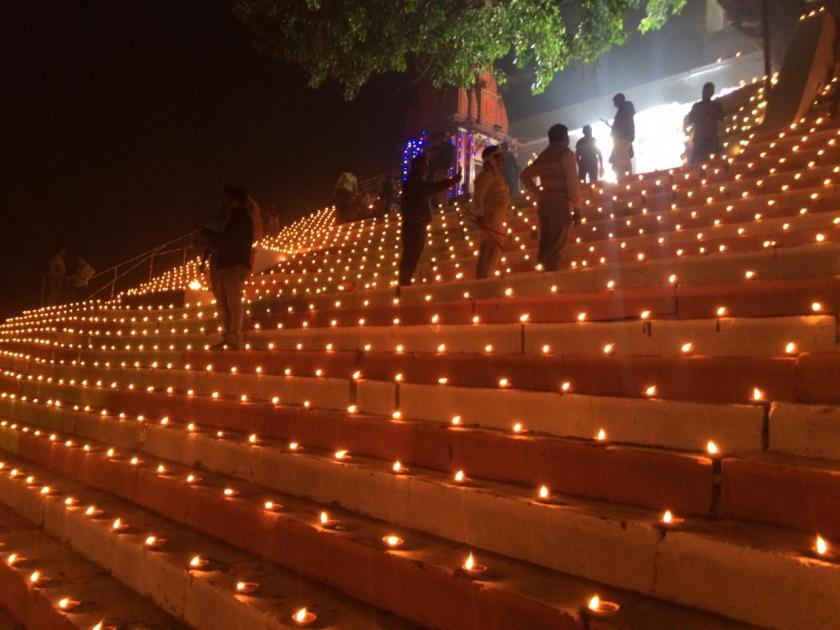
On Dev Diwali, the ghats along the riverbanks are beautifully lit up with thousands of earthen lamps. The sacred Hindu symbols, such as Om and Swastika, are also decorated with lamps, adding to the spiritual glow of the celebration. The entire scene creates a stunning atmosphere of light, reverence, and devotion.
Dev-Deepawali: A Festival of Light and Divine Presence
In North India, Dev-Deepawali is a special day when it is believed that the Gods descend from the heavens to bathe in the holy Ganges River.
To welcome the divine presence, people light diya lamps—small, cup-shaped oil lamps made of baked clay—at temples. Traditionally, devotees also place these lamps along the banks of the Ganges after taking a sacred dip in its waters on this auspicious day.
Ancient Hindu Festivals Shine Globally: How Diwali Became a Worldwide Phenomenon
As the world became more interconnected, the charm and beauty of Dev-Deepawali began to capture global attention. Through the power of media and globalization, this sacred festival, with its radiant display of lights and reverence for the divine, spread beyond India’s borders, attracting people from all corners of the world. The glow of countless diyas on the riverbanks now symbolizes not only a deep spiritual tradition but also a celebration of unity, light, and devotion shared by many cultures worldwide.
In Varanasi, the holiest city for Hindus, the Ganga River flows for many kilometers along the city’s banks. The places where the land meets the river are called Ghats, and they are decorated with lamps. The sight is breathtaking. When millions of earthen lamps are lit together, their flickering light brightens up the entire area. It’s a scene that seems unique and unlike any other place.
From Preparation to Illumination: The Journey of Diyas on Dev Diwali
On Dev Diwali, priests create beautiful geometric shapes along the banks of the Ganges using earthen lamps and flowers. The preparation for this grand display is a full day’s marathon of work.
First, the earthen lamps are cleaned by dipping them in the holy water of the Ganges, and then they are carefully dried in the sun. Once dry, a cotton wick is placed in each lamp, and the diya is filled with mustard oil, ready to light up the sacred banks of the Ganges in a mesmerizing glow.
The Ganga Banks Sparkle with Diyas on Dev Diwali
In recent years, many ghats have started using artificial lights, laser shows, and big fireworks, but I don’t like it.
What stays with me is the sight of rows of earthen diyas, their flames flickering in the wind, and their reflections on the Ganga water. The priests reciting Hindu prayers, people bathing in the holy water, and others floating flowers and diyas in the Ganga create a unique atmosphere. Women sitting on boats performing Ganga Aarti adds to the beauty of it all. This moment is unforgettable.
Anyone, no matter where they live or what religion they follow, should experience this moment at least once in their life.
Varanasi, the holiest city for Hindus, was referred to as Banaras during the British era.
The Banaras Revolt: The People Stand Against British Tyranny.
*In the tug-of-war between the East India Company and the King of Banaras, the people of Banaras stood resolutely by their ruler, transforming the conflict into a significant revolt against the Company.
*The Banaras Revolt resulted in heavy casualties for the East India Company’s army, with a significant number of soldiers killed and many others injured.
*The Banaras Revolt of 1781 tells the story of the East India Company’s relentless looting in India and its excessive exploitation of Indian kings. It also highlights the timidity and submissiveness of an inactive ruler.
*Though the rebellion seemed unsuccessful, it planted the seeds for the First War of Independence in 1857. Moreover, its influence can be traced tothe revolutionary movements that followed in India’s struggle for freedom.
Background of the Rebellion: Tensions Between Hastings and Chet Singh:
BHARATKALA BHAVAN (B.H.U) VARANASI.
CHET SINGH : (MAHARAJA OF BENARES)A Pawn in the East India Company’s Game :
Chet Singh came to power in Varanasi with the support of the East India Company, replacing the hereditary king.
Chet Singh, the ruler of Benares, was burdened with increasing demands from the British East India Company, including a substantial contribution of money and troops during the ongoing war against the Marathas and Mysore.
When he failed to meet these demands, Hastings imposed heavy penalties and even sought to depose him.
WARREN HASTINGS :
Warren Hastings, the first Governor-General of Bengal, faced significant resistance during his tenure. One of the most notable events was the rebellion led by Chet Singh, the Raja of Benares (modern-day Varanasi), in 1781.
Warren Hastings Departure from Kolkata:
On July 7, 1781, Warren Hastings left Kolkata with his retinue and troops. The journey was fraught with logistical challenges, reflecting the turbulent political climate and the pressing nature of the mission.
Stops En Route:
Hastings made stops at Bhagalpur and Buxar, key locations under British control. These stops likely served as strategic points for planning and reinforcing his position before arriving in Banaras.
Warren Hastings’s Arrival in Varanasi
On August 15, 1781, Warren Hastings reached Varanasi. Serious complaints and allegations against Maharaja Chet Singh prompted his visit.
Purpose of the Visit
Hastings came to investigate allegations that Chet Singh had failed to meet the British East India Company’s financial and military support demands.
These demands were weighty due to the ongoing wars against the Marathas and Mysore. Chet Singh’s inability or unwillingness to comply was perceived as defiance, prompting Hastings to take direct action.
Chet Singh vs Warren Hastings: A Clash of Power, Pride, and Politics in Banaras
To Grasp the Chet Singh-Warren Hastings Conflict, We Must Rewind a Few Years
The Struggle of Raja Chet Singh and the Rise of the East India Company’s Power.
In 1775, following the death of Nawab Shuja-ud-Daula,Nawab Asaf-ud-Daula ascended the throne, and the political landscape in India shifted dramatically.
This shift began an era where the East India Company’s influence in regional politics grew stronger.
One significant event during this time was the rise of Raja Chet Singh of Banaras, whose reign would soon come under the heavy hand of the East India Company.
The Treaty Between the Nawab and the East India Company.
Raja Chet Singh’s ascension to the throne of Banaras was not simple. His position as ruler was secured only through the mercy of the East India Company, which had considerable sway in the region.
The Company charged an exorbitant “appointment tax” to make Chet Singh the ruler, a demand that set the stage for years of financial burden on the Maharaja. This initial tax, although steep, was only the beginning of what would become a pattern of excessive financial demands.
The Growing Demands of the East India Company
With the East India Company’s growing control, the demands placed upon Chet Singh became more severe.
Soon after securing his rule, the Company imposed an additional demand of five lakh rupees on the Maharaja. This money was supposedly required to help the Company fund its military campaigns against the Marathas in the Deccan and Tipu Sultan in the south.
For three years, Raja Chet Singh managed to meet these demands, though his resources were stretched thin. However, as the Company’s demands continued to escalate, it became clear that the burden would be unsustainable. When the Maharaja finally refused to comply with the Company’s increasing tax demands, tensions escalated quickly.
The Breaking Point: The 50 Lakh Rupees and Two Thousand Horsemen
The East India Company, led by Warren Hastings at the time, did not take kindly to Chet Singh’s defiance. In retaliation for his refusal to pay, the Company imposed an even more severe penalty: a demand for 50 lakh rupees and an additional contribution of two thousand horsemen for the Company’s military campaigns.
In 1781, Warren Hastings personally visited Banaras to enforce this new levy.
His presence signified the Company’s intent to tighten its control over the region, and the demands placed upon Chet Singh marked a significant turning point in Banaras’s history and indeed, the growing dominance of the East India Company.
The Road Ahead for Chet Singh
The mounting demands of the East India Company on Raja Chet Singh highlighted the increasing pressure faced by regional rulers in India under the influence of foreign powers.
As tensions continued to rise between the Maharaja and the Company, Banaras became one of the many battlegrounds for control in colonial India. The fate of Chet Singh, caught between his obligations to the Company and his loyalty to his people, would unfold in the years to come, ultimately contributing to the larger story of resistance against colonial rule.
MADHODAS BAG OR MADHODAS GARDEN HOUSE
Image:Dinesh Seth
When Warren Hastings arrived in Varanasi on August 15, 1781, he stayed in a prominent garden known as Madhodas Garden.
The inscription on the wall of Radhaswami Bagh is now hidden among the nearby shops. This stone slab was placed to mark Warren Hastings’ arrival in Varanasi on 15th August 1781. It commemorates his stay at this location. (Image: Dinesh Seth)
Current Name:
Over time, the garden became known as Radhaswami Bagh or Swami Bagh, reflecting its association with the Radhaswami religious community in later years.
After arriving in Banaras, Warren Hastings set up camp at Madho Das Bagh. It was there that opponents of Maharaja Chet Singh seized the opportunity to turn Hastings against the king.
Some of the king’s close associates were among them, including Rani Gulab Kunwar,Ausan Singh, and Aliuddin Kubra, who had been waiting for the right moment to air their grievances. They accused Chet Singh of disloyalty, claiming that he had forgotten the East India Company’s support and was unwilling to pay the required taxes.
~Chet Singh sought an audience with Hastings to explain his position, but his request for a meeting was denied.~
Chet Singh Fort and Ghat: A Legacy of Varanasi’s History
Credit UNSPLASH
Chet Singh Fort:
This fort, built on the banks of the Ganga in the Shivala area of Varanasi, was owned by the Maharaja of Banaras and was originally called Shivala Fort. It later became known as Chet Singh Fort, after Maharaja Chet Singh.
Ghat: A stretch of land along the river.
Chet Singh Ghat: This fort is located here, and the place is also called Chet Singh Ghat, after Maharaja Chet Singh.
(SHIVALA BHAVAN, WILLIAM DANIELL R A,(1769-1837)
(SHIVALA BHAVAN, WILLIAM DANIELL R A,(1769-1837)
A Meeting That Changed Everything
Raja Chet Singh left his Ramnagar fort and arrived at Shivala Bhawan for a meeting with Warren Hastings, the Company’s Governor-General. The purpose of the meeting was far from cordial; Hastings intended to demand compliance with the Company’s escalating demands.
Resident Markham visited Chet Singh at Shivala Bhawan the next morning with an alarming message. Hastings had ordered that the Maharaja be placed under house arrest.
Markham also read aloud a decree outlining the “crimes” allegedly committed by the Maharaja, including his failure to meet the financial and military demands of the Company.
Though Chet Singh outwardly complied with the order, the situation quickly escalated.
Markham returned to Madhodas Garden House, where Hastings was staying, after leaving behind a contingent of soldiers and officers to enforce the house arrest.
A Spark Ignites
The tension in Shivala Bhawan reached a breaking point when Chetram, a soldier stationed by the Company, began mocking and provoking the Maharaja’s soldiers. Insults soon turned into abuses, further inflaming the Maharaja’s loyal guards. The spark ignited when Chetram went too far, leading to a violent clash.
Enraged by the humiliation of their king, the Maharaja’s soldiers attacked the Company’s forces. In the skirmish that followed, the Maharaja’s men killed most of the Company’s soldiers and officers stationed at Shivala Bhawan, including Chetram.
A Dramatic Escape
The Shivala Bhavan’s rock plate marks where Maharaja of Banaras, Chet Singh, escaped from Warren Hastings. (Image: Dinesh Seth)
Amidst the chaos, Raja Chet Singh made a daring ?? escape. Using a window at the northern gate of Shivala Bhawan that opened towards the Ganga River, he descended discreetly and boarded a waiting boat. The Maharaja fled back to the safety of his stronghold at Ramnagar Fort, evading the East India Company’s forces.
Encounter between Maharaja of Benares and soldiers of East India Company at Chet Singh Ghat.
The English army faced a major defeat in the battle between the British and the native forces at Shivala. Several British officers, along with many English and native soldiers, were killed.
Tablet at Shivala: Commemorating the 1781 Encounter at Chet Singh Ghat :
(Image: Dinesh Seth)
This text appears to be a historical inscription or record commemorating a tragic event in which British officers and Indian sepoys of the East India Company’s army lost their lives near a specific location during the Banaras Revolt of 1781.
Here’s a more readable version for clarity:
In Memory of:
Lieutenant Archibald Scott (1st Battalion Sepoys)
Lieutenant Jeremiah Symes (2nd Battalion Sepoys)
Lieutenant J. Stalker (Resident Bodyguard)
And 200 Sepoys Who were killed on August 17, 1781, Near this spot, while doing their duty.
(Sepoy: An Indian foot soldier, especially one serving in the East India Company’s army.)
RAMNAGAR FORT
Ram-Nagar Fort (Varanasi)
Ramnagar Palace Entrance: A Regal Landmark from 1790s Benares
Padaav Ramnagar Encounter:
In this battle between the British and the soldiers of Maharaja Chait Singh of Varanasi, 30 foreign soldiers and 150 native soldiers from the British side were killed, and 100 were injured. On the Maharaja’s side, only two soldiers lost their lives.
Captain Mayfair’s Fate in Varanasi:
Captain Mayfair marched into Varanasi with his troops but was surrounded by the locals. The crowd attacked Mayfair and his soldiers in the streets. Mayfair, along with 36 foreign soldiers, was killed. Additionally, 108 native soldiers died, and 42 were injured in the clash.
Warren Hastings’ Escape to Chunar
CHUNARGARH: Chunar’s ancient and historical fort( Image:-Dinesh Seth) Chunar Fort on the Ganges: A Painting from 1795 by Daniels
Frightened by the hostile situation in Varanasi, Warren Hastings decided to leave the city as quickly as possible. Seeking safety, he chose to retreat to Chunar, a fort controlled by the East India Company and located just a few kilometers away. Under the cover of night and accompanied by a few trusted men, Hastings managed to reach Chunar after a perilous journey.
This kothi was built by the company(EAST INDIA COMPANY) in Chunar Fort. Warren Hasting had to stay here until he got help from Allahabad and Kolkata. (Image Dinesh Seth.)
“If Chet Singh had not run away at this time and would have attacked the garden of Madhodas, I would have been killed surely, and thus rebellion would have spread all around.”SELECTIONS FROM THE STATE PAPERS OF THE GOVERNORS-GENERAL OF INDIA: WARREN HASTINGS (George Forest Page 160)
This statement reflects Hastings’ awareness of the danger he faced during the rebellion. It also underscores a missed opportunity by Chait Singh, whose inability to exploit Hastings’ vulnerable state allowed the British to regroup and eventually suppress the revolt.
I AM NOT AFRAID OF AN ARMY OF LIONS LED BY A SHEEP, BUT I AM AFRAID OF AN ARMY OF SHEEP LED BY A LION.
ALEXANDER THE GREAT
The public was highly motivated by this incident and eager to avenge the insult of their king. However, they desperately needed capable leadership to channel their enthusiasm. Sadly, the king failed to rise to the occasion.
Instead of leading his people, he chose to flee like a coward, prioritizing the safety of himself and his family. This disappointing and self-centered behavior caused the people and the army to lose faith in their ruler, ultimately weakening the rebellion’s potential.
Some valuable lessons from this important event of modern Indian history
Responsibility of the People in Leadership Failures:
When the ruling class neglects its duties, the people must rise to the occasion, taking initiative and responsibility to lead themselves.
This perspective reflects the need for collective empowerment and the rejection of passivity in the face of failed governance. It underscores the idea that a society’s strength lies in its ability to act independently when necessary, fostering self-reliance and unity.
Timeliness in Decision-Making:
The ability to make timely decisions is crucial for shaping a brighter future. Decisions made at the right moment can determine the trajectory of events, turning challenges into opportunities. This principle highlights the importance of situational awareness, decisiveness, and the courage to act swiftly when the moment demands.
Together, these ideas advocate for proactive leadership—whether by the ruling class or the people themselves—and the value of timely, well-considered action to ensure a prosperous and just future.
Immediate Effects:
The defeat of King Chet Singh and the subsequent installation of Mahip Narayan Singh as a puppet ruler symbolizes the increased control of the East India Company in Banaras.
The rebellion’s immediate consequence was the assertion of British power and the subjugation of the local monarchy.
Long-Term Effects:
Despite the rebellion’s failure, it sparked a deep resentment among the people of Banaras, leading to heightened anger towards British rule.
This anger helped form the ideological and emotional basis for India’s first major revolt in 1857, often considered the first war of Indian independence.
The connection between the Banaras Rebellion and later freedom struggles is made clear through figures like Veer Savarkar, who identified it as a precursor to the 1857 rebellion.
Connection to Key Figures:
The rebellion indirectly influenced key revolutionaries like Rani Lakshmi Bai of Jhansi and Sachindra Nath Sanyal.
Rani Lakshmi Bai, born near the site of the Banaras Revolt, is noted for her involvement in the 1857 rebellion and likely carried the memory of these events in her heart.
Sachindra Nath Sanyal, another important revolutionary, was personally connected to Banaras through his grandfather, the chief priest of the Maharaja at the time of the rebellion.
The Banaras Rebellion, although unsuccessful, had a lasting impact on India’s freedom struggle, motivating future generations of nationalists. Its legacy is seen as an important chapter in the larger narrative of India’s resistance to British colonialism.
“I think Banaras is one of the most wonderful places I have ever seen. It it has struck me that a westerner feels in Banaras very much as an oriental must feel while he is planted down in the middle of London”.
MARK TWAIN.
Celebrating Christmas and New Year in Varanasi: A Blend of Cultures
My elder sister, who has been living in Denmark for four years, called me during Christmas. Naturally, we talked about how Christmas is celebrated there. She told me that most shops in Denmark are closed, and many people prefer to spend the holiday with their families.
But then she mentioned that she missed celebrating Christmas in Varanasi. This surprised me because Christmas is a Christian festival, and New Year traditions also come from the West. Yet, she longed for the way these festivals were celebrated in Varanasi.
It made me reflect on how, just like England’s national food Chicken Tikka, or tea time became a tradition in England (even though tea is popular in Asia), Varanasi has its unique way of celebrating Christmas. It’s a blend of cultures, showing how traditions evolve across borders.
Away from the debates of civilization clashes and misunderstandings, I thought of Marianne Williamson’s words: “Personal transformation can and does have global effects. As we go, so goes the world, for the world is us. The revolution that will save the world is ultimately a personal one.”
This made me think of the Christmas stories of O. Henry, especially “A Cosmopolitan in Café.” In this story, a man is asked where he’s from, to which he replies that it doesn’t matter. He argues that we should judge people by who they are, not by their origins. He humorously points out how people from all regions can defy stereotypes and still be human.
Similarly, in Varanasi, despite its slow pace of change, the city has welcomed elements of various cultures. Varanasi is one of the oldest cities in the world, and while it may hold on to its traditions, it has not rejected change entirely. It has adapted over time while maintaining its vibrant spirit.
The Christmas fairs in Varanasi, mostly held at churches like St. Mary’s School, are an example of this blend. Hindus, who may not know the religious significance of Christmas, still participate, understanding it as a celebration of Christ’s birth. This is similar to how Hindus celebrate Krishna’s birthday, as both have similarities in their childhood stories.
On New Year’s Day, temples in Varanasi are filled with people seeking blessings. It is an old tradition to visit the temple and seek blessings from God.
A few methods are also equally popular *Many Hindus enjoy celebrating Christmas and New Year because these holidays allow them to eat non-vegetarian food, which is otherwise restricted during Hindu festivals.
*Interestingly, the old generation in Varanasi still remembers the influence of Buddhism and Jainism on Hinduism, particularly the emphasis on non-violence. This is why eggs are not used in cakes or pastries during Christmas.
This can be confusing for foreigners, but it’s not a problem for those who have lived in Varanasi for years.
For example, the owners of Good Hope Bakery, who have been living in Varanasi for twenty years, happily distribute cakes during Christmas, offering both egg and eggless options to cater to local preferences.
In Varanasi, both locals and foreigners have adapted their ways of celebrating the New Year to respect each other’s beliefs. It’s refreshing to see such cultural coexistence in a world that often focuses on the clash of civilizations. This blend of traditions in Varanasi shows an optimistic picture of a future where cultures live together in harmony.
We believe religion to be the surest foundation of character and the truest source of human happiness. We believe patriotism to be a powerful elevating influence which inspires men to high-minded unselfish action.
I spent some of the most meaningful years of my life as a student of Banaras Hindu University. This post is born out of the memories that time has not been able to erase.
BHU
Banaras Hindu University (BHU) is situated in Varanasi, one of the world’s oldest continuously inhabited cities, also known as Kashi.
The word Kashi comes from “Kash”, meaning the light of knowledge, wisdom, and consciousness.
In ancient times, Varanasi stood alongside Nalanda and Taxila as one of the greatest centers of learning in the world.
This long tradition of education and culture found a modern expression with the establishment of Banaras Hindu University.
MAHAMANA
The name of Madan Mohan Malaviya is inseparable from India’s cultural and educational legacy. His vision, sacrifice, and tireless efforts gave birth to B.H.U, not merely as a university, but as a national institution rooted in Indian values. In recognition of his greatness, he was honored with the title “Mahamana, a name by which he is remembered even today.
An Unbroken Chain of Commitment
Dr. Ganeshi Prasad, a renowned Indian mathematician, was the Head of the Mathematics Department at B.H.U. He was also a member of the prestigious Royal Society, an institution that included legendary scholars like Isaac Newton and Srinivasa Ramanujan.
During the same period, a young and brilliant mathematician, V. Narlikar, was working at Cambridge University and was considered a rising star in his field.
Malaviya Ji was deeply committed to bringing the best minds back to India. When he met Narlikar, he urged him to return and join B.H.U. Narlikar, being a true patriot, agreed—but half in jest, he added a condition: if he were to leave Cambridge, he should be appointed Head of the Mathematics Department.
Malaviya Ji responded with honesty and humility. He explained that the department was already led by Dr. Ganeshi Prasad, a scholar senior in both age and experience.
A Rare Act of Selflessness
A few days later, when Dr. Ganeshi Prasad learned about this conversation, he went to Malaviya Ji and made an extraordinary offer. He expressed his willingness to step down from his position so that a younger and exceptionally talented scholar like Narlikar could be brought to India.
His words reflected deep national concern—a country still struggling for independence needed every great mind it could get.
Although Narlikar later clarified that his demand was made jokingly, the incident deeply moved him.
Eventually, he left Cambridge and joined Banaras Hindu University. Dr. Ganeshi Prasad continued his association with the university, contributing through his scholarship and mentorship.
The Legacy Continues
Years later, this chain extended further. J. V. Narlikar, the son of V. Narlikar, also studied at B.H.U and went on to achieve remarkable success in science and astronomy.
He taught at Cambridge University, later returned to India, and played a key role in building important scientific institutions, including the Inter-University Centre for Astronomy and Astrophysics (IUCAA) in Pune. He, too, became a member of the Royal Astronomical Society, London.
I still remember listening to a radio interview of J. V. Narlikar—something that reminded me of my hostel days at B.H.U, when listening to the radio was a daily habit. When he was asked about his favorite movie, he smiled and replied that he wasn’t much interested in films, but loved humming the Kulgeet of B.H.U—“Madhur Manohar Ateev Sundar.”
That Kulgeet was written by Dr. Shanti Swarup Bhatnagar, a distinguished scientist, teacher at B.H.U, and another member of the Royal Society. Today, India’s most prestigious science award—the Shanti Swarup Bhatnagar Prize—bears his name.
A Chain That Must Never Break
From Malaviya Ji’s vision, to Ganeshi Prasad’s sacrifice, to the Narlikars’ scholarship, and to Bhatnagar’s contribution—this is not just history. It is a living chain of values, where knowledge, humility, patriotism, and service flow from one generation to the next.This chain must never be broken.
A Divine Beginning: The Birth of Swami Vivekananda in Connection with Varanasi
BIRESWAR SHIVA or Brijeshwar Mahadev
A Mother’s Faith and the Blessing of Bireshwar Temple
Swami Vivekananda’s mother, Bhuvaneshwari Devi, was a deeply religious woman living in Kolkata. She longed for a son and believed in the power of prayer.
A relative suggested she seek blessings from the Vireshwar (or Bireshwar) Temple in Varanasi, a sacred temple known for granting the wish of a son to devoted mothers.
Since she was unable to travel during pregnancy, her relative in Varanasi performed the rituals and prayers on her behalf at the Bireshwar Temple.
A Divine Answer to a Mother’s Prayer
Soon after these rituals, on January 12, 1863, which was Makar Sankranti, Bhuvaneshwari Devi gave birth to a baby boy. Seeing this as a blessing from Lord Shiva of the Bireshwar Temple, she named him Bireshwar, meaning “Lord of Heroes.”
At home, the child was lovingly called Biley, a simple name that showed affection and joy. Later, during his Annaprashan (first rice-feeding ceremony), he was given his formal name: Narendranath Dutta.
This Vivekananda birth story reminds us of how faith and devotion can shape destiny. From the very beginning, his life was linked to Varanasi, the city of Shiva.
As a mark of reverence for that sacred grace, a replica of the Shiva Linga from the Brijeshwar Mahadev Temple has been enshrined in Swami Vivekananda’s ancestral home in Kolkata.
This symbolic presence of Lord Shiva is not merely a relic of faith—it is a living reminder that the spiritual energy of Varanasi never left Vivekananda.
It journeyed with him through his life’s mission, illuminating hearts, awakening courage, and spreading the divine message of fearlessness and self-realization across India and the world.
The Making of a Saint: From Biley to Swami Vivekananda
As young Biley grew, he showed unusual curiosity, energy, and courage. His sharp mind and questioning spirit amazed everyone around him. His mother would often say, “This boy is not ordinary—he has come for a great purpose.”
Years later, Biley became Swami Vivekananda, the disciple of Sri Ramakrishna Paramahamsa, who taught him about the unity of all religions and the power of service to humanity.
But before he became world-famous, Varanasi once again became an important chapter in his life.
Swami Vivekananda in Varanasi: The Bengali Deodhi Connection
Bangali Deodhii
A Meeting Place of Great Minds
During his travels, Swami Vivekananda visited Varanasi several times, and one of his favorite places was the Bengali Deodhi, the home of Pramadadas Mitra.
Pramadadas Mitra
Pramadadas Mitra was a brilliant scholar who was well-versed in both Indian and Western traditions. He had translated the British National Anthem into Sanskrit and the Bhagavad Gita into English—a rare combination of East and West.
The Bengali Deodhi became a meeting ground for great minds and spiritual discussions. Here, Swami Vivekananda spent hours talking about India’s future, religion, and education.
Swami Vivekananda’s Visits to Bengali Deodhi
In 1888, Swami Vivekananda penned this thoughtful letter to Babu Pramadadas Mitra, reflecting his early spiritual ideas.
Swami Vivekananda first stayed at Bengali Deodhi in 1888. During this visit, he developed a close friendship with Pramadadas Mitra. They discussed the Vedas, philosophy, and India’s role in the modern world.
He returned in 1890, accompanied by Swami Akhandananda, another devoted monk. Once again, Bengali Deodhi became a center of thought, courage, and inspiration.
Vivekananda’s Fiery Words in Varanasi
One famous moment from his stay still echoes through time. When Vivekananda saw rich people ignoring social problems, he spoke with passion:
“I shall not return until I burst on society like a bombshell, and it will follow me like a dog.”
The Life-Changing Lesson at Durgakund Varanasi
Durgakund Temple Varanasi
An Unexpected Encounter with Fear
One of the most famous incidents from Swami Vivekananda’s life in Varanasi took place at the Durgakund Temple, dedicated to Goddess Durga.
One day, while returning from the temple, young Vivekananda was suddenly chased by a group of monkeys. The monkeys were loud and aggressive, and he began to run away in fear.
But the more he ran, the more the monkeys chased him!
A Monk’s Simple Advice: “Face Them!”
Just then, a monk standing nearby called out to him, “Stop running! Face them!”
Swami Vivekananda stopped, turned around, and stood firm. The monkeys, seeing his courage, slowly backed away and left him alone.
This simple moment taught him one of the most powerful lessons of his life: Never run away from fear. Face it boldly.
“Face Fear” – A Universal Teaching
Later, Swami Vivekananda often told this story in his lectures to teach people how to overcome fear and difficulties.
He said that fear grows stronger when we run from it, but it disappears when we face it.
The incident at Durgakund Varanasi became a lifelong lesson that shaped his courage and his teachings to the world.
FOR MORE INFORMATION ABOUT THE DURGA-KUND TEMPLE, PLEASE VISIT
Swami Vivekananda’s Final Days in Varanasi: The Gopal Lal Villa
The Return of the Saint
Gopal Lal Vila
In 1902, just a few months before his death, Swami Vivekananda returned once again to Varanasi. Although he was very weak and ill, he continued to serve others with his usual energy and kindness.
He stayed at the Gopal Lal Villa, a beautiful garden house belonging to King Kali Krishna Thakur. The calm environment of this villa gave him some rest, but his heart remained focused on helping others.
Service Beyond Suffering
Even during his illness, Vivekananda met visitors, shared knowledge, and encouraged everyone to work for the nation. He truly lived by his own teaching of Karma Yoga—the path of selfless action.
He believed that true spirituality means serving others without expecting anything in return.
A Peaceful Farewell
A few days after his stay at Gopal Lal Villa, Swami Vivekananda left Varanasi and returned to Belur Math, near Kolkata.
On July 4, 1902, at the young age of 39, he passed away peacefully while meditating. His death was not an end, but the completion of a great spiritual journey that began with faith, devotion, and the blessings of Lord Shiva in Varanasi.
FOR MORE INFORMATION ABOUT GOPAL-LAL VILA, PLEASE VISIT :
The Eternal Light of Swami Vivekananda in Varanasi
The story of Swami Vivekananda and Varanasi is like a shining river of faith flowing through time. From the Bireshwar Temple, where his birth was blessed, to the Gopal Lal Villa, where he spent his last days, the holy city was his spiritual anchor.
Each visit, each experience in Varanasi, added a new chapter to his growth—from a child called Biley to a monk who awakened the world.
Swami Vivekananda’s legacy continues to guide millions. His teachings from Varanasi remind us to live with courage, compassion, and faith. He proved that true strength lies not in wealth or power, but in character and service to humanity.
Varanasi, the city of Shiva, witnessed his journey from birth to enlightenment to peace. And even today, as the bells of its temples ring and the Ganga flows silently by, one can almost hear his words echo through the ghats:
“Arise, awake, and stop not till the goal is reached.”