Deadly attack on Sir Salman Rushdie and the spread of Islamic fundamentalism in South Asia.

“BEHEADING IS THE ONLY PUNISHMENT FOR THOSE WHO INSULT PROPHET MUHAMMAD” Rushdie’s writings feature South Asia’s Islamic fanaticism. What similarities and future threats are there in the present-day mortal attack on Rushdie and the slogans of splitting up in South Asia???

A couple of weeks ago the famous Novelist, Sir Salman Rushdie, was attacked by an Islamic fanatic who tried to kill him.

According to the New York State Police, around 11 a.m. at the  Chautauqua Institution, in Chautauqua New York . A Muslim youth ran up to the stage and attacked Salman Rushdie with a knife.

The Muslim youth stabbed Salman Rushdie several times with a knife. Rushdie collapsed right there on the stage. He was immediately sent to the hospital. Doctors there said that Rushdie was completely covered in blood after the attack. According to media reports, Rushdie is seriously injured and is undergoing treatment. Doctors have performed surgery on him. According to the information, his health has already improved quite a lot and is gradually getting better, he has now been removed from the ventilator.

The attacker is 24 years old and has been identified. His name is Hadi Matar.

SALMAN RUSHDI

Salman Rushdie is an Indian-born British-American novelist. Known for his provocative writings on medieval thought and ideology of Islam. His novel, written in the early days, describes the stifling social environment of the converted Muslims of South Asia.

Note:- I consider Rushdie’s book “Shame” written upon the Muslims of South Asia to be equivalent to “Among The Believers” by V.S Naipaul. Both books depict the medieval behavior of the converted Muslims of South Asia. While Naipaul speaks very clearly in his writings, Rushdie attacks Islamic beliefs with the help of satire and imagery. How the seeds of Islamic terrorism were being planted in South Asia, which currently exports Islamic terrorism to the entire world, have been very well portrayed by both the authors.

THE REASON FOR THE FATAL ATTACK ON RUSHDIE

THE TALIBAN WHEN THEY SAY SOMETHING, THEY DO IT . THEY THREATEN TO KILL PEOPLE AND THEY DO IT . BUT WHEN WE SAY WE WILL PROTECT YOU , WE OFTEN DO NOT — Jelani popal , afghan government official

The attacker attacked Rushdie with the intention of slitting his throat.

  1. The attacker considers Rushdie to be an ENEMY OF ISLAM According to him, Rushdie is accused of blasphemy and such a person has no right to live according to Islamic law. Salman Rushdie has been a target of Islamic fundamentalists ever since the publication of his book “Satanic Verses”. In 1989, Iran’s religious leader Ayatollah Khomeini issued a fatwa against Rushdie, calling the book “Satanic Verses” an insult to Islam. On February 14, 1989, the fatwa to kill Rushdie was officially announced on Radio Tehran by Ayatollah Ruhollah Khomeini saying that the book was “blasphemous against Islam”.

WHAT IS FATWA

The decree issued on any issue related to Islam on the basis of Quran and Hadith is a fatwa.

According to media reports, Hadi Matar was not under the influence of the fatwa.
So was he making an easy way to enter Paradise by killing a GUSTAKH E NABI. GUSTAKH E NABI KI EK SAJA SIR TAN SE JUDA. ‘Beheading is the only punishment for those who insult Prophet Muhammad.’ 

But take not friends

From their ranks Until they flee

In the way of God (From what is forbidden). And (in any case) take No friends or helpers

But if they turn renegades, Seize them and slay them Wherever you find them;

From their ranks…..

(Quran, 4.89)

The attack on Salman Rushdie is not just an attack on a human being. It is an attempt to suppress a strong and loud voice against fundamentalism. The concept of modern world is not only from modern electronic devices, ideas like democracy, coexistence, space for opposing views, multiculturalism are the foundation of the modern world. If any person rejects or attacks these ideas of modern times, then his medieval thinking is a threat not only to the present but also to the future.

So, how will the attack on Rushdie, who raised his voice against Islamic fundamentalism in South Asia, affect the countries in South Asia?

“There is no God but Allah, and Mohammed is the prophet of Allah.’ Such is the cry which electrifies 250 millions of the inhabitants of this globe. Such is the cry which thrills them so that they are ready to go forward and fight for their religion, and consider it a short road to Paradise to kill Christians and Hindus and unbelievers. Dr Theodore Pennell Missionary Doctor at Bannu , Among the wild tribes of the afghan frontier 1909

JAMA MASJID DELHI

THE IMPACT OF THE ATTACK IN SOUTH ASIA

This attack will have far-reaching consequences in the converted Muslim-majority countries of South Asia. Like mushrooms, Islamic seminaries spread across South Asia will leave no stone unturned to justify the attack on Salman Rushdie.

The attack on Salman Rushdie is being promoted as an Islamic victory and this propaganda will continue. With the help of Hadi Matar’s jihadi image, youth will be inspired for jihad.

Describing any Islamic terrorism act in the world as jihad, giving martyr status to jihadis is an old custom of madarasas of Pakistan, Afghanistan, Bangladesh. Presently these madarasas are engaged in the production of human bombs day and night like a sucide bomb factory.

Any kind of question mark on the beliefs of Islam falls under blasphemy.

Beheading the person who put the question mark is a holy act like worshiping God for Muslims. Medieval Islamic beliefs, such as the beheading of a non-religious person, a blasphemer, are rapidly spreading across South Asia again. Incidents of beheading are happening not only in Pakistan, Afghanistan, and Bangladesh, but also in the Hindu-majority country of India, dozens of people have been beheaded by Islamic extremists in just the past few months.

Nowadays, whether it is a virus, or ideology, it cannot be limited in one scope. 9/11 is the best example of this. The revival of the Islamic practice of cutting throat in South Asia is a warning bell for the whole world. The goal of Islamic fundamentalists is very clear. The killing of any non-religious person remains a guarantee of paradise.

At the same time, countries who believe in the democratic values ​​of the world have so far been unsuccessful in even deciding the definition of terrorism. It seems impossible to defeat Islamic terrorism without all the democratic countries of the world coming and together.

Historic Landmarks of Varanasi: Iconic Buildings from the East India Company Era

In this post, I would like to mention some of the major buildings, institutions, Temple built in and around Benares under the East India Company and which are still in existence and which are a major part of the daily life of the people of Banaras from the time of its construction till the present.

EAST INDIA COMPNY RULE AND BANARAS

In 1781, the East India Company took control of Banaras, declaring the rule of the Nawabs and Rajas unsuccessful. The Company appointed magistrates to govern the city.

In 1788, Jonathan Duncan, a young man, was appointed as the Resident and Superintendent of Benares. The East India Company also took control of the mint house from the Raja of Banaras. Starting in 1794, East India Company civil and criminal courts were established in the city.

BITTER MEMORIES OF BANARAS (VARANASI)

Benaras Slaughter

After learning from the “Benaras Rebellion,” Duncan decided not to interfere with the religious practices and rules of the Hindus. In 1781, the people of Banaras rose against Warren Hastings, who had insulted Raja Chet Singh. This uprising became known as the “Benaras Slaughter” among the British because a large number of British soldiers were killed during the rebellion.

For more information: https://nithinks.com/2020/08/14/benares-rebellion-15august-1781/

GOVT. SANSKRIT COLLEGE BENARES

By the end of the 18th century, the British decided to establish a Sanskrit college in Banaras. Kashi Nath, the first Acharya (principal) of the Sanskrit College, wrote a letter to the East India Company officials regarding the establishment and functioning of the college.

In 1791, Jonathan Duncan wrote a letter to the officers of the East India Company about establishing the Sanskrit College in Banaras. Although Duncan moved to Bombay in 1795, he remained connected with the Sanskrit College throughout his life.

The college started with eight teachers and about 200 students. Initially, the curriculum focused solely on the rituals, traditions, and religious beliefs of Hinduism, which is why most of the teachers and students at the college were Brahmins.

Expansion of Sanskrit College

In 1846, Dr. J.R. Valentine was appointed as the principal of Sanskrit College. In 1852, the college moved to a new building, and it was renamed Queen’s College.


QUEEN’S COLLEGE BENARES

The new building of Queen’s College was designed by Major Kittu. Built in Gothic style, the structure was made using Chunar sandstone.

In 1870, renowned scholar Bapu Dev Shastri taught Indian astrology to his students at Queen’s College.


SAMPURNANAND SANSKRIT UNIVERSITY

SAMPURNANAND SANSKRIT UNIVERSITY

With the efforts of the then Chief Minister of Uttar Pradesh, Dr. Sampurnanand, the college was upgraded to university status and renamed from “Queen’s College” to “Sanskrit Mahavidyalaya Varanasi.” In 1974, it was again renamed to its current title, Sampurnanand Sanskrit University.

Unlike before, the university now offers a broad curriculum that includes various subjects related to Hindu religion, culture, and civilization. The university also houses a museum and the Saraswati Bhavan Library.

  • Sampurnanand University Archaeological Museum: Most of the artifacts in the museum were discovered during excavations in Sarnath by Major Kittu.
  • Sarnath, located about ten kilometers from Varanasi, is a significant Buddhist site where Gautam Buddha gave his first sermon, known as the “Turning of the Dhamma Chakra.”
  • Saraswati Bhavan Library:
  • The library holds thousands of manuscripts and rare ancient texts, preserving invaluable knowledge of Indian history and culture.

Note: There is an intermediate college near Sampurnanand University also called Queen’s College. Do not confuse this with the university.

Tomb of Lord Cornwallis

The tomb of Lord Cornwallis is situated in Ghazipur city, which is approximately 84 km from Varanasi.

Lord Cornwallis, known for his significant role in the American Revolution as a Major General, later served as the Governor General of India.

He is often called the “father of civil services” in India due to his major administrative reforms. Cornwallis passed away on 5th October 1805 in Ghazipur, possibly due to smallpox. His tomb was built using British stones and is located in Gorabazar, Ghazipur.

Gorabazar was once a locality where the British bungalows and kothis were situated, which is why it came to be known as “Gorabazar” (meaning “Colony of white people”). This area played a significant role during British colonial rule and remains an important landmark today.


The unfinished monument to the Marquis Cornwallis at Ghazipur

The painting of the Cornwallis tomb under construction was created by Sita Ram, a painter employed by the East India Company.

This artwork, made in 1814-15, depicts the tomb of Lord Cornwallis while it was still in the process of being constructed in Ghazipur.

Sita Ram, who was traveling from Patna to Banaras at the time, captured the scene of the tomb under construction, giving us a rare visual glimpse into the historical site during that period.

His painting is significant not only for its artistic value but also for its documentation of colonial-era architecture and British memorials being built in India.

The painting shows the tomb’s unfinished structure and the labor involved in its construction, providing an insight into the colonial ambition to memorialize figures like Lord Cornwallis.

This work is important as it offers a snapshot of the early 19th-century British presence in India, as well as the artistic style of the time, blending colonial architecture with Indian artistic traditions.

Today, this painting is a crucial historical artifact, preserving a moment in the construction of a key colonial monument and shedding light on the cultural exchange and interactions between British colonial powers and local Indian artists like Sita Ram.

CHUNAR FORT CHUNAR GADH OR CHUNAR GUR

Artist: Hodges, William ( DATE:-1787)

The Chunar Fort is one of the oldest and most historically significant forts in India, with a rich past spanning several centuries.

Chunar Fort

Evidence shows that the fort was once under the control of Vikramaditya, the legendary king of Ujjain in 56 AD, showcasing its deep historical roots. Over time, the fort saw rule from various notable figures, including Prithvi Raj Chauhan.

In 1538, Sher Shah Suri, the founder of the Suri Empire, made this fort his residence, adding a pavilion to the fort during his rule. The fort later came under Mughal control and remained under their authority for a long period, marking its significance during their empire.

After the Battle of Buxar in 1764, the fort fell into the hands of the British.

This Kothi was built by the company(EAST INDIA COMPANY) in Chunar Fort

Warren Hastings, the first Governor-General of India, took refuge in the fort during the rebellion in Banaras, cementing its role in British history. Under British rule, the fort was modernized, and British-style bungalows were constructed within the fort’s walls, blending colonial architecture with the fort’s traditional design.

The fort’s historical importance is clear from its long-standing strategic, military, and political relevance under various rulers. The fort has witnessed the rise and fall of empires and continues to be a reminder of India’s rich and diverse history. This proves why Chunar Fort remains an important historical site, reflecting a blend of ancient, medieval, and colonial influences.

How the East India Company Shaped India’s Landscape Through Architecture

The history of the East India Company’s rule in India marks a pivotal chapter in the nation’s past, shaping both its political and social landscape.

The buildings constructed during this period serve as living symbols of the era’s colonial influence, showcasing architectural styles that blended British and Indian traditions.

These structures are not only important for their historical and architectural value, but also for the stories they tell of India’s struggle, resilience, and transformation during British rule. Many of these buildings, still standing today, continue to serve as witnesses to the significant events and changes that took place during that time, reminding us of India’s complex journey toward independence.

When Ashoka’s Lions Roared Again: The Symbol That Shaped Independent India

In 1905, two powerful events unfolded in the timeless Hindu city of Varanasi, and together they lit a spark that would help change India’s destiny.

In that single year, the sacred soil of Varanasi witnessed both the historic Banaras Session of the Indian National Congress and the extraordinary discovery of the Lion Capital at Sarnath. One event awakened political courage, the other revived cultural pride. Side by side, they stirred the sleeping spirit of the nation and helped shape the rising wave of Indian nationalism.

The Lion Capital and the Rise of Indian National Pride

In the year 1905, two remarkable events took place in the ancient and sacred city of Varanasi, which would silently shape the course of India’s future.

(I)

The first was the Banaras Session of the Indian National Congress, where national leaders called upon the people to support the Swadeshi Movement — a movement urging Indians to boycott foreign goods and revive indigenous industries.

(II)

The second, though seemingly an archaeological event, was no less significant — the discovery of the Lion Capital at Sarnath, built by Emperor Ashoka more than two thousand years ago.

These two moments — one political and the other historical — came together like two flames merging into a single fire of awakening.

The Congress session reminded Indians of the need for action and unity, while the Lion Capital whispered from the soil of history, reminding them of their ancient greatness.

A Voice from the Soil of Sarnath

When British archaeologists unearthed the Lion Capital in Sarnath in 1905, they did not know they had uncovered more than a sculpture — they had unearthed a nation’s pride.

The polished sandstone sculpture, featuring four majestic lions standing back-to-back atop a circular abacus, was a masterpiece of Mauryan craftsmanship. Each lion faced a different direction, symbolizing power, courage, and confidence radiating to every corner of the world.

Beneath them was the Dharmachakra, the Wheel of Law, with twenty-four perfectly spaced spokes, representing truth, justice, and righteousness. Alongside the wheel were carvings of a bull, horse, elephant, and lion, symbolizing strength, energy, wisdom, and pride — the noble virtues of Indian civilization.

This grand creation stood on a bell-shaped lotus, symbolizing purity and enlightenment rising from the mud of ignorance. Today, this very sculpture — perfectly preserved and displayed at the Sarnath Museum — continues to inspire millions.

The Symbol That Awakened a Sleeping Nation

India in 1905 was still under British rule, a time when foreign powers not only controlled its land but also attempted to weaken its spirit.

People were losing confidence in their culture, language, and traditions. But when the Lion Capital was rediscovered, it was as if India’s buried soul had spoken again.

The four lions seemed to roar: “Your land was once a beacon of peace, strength, and wisdom. Remember who you are.”

The message struck a deep chord in people’s hearts. At a time when national leaders were urging Indians to believe in themselves and resist foreign control, the Lion Capital stood as living proof that India had once been the cradle of one of the greatest civilizations on earth.

In the same year, the Swadeshi Movement encouraged Indians to produce their own goods and depend on their own skills.

The Lion Capital complemented this spirit perfectly — it reminded everyone that Indian artisans, thousands of years ago, had achieved levels of perfection in art and geometry that the world still admired.

Together, these two events became a turning point. The political energy of the Swadeshi Movement and the historical pride rekindled by the Lion Capital gave rise to a new wave of national consciousness.

Rediscovering India’s Glorious Past

For centuries, India’s rich history had been neglected or misrepresented. Many people had begun to believe that India had always been weak, divided, or dependent on outsiders.

The discovery of the Lion Capital shattered that myth. It proved that long before foreign invasions and colonial rule, India had been a land of power, peace, and progress.

The Lion Capital was built by Emperor Ashoka, one of the greatest rulers in human history, who chose peace over war.

Through his inscriptions and pillars, he spread the message of dharma, or righteous living, across Asia. His empire stretched from Afghanistan to Bengal — and yet, his greatest conquest was not of territory but of the human heart.

The Lion Capital became a silent teacher. Its lions roared not for conquest but for moral strength. Its wheel spun not for power but for justice. Its lotus bloomed not for show but for purity. In every curve and carving lies the timeless values of India — compassion, wisdom, and unity.

A Symbol Reborn

When India achieved independence in 1947, the newly formed government sought an emblem that could represent the nation’s spirit — something that embodied truth, justice, peace, and power. The choice was clear.

On January 26, 1950, the Lion Capital of Ashoka was adopted as the National Emblem of India. The Ashoka Chakra, taken from the same sculpture, found its place at the center of the national flag. Its 24 spokes became symbols of eternal progress, reminding citizens that the wheel of dharma must never stop turning.

Today, the Lion Capital stands tall on government buildings, coins, passports, and official documents — a reminder of India’s moral and cultural heritage. Whenever we see the emblem or the Ashoka Chakra, we are reminded of the values it represents — truth, compassion, service, and unity.

A Legacy That Still Roars

The Lion Capital is more than stone — it is India’s spirit carved in rock. From the peaceful sands of Sarnath, it speaks to every Indian heart: “Walk the path of righteousness, stay united, and be proud of your heritage.”

Even after more than two millennia, its message remains alive. The lions still roar for courage. The wheel still turns for truth. And the lotus still blooms for purity.

The Lion Capital continues to guide India — a symbol born in ancient times, rediscovered in the age of freedom, and still glowing in the heart of every Indian as a timeless emblem of pride, wisdom, and peace.

Exploring Aamir Khan’s Views: Actor, Activist, or Religious Advocate?”

Aamir Khan is a well-known Indian actor, but in recent years, he has faced criticism due to certain statements and actions. He has been accused of making anti-Hindu remarks and engaging with individuals linked to ISIS, an extremist organization.

Additionally, during his Hajj pilgrimage, he was seen talking to people from Pakistan who support terrorism, which led to accusations of him supporting Pakistan and Islamic extremists. These events sparked a lot of opposition on social media.

However, Aamir Khan’s interactions during this trip raised doubts and controversies among some people, particularly regarding his views on religion and politics.

Mainstream media in India openly supported Aamir Khan, with many articles and TV discussions in his favor. This led to even more criticism of him on social media.

WHAT WAS THE MATTER

Aamir Khan, the famous Bollywood actor, met with prominent Pakistani figures like Tariq Jameel, singer Junaid Jamshed, and cricketer Shahid Afridi. These individuals are widely recognized in Pakistan and have large followings. They have a few things in common:

*All of them were associated with Tablighi Jamaat, a conservative Islamic group.

*They have been criticized for promoting extreme views and expressing contempt for other religions.


Shahid Afridi shared his hatred towards the Hindu religion with people during a TV show

The Pakistani government is not only the biggest exporter of Islamic terrorists, but Islamic terrorism is an essential part of Pakistan’s foreign policy. Pakistan has been using Islamic terrorism against India for decades.

Tablighi Jamaat organization has close links with all the hardline and dreaded Islamic terrorist organizations in the world and its main task is to spread terrorism in India.

T.J

TABLEEGHI JAMAAT “preaching party”

History of Tablighi Jamaat

Tablighi Jamaat was founded in the 1920s by Maulana Muhammad Ilyas Kandhlavi in Mewat, India.

The aim was to spread religious education based on the Hadith, which is the second most sacred Islamic book after the Qur’an.

Today, Tablighi Jamaat has spread to over 150 countries. It is closely linked with Deoband and Madrasas, all working to promote Islam.

In some institutions, students must spend time doing missionary work (tabligh) before they can complete their studies. Part of Tablighi work involves criticizing and refuting other religions.

Tablighi Jamaat, like some other groups, uses prominent Muslim personalities, especially from South Asia, as role models to promote Islamic teachings.

One of their goals is to encourage conversion to Islam.

As part of this, they sometimes criticize or make fun of the beliefs of other religions, particularly Hinduism, which can create tensions between communities. However, it’s important to remember that not all individuals within the group or broader Muslim community share these views.

Aamir Khan has been accused of showing double standards in his films and public statements.

While he has depicted Hindu beliefs critically in some movies, he remains silent on controversial Islamic practices like triple talaq, halala, and burqa.

This has led to suspicion among some Hindus, who question whether he is using India’s democracy and freedom of expression for a hidden agenda.

Indian Muslims must understand that their interests should never be against the nation. Aamir Khan’s silence on the atrocities against Hindus in Kashmir, while showing deep respect for orthodox Islamic traditions, raises concerns among many.

His films have often depicted Hindu beliefs in a critical light, yet he avoids speaking on controversial Islamic practices like triple talaq, halala, and the burqa. This selective approach creates suspicion.

Many people feel that while he enjoys the freedoms of India’s democracy, he does not stand up for issues that affect Hindus. His silence on the historical and ongoing struggles of Hindus, especially in Kashmir, makes people question his true stance. At the same time, his deep reverence for traditional Islamic customs, even those that are now opposed by modern Muslims, adds to this perception of bias.

To remove these doubts, Aamir Khan should openly address these concerns. If he truly believes in equality and justice, he must be vocal about the suffering of Hindus just as he is about Muslim issues.

Speaking up on these matters would not only help in clearing misunderstandings but also foster trust and unity in society.

RAJGHAT BRIDGE ~ A WITNESS OF CHANGING TIME

If someone travels to Varanasi from Kolkata or Gaya by train or road, they must cross the river Ganga to enter the city.

Today, crossing the Ganga is easy, thanks to modern bridges. But in the past, it was not so simple—it was a challenging task. Building a bridge over the Ganga was the solution, and the story of how this bridge was constructed is quite interesting.

The Rise of Railways and Bridges in British India

In 1853, the British started rail service in India. After the First War of Independence in 1857, they realized the importance of efficient postal services, telegrams, and railways. To maintain control over such a vast territory, they needed an excellent postal system and reliable transportation.

The British wanted a modern transport system that could allow them to reach any part of India within 24 hours. They believed this was essential to quickly suppress any uprisings. Railways became the obvious solution to this need.

As the railway network expanded, hundreds of bridges were built across the country. Among these, the construction of a railway bridge over the Ganga in Varanasi was completed during this time.

Rajghat Bridge: A Timeless Landmark of Varanasi

Rajghat in Varanasi is home to a monumental bridge built over the Ganga during the British Raj. Remarkably, this bridge remains fully operational and continues to serve as a vital connection.

While locals commonly refer to it as the Rajghat Bridge, its official name has changed several times over the years, reflecting its enduring significance and historical legacy.

RAJ-GHAT, BENARES: TEMPORARY PONTOON BRIDGE (1869)


The image titled ‘Views of Benares, from the River Side’, captured by Brajo Gopal Bromochary in 1869 offers a rare glimpse into the historic pontoon bridge at Rajghat.

Before the Permanent Bridge: The Temporary Pontoon Bridge at Rajghat

Before the construction of the permanent bridge at Rajghat, a temporary pontoon bridge was used to facilitate crossing the Ganga. This floating bridge was removed during the monsoon season when the river’s water level rose.

A rare photograph taken by Brajo Gopal Bromochary in 1869 captures this temporary bridge, offering a glimpse into the innovative yet challenging engineering solutions of that era.


Rajghat Bridge at present

* SOME INTERESTING FACTS RELATED TO THE RAJGHAT BRIDGE

This is a two-floor bridge and holds the distinction of being the first bridge in the Indian subcontinent with railroad tracks on both the top and bottom levels.

Construction began in 1882 AD and was completed in 1887 AD. The total cost of construction was ₹750,000, a significant amount in the 1880s.

Spanning a length of 1,048.5 meters, this bridge connects Rajghat to Padav across the Ganga River.

Located in the Rajghat area of Varanasi, the bridge has been popularly referred to as “Rajghat Bridge” by residents since its inception and continues to be known by this name today.


THE DUFFERIN BRIDGE

Oudh and Rohilkhand Railway Collaboration: The bridge was constructed collaboratively by engineers from the Oudh (Awadh) and Rohilkhand regions.

The Dufferin Bridge: Inaugurated by Lord Dufferin on 16th December 1887 AD, the bridge was initially named the Dufferin Bridge in his honor.

Malviya Bridge: After India gained independence, on 5th December 1947, the bridge was renamed Malviya Bridge to commemorate the contributions of Madan Mohan Malviya, a prominent freedom fighter and educationist.


The stairs leading from the Kashi railway station down to the ghat take you towards the sacred river Ganges. These stairs are an important part of the pilgrimage route for many visitors to Varanasi, providing access to the ghats where people come to bathe, offer prayers, and perform religious rituals.


The small bridge-like structure, visible in the image, was designed to provide convenient access for rail passengers, allowing them to directly travel from the bridge to the Kashi railway station.

Even today, this bridge remains in use by pedestrians and cyclists, offering a safe and easy passage over the busy area. It serves as a vital link between the railway station and nearby areas, making travel more efficient for local commuters and visitors alike.


During the British Raj, gunmen were stationed at the bridge to ensure its protection. This was a period marked by heightened security concerns, and strategic locations like the bridge were often guarded to maintain order and prevent potential threats or disturbances. The presence of gunmen symbolized the British authority’s efforts to control and safeguard important infrastructure, ensuring smooth operations and deterring any unrest in the area.

DUFFERIN’S BRIDGE

The book “Dufferin’s Bridge”, published in 1887 AD from Banaras, is a rare historical document, with only 50 copies printed. It provides valuable information about the bridge, including detailed plans, maps, and other crucial details related to the structure.

This book is considered an important piece of history as it offers insights into the construction and strategic significance of the bridge during the British era.

The scarcity of copies makes it a collector’s item for historians and researchers interested in colonial-era infrastructure and its impact on the local communities.

BRITISH RAJ AND RAJ GHAT

In 1781, the people of Varanasi rose against the East India Company, leading to the deaths of hundreds of British soldiers, many of whom were killed in areas like Padao and Ramnagar near Raj Ghat.

The British suffered significant losses again during the First War of Indian Independence in 1857. These uprisings taught the British valuable lessons, and they became cautious, avoiding interference in the religious affairs of the Hindus.

However, even with the construction of the bridge, many Hindus were suspicious and unhappy. The Ganges River was revered as the holiest river in Hinduism, and there were concerns that the British might be attempting to humiliate Hindus by constructing a bridge over it. Some believed this act could anger Ganga Maiya (Mother Ganga) and bring about an epidemic.

To mitigate these fears, the British sought the help of the king of Banaras to reassure the public that the construction of the bridge would not harm the sacredness of the Ganges.

The king’s efforts helped quell the protests, and over time, the people of Varanasi accepted the bridge, acknowledging that it would make the journey for pilgrims much easier.

Bankim Chandra Chatterjee: Author of ‘Vande Mataram’ and a Beacon of Nationalism

After India gained independence, most research on the freedom struggle was influenced by political interests.

Historians following Nehruvian and Marxist ideologies often ignored nationalist ideas and strong nationalists in school textbooks. These historians, who focused on hero-worship and pleasing political leaders, tried to sideline Bankim Chandra Chatterjee, a man of great talent and versatility.

Life Introduction

Bankim Chandra Chatterjee was born on 27 June 1838 in a prosperous Bengali family in Naihati, Bengal. A versatile genius, he was a writer, poet, novelist, essayist, and journalist. Bankim Chandra utilized his literary talents to serve the nation and inspire people.

He was likely the first Indian writer to deeply connect with the common people through his literature. Before him, literature was either strictly religious or a status symbol for the elite. The credit for making literature accessible to all sections of society in India goes to Bankim Chandra Chatterjee.

Political and Social Condition of India at the Time

The Hindu population, overwhelmed by the changing circumstances, was in despair. India was slipping from one imperial power to another, with little hope of liberation.

It was at this critical juncture that Bankim Chandra Chatterjee emerged as a source of hope and inspiration. His works revived a sense of strength and pride among Hindus, awakening a nation that had been dormant for centuries to rise against imperialist forces with renewed vigor.

During Bankim Chandra Chatterjee’s time, India was experiencing immense turmoil. The East India Company (EIC) was expanding its control over the country, while the Islamic empire was collapsing.

The dream of reviving a strong Hindu nation had been shattered with the defeat of the Maratha and Sikh empires. There was widespread chaos and uncertainty across the land.

India had become isolated under Islamic rule, disconnected from the advancements taking place in the rest of the world. While the Western world was undergoing the industrial revolution and making great strides in science, India remained stuck in medieval times.

In the West, literature played a crucial role in awakening and motivating the masses, but in India, literature was largely confined to religious texts.

Major Works

Anand Math, Durgesh Nandini, Devi chaudhrani, SitaRam

Bankim Chandra and Anand Math

Anand Math is undeniably Bankim Chandra Chatterjee’s most significant work. The novel is set during the Sanyasi Rebellion of 1773 in Bengal and portrays the courage and sacrifice of the rebels who fought against the British colonial powers. It showcases the valor of those who stood up to imperialism, embodying the spirit of resistance and patriotism.

One of the most iconic aspects of Anand Math is the inclusion of the song “Vande Mataram”, which became India’s national song. While most people are familiar with the book because of this patriotic anthem, there is much more to Anand Math than just the song. The novel presents numerous ideas that formed the foundation for India’s freedom struggle, though these aspects remain underappreciated by many.

Additionally, Anand Math offers valuable insights into the questions and doubts related to Indian civilization and culture, making it a vital literary work that reflects the nation’s historical and cultural consciousness. Its translations are available in almost all major languages spoken in India, making it accessible to a wide audience.

SCARCITY IN INDIA

BRITISH PLENTY

Background of Anand Math (The Abbey of Bliss)

The novel Anand Math is rooted in the grim realities of Bengal around 1770, when a devastating famine struck the region, leading to the death of millions. The famine was so severe that people were forced to eat leaves, tree bark, and other inedible items to survive. This tragic period was chronicled by British officer Wilson Hunter in his book, The Annals of Rural Bengal.

As the famine ravaged the land, it brought with it a host of diseases, including cholera, tuberculosis, and smallpox. These illnesses claimed countless lives, with families often abandoning their sick members. Amid this misery, crime surged—thieves, swindlers, and dacoits exploited the chaos to plunder and terrorize.

Despite these dire circumstances, the ruling class showed no compassion. Instead of providing relief, they imposed heavier taxes, exacerbating the suffering of the common people. Witnessing this, the monks of Bengal rose in rebellion, rallying the oppressed masses and challenging the exploitative British rule.

This heroic uprising of the revolutionaries forms the foundation of Anand Math. The novel vividly captures their courage and sacrifice, offering a powerful depiction of resistance in the face of tyranny.

Influence and Inspirations

Bankim Chandra Chatterjee’s profound impact is evident in the nationalist ideologies of luminaries such as Swami Vivekananda, Sri Aurobindo (Arvind Ghosh), and Sachindra Nath Sanyal.

His works stirred a sense of self-respect and awakened the spirit of independence among Indians during a time of colonial oppression.

The Anushilan Samiti, known as the cradle of revolutionary activities in India, drew heavily from Bankim Chandra’s ideas. His emphasis on cultural revival, self-reliance, and patriotism inspired the organization’s vision and actions.

Moreover, Bankim Chandra’s interpretation of the Bhagavad Gita deeply influenced Sri Aurobindo, who further developed his interpretation based on these ideas. Bankim’s ability to weave spirituality and nationalism into a cohesive narrative became a guiding principle for the freedom struggle, leaving an indelible mark on India’s fight for independence.

Conclusion

Bankim Chandra Chatterjee was a pioneer who laid the foundation for India’s cultural and intellectual renaissance during a time of colonial domination. Through his writings, particularly Anand Math and the iconic Vande Mataram, he awakened a sense of patriotism and self-worth among Indians. His literary genius democratized literature, making it a tool for national awakening and cultural revival.

Bankim’s influence extended beyond literature, inspiring revolutionary movements, nationalist leaders, and spiritual reformers. He instilled pride in India’s heritage while addressing the need for progress, leaving a legacy that continues to resonate. Bankim Chandra Chatterjee remains an enduring symbol of India’s fight for independence and the power of ideas to shape a nation.

GURU DHAM YOG TEMPLE VARANASI

Varanasi, often referred to as the City of Temples, holds an unparalleled position as a spiritual and cultural center for Hindus. With countless temples, both grand and modest, scattered across its sacred landscape, it embodies the essence of devotion and religious practice.

The city’s significance extends beyond its temples. Since ancient times, Varanasi has been a hub for the practice of Yoga and Tantra, traditions deeply rooted in India’s spiritual heritage. However, during the Mughal era, the practice of idol worship and yoga faced suppression. This lull in activity saw a resurgence under the Marathas, who revitalized Hindu traditions by building new temples and fostering a revival of spiritual practices.

Despite the establishment of the East India Company’s dominance over Varanasi in 1781, the city’s rich tradition of temple construction and religious devotion persisted. The uninterrupted building of temples during this period reflects the resilience of Varanasi’s cultural and spiritual identity, even in the face of political changes.

Presently, one notable temple in Varanasi is the Yoga Mandir, located in the Gurudham locality. This temple stands out for its unique and captivating architecture, which beautifully blends spiritual significance with artistic excellence.

The Yoga Mandir serves not only as a place of worship but also as a center for practicing and learning yoga, continuing Varanasi’s ancient traditions of spiritual and physical discipline. Its distinct design and cultural importance make it a prominent landmark in the city, attracting devotees and visitors alike.

RAJA JAI NARAYAN GHOSHAL

The Yoga Mandir in Gurudham, Varanasi, built-in 1814 by Raja Jai Narayan Ghoshal of Khedderpur (Bengal), is not only a temple of architectural brilliance but also a testament to Raja’s visionary efforts to revive and modernize Indian education. Raja Jai Narayan Ghoshal is remembered for his profound foresight during the transformative era of the East India Company’s rule.

Recognizing the stagnation of the traditional Hindu education system, which had been limited to religious teachings and severely impacted during the Mughal period, Raja Jai Narayan Ghoshal sought to bring about educational reform.

Influenced by the modern European education system, he took the initiative to establish the Jai Narayan Ghoshal Vidyalaya in Varanasi in the same year he built the Yoga Mandir. This institution marked a significant step towards introducing contemporary education to the region while preserving the city’s cultural and spiritual heritage.

Raja Jai Narayan Ghoshal’s contributions extended beyond his architectural and educational endeavors. His work reflects a keen understanding of the importance of blending traditional values with modern advancements, making him a key figure in the socio-cultural evolution of Varanasi during the 19th century.

The Yoga Mandir in Gurudham, Varanasi, showcases a stunning example of octagonal architecture, particularly notable when viewed from above.

The design consists of four concentric octagons, each of a different size, symbolizing a layered harmony of form and function.
This multi-layered, concentric octagonal design is not only a marvel of architectural ingenuity but also a reflection of the temple’s spiritual essence.

The symbolism of the Octagon:

The octagon has symbolic significance in Hindu architecture. It is often associated with balance and cosmic order, reflecting the eight cardinal and intermediate directions in Vastu Shastra, the traditional Indian science of architecture. This shape might have been favored for religious and spiritual structures due to its alignment with sacred geometry.

Maratha Influence:

During the late 17th and early 18th centuries, the Marathas played a significant role in the cultural and architectural revival of Varanasi. Their patronage led to the construction of numerous temples, dharmshalas, and wells. The octagonal shape might have been a stylistic preference or a design choice rooted in the Marathas’ interpretation of sacred architecture.

Practical and Aesthetic Considerations:

The octagonal shape provides structural stability and an aesthetically pleasing symmetry. For wells, this design could also have been functional, as the shape facilitates easier water retrieval and maintenance.

Regional Traditions:
Banaras has a long history of architectural experimentation influenced by various dynasties and patrons. It is possible that the octagonal shape became popular during this period, either as a regional trend or as part of a broader culture.

TEMPLE STRUCTURE


WINGED LION

The influence of Christianity on Raja Jai Narayan Ghoshal, as mentioned in Bishop Haber’s letter, adds a fascinating dimension to the story of the Yoga Mandir in Gurudham, Varanasi.

Ghoshal’s contact with Mr. Kori, a priest in Banaras, seems to have introduced him to Christian teachings, which subtly found expression in the design and ethos of the temple.

The Guru-Dwar of the Yoga Mandir in Gurudham, Varanasi, carries deep symbolic and spiritual meaning, reflecting a blend of Hindu and Christian cultural influences. The gate and its accompanying elements serve as a profound representation of faith, reverence, and integration.

Guru-Dwar:

The main gate, referred to as “Guru-Dwar,” is built into the temple’s octagonal wall and holds great significance in Hindu culture. The term Guru encompasses meanings such as teacher, guide, elder, and one worthy of respect, symbolizing the gateway to spiritual enlightenment and knowledge.

Its placement at one side of the octagonal wall aligns with the temple’s architectural harmony, emphasizing its role as the primary entry to this sacred space.

Winged Lion Statues:

On either side of the Guru-Dwar are statues of a winged lion, a symbol historically associated with Saint Mark the Evangelist, the patron saint of Venice. This heraldic symbol links the temple to Christian iconography, possibly reflecting Raja Jai Narayan Ghoshal’s exposure to European Christian influences through his interactions with Mr. Kori, the priest of Banaras.

The winged lion is often interpreted as a guardian figure, representing strength, courage, and protection, qualities that resonate with the spiritual sanctity of the temple.

Saptapuris and Their Representation:

Within Kashi, localities are named after the other six puris, allowing devotees unable to physically visit these distant cities to symbolically fulfill their pilgrimage by visiting these localities. This reflects a compassionate and practical aspect of Hindu religious practices, emphasizing accessibility to spiritual merits.

The seven other gates of the octagonal wall are named after the Saptapuris, the seven sacred cities of Hinduism:

Kashi (Varanasi)

Ayodhya

Mathura

Maya (Haridwar)

Dwarkadham (Dwarka)

Avantika (Ujjain)

Kanchi (Kanchipuram)

These cities are considered salvific and deeply revered in Hinduism, believed to grant liberation (moksha) to those who visit them.

Jai Narayan Ghoshal supported Western education and had good relations with the Christian missionaries in Varanasi. In the school he founded, subjects like English, British History, and the Bible were included in the curriculum. The cross, a symbol of Christianity, is visible on the gate above.

When entering through the Guru Dwar (main gate), there are two small temples. Each temple has an idol of a Hindu deity. One of the deities is Lord Hanuman (on the left), but I was unable to identify the other deity (on the right).

The design of the three-floor octagonal building of the Yoga Mandir is based on the idea of reaching God through the Guru and then achieving Yoga (a state of spiritual awareness) through God. Many historians believe that the temple’s construction follows the Samkhya philosophy of Kapil Muni.

The stairs leading from the ground floor to the first floor are built to represent the human Kundalini (spine, coiled snake) and Nadis (nerves, blood vessels, and pulse). According to Shaiv Tantra, the power of every person is stored in the Kundalini.

Manuscript painting of a yogin in meditation, showing the chakras and the three main nadis.

First Floor (The Ground Floor):

On the bottom-most floor of the temple, there are 32 stone pillars outside the sanctum and 24 pillars inside it. The building has four doors. This floor has always remained without any idols.

Second Floor:

To reach the second floor, there are narrow pathways, representing the Kundalini (coiled snake), both from the outside and inside. It is believed that an idol of Radha-Krishna was once placed on this floor, but these idols are no longer there.

Third Floor:

The third and final floor of the temple has a circular roof. This floor represents SHUNYA, or space.

A corridor leads forward from the three-story octagonal building, and at the end of the corridor, there is a verandah. The floor of the verandah is made of stone, and on both sides, there are small house-like figures.


The total number of house-like figures is seven. The ceiling of the first and last rooms is circular, while the roofs of the five houses in between are conically shaped.

On the opposite side, there must have been similar figures, but except for one, all the others seem to have been destroyed.

Going a little further, there is a European-styled building, and this is the last structure inside the temple.

The European-styled building.

The unique temple built by Jai Narayan Ghoshal was in very poor condition a few years ago. Due to its religious and spiritual significance, it was declared a monument of national importance in 1987.

In 2007, the Uttar Pradesh State Archaeological Department took over the temple and began its renovation. Since 2016, it has been open to the public. Although the restoration work is still ongoing, the temple’s condition has greatly improved, and the archaeological department deserves significant credit for this.

How Nupur Sharma Unmasked Radical Islam: The Truth Behind the Controversy

(I)

Nupur Sharma is a politician and former spokesperson of the Bharatiya Janata Party (BJP). During a TV debate, a Muslim panelist mocked Hindu beliefs, and in response, Nupur Sharma mentioned the age of Prophet Muhammad’s wife, Ayesha, at the time of their marriage.

Her statement led to widespread controversy. Although she later apologized, the BJP expelled her to avoid further disputes.

The incident sparked strong reactions across India. Many Hindus supported Nupur, while Muslims protested against her.

These protests soon turned violent, with incidents of stone-pelting reported in various parts of the country. The issue even gained international attention, with some Muslim nations condemning her remarks.

__________

(II)

Is Nupur responsible for Muslim violence?

Blaming Nupur Sharma alone for the violent protests by Muslims across the country is a distraction from the real issue. In recent times, stone pelting has become a common weapon used by radical groups against non-Islamic communities.

In many places, Muslim mobs even opened fire on security forces. These violent reactions are driven by Islamic fundamentalism.

____________

(III)

Nupur Sharma’s TV Debate: A Controversy That Shook the Nation

The controversy over Nupur Sharma’s statement arose although she did not present any false or fabricated information. Her statement was based on Islamic hadiths, which are considered authentic texts in Islam.

The real question is: Why did this statement cause outrage if it was directly quoted from Islamic scriptures?

No Islamic scholar or religious leader has openly refuted Nupur’s statement or proven it to be factually incorrect. Instead, there was widespread outrage, protests, and even violent incidents.

If these facts are already documented in Islamic texts, how can quoting them be considered an insult to Islam?

The controversy seems to stem not from the statement’s accuracy but from the reaction of those who do not want certain aspects of religious history to be discussed openly.

During the debate, Nupur Sharma mentioned Ayesha's age as described in the Hadith, where it is stated that Ayesha was married to Prophet Muhammad at the age of six and went to live with him at the age of nine. This statement was based on Islamic religious texts.

____________

(IV)

Nupur Sharma’s Statement on Prophet Muhammad’s Marriage: A Clarification of Facts from the Hadith.

Ayesha, also known as Aisha bint Abi Bakr, was the third wife of Prophet Muhammad, the founder of Islam. She holds significant importance in Islamic history and theology for several reasons:

Marriage to Muhammad: Ayesha married Muhammad at a young age, and her marriage is recorded in Islamic texts, with her age at the time being a topic of discussion due to the Hadiths that mention her age as six at the time of marriage and nine when the marriage was consummated.

Role in Islamic Historiography: Ayesha played a crucial role in preserving and transmitting Muhammad’s sayings (Hadith) and actions (Sunnah).

She is considered one of the most important sources of Hadith, having narrated many incidents from Muhammad’s life, which have shaped Islamic teachings and practices.

In Ayesha’s Own Words: Insights into Her Marriage and Role in Islam

The Prophet engaged me when I was a girl of six years. We went to Medina and stayed at the home of Bani-al-Harith bin Khazraj. Then I got ill and my hair fell. Later on, my hair grew (again) and my mother, Um Ruman, came to me while I was playing in a swing with some of my girlfriends.                                                                                                   She called me, and I went to her, not knowing what she wanted to do to me. She caught me by the hand and made me stand at the door of the house. I was breathless then, and when my breathing became All right, she took some water and rubbed my face and head with it. Then she took me into the house. There in the house, I saw some Ansari women who said, “Best wishes and Allah’s Blessing and good luck.” Then she entrusted me to them and they prepared me (for the marriage). Unexpectedly Allah’s Apostle came to me in the forenoon and my mother handed me over to him, and at that time I was a girl of nine years of age.                        

(Sahih Bukhari volume 5, book 58, number 234)

The controversy surrounding Nupur Sharma’s statement arose from the sensitive nature of the topic she raised, which is the age of Ayesha, the wife of Prophet Muhammad, at the time of her marriage.

Nupur referenced a well-documented account from the Hadith, which are the sayings and actions of the Prophet Muhammad, where it is stated that Ayesha was six years old when she was married and nine when the marriage was consummated.

However, despite this being a documented fact within the Islamic tradition, the topic became controversial due to its sensitive nature in modern discussions, especially concerning the age of consent and marriage norms.

This created a clash between historical religious texts and contemporary social values. Many felt that bringing this issue up in a public debate, particularly in a provocative manner, was disrespectful or inflammatory, leading to strong reactions from certain communities.

While the statement was a direct quote from Islamic texts, the controversy stemmed from the perception that discussing such topics on a public platform was intended to insult or attack Islam, rather than engage in scholarly discussion.

This led to widespread protests and backlash, although the facts themselves, as recorded in Hadith, remained uncontested by Islamic religious leaders.

The issue revolves less around the accuracy of Nupur’s statement and more around the political, social, and cultural context in which such sensitive religious topics are discussed in public forums.

The core issue here stems from a clash between traditional and modern interpretations of Islam, especially in the context of interfaith relations.

The narrative suggests that some proponents of fundamentalist Islam believe in a hierarchical view where Islam is considered superior and that non-Muslim religions should be ridiculed or undermined.

This belief system fuels the idea that Muslims, to be “true” to their faith, must hold contempt for other religions, and that any criticism or questioning of Islam by non-Muslims is not tolerated.

This mentality has created friction in modern times, where the world is more interconnected, and diverse ideas are exchanged. The idea that Islamic customs, culture, and holy books should not be questioned and must be respected by others without criticism is rooted in a rigid interpretation of the faith that may not align with the increasingly globalized world.

When left unchallenged, these rigid beliefs can lead to social and cultural conflict, particularly when these ideas are juxtaposed with the rights of other religions and their freedoms.

The growing difficulty for Muslim leaders, especially those adhering to traditional interpretations, is addressing questions posed by individuals in an era where information is freely available and widely accessible.

The conflict arises when these questions challenge the long-standing narrative upheld by religious authorities, and the modern Muslim community is left in a position where they must either confront these issues or remain silent out of fear of backlash from the more orthodox elements within Islam.

Nupur Sharma’s comments challenge the very nature of questioning religious orthodoxy, especially when it concerns sensitive matters.

Her statements put the spotlight on the difficulties faced by many Muslims in reconciling modernity with traditional teachings. As the global conversation around religion becomes more inclusive and diverse, these issues will likely continue to emerge as significant discussion points.

The real question now is whether modern Muslims will be able to address these challenges without fear of retribution from traditional religious leaders, and whether they will be able to create a space for dialogue and reform that reflects the realities of today’s interconnected world. The future of this discussion lies in the ability to balance faith with the realities of coexistence and mutual respect in a global society.

Defining Freedom for Indian Muslims: A Complex Journey of Faith and Rights

MODERN INDIA AND THE CONCEPT OF FREEDOM

Where the mind is without fear and the head is held high;
Where knowledge is free;
Where the world has not been broken up into fragments By narrow domestic walls;
Where words come out from the depth of truth;
Where tireless striving stretches its arms toward perfection;
Where the clear stream of reason has not lost its way
Into the dreary desert sand of dead habit;
Where the mind is led forward by thee
Into ever-widening thought and action
Into that heaven of freedom, my Father, let my country awake.

These lines are written by the great Indian poet and philosopher, Rabindranath Tagore.

He expresses the pain of a country that has been oppressed and colonized by another. The poem speaks about humanity, love for truth, and knowledge, highlighting India’s rich cultural history of devotion to truth. It also prays to the Supreme Lord to keep a kind watch over the country.

There is nothing in this poem that offends any religion or the sentiments of any religious group. However, some Indian Muslims believe that the words in this poem clash with the Islamic culture they follow, which they feel makes it hurts their religious sentiments.

The Constitution of India clearly defines the country as a secular state. This means that the government will not promote any particular religion and will treat all religious groups with equal respect.

It ensures that all citizens, regardless of their religious beliefs, are provided with equal opportunities and protection under the law. The idea of secularism in India aims to create an environment where people of different religions can live together harmoniously, free from discrimination based on their faith.

The Expansionist Nature of Islam: A Legacy of Arabian Imperialism

Many Muslims in India feel that the secular constitution goes against the core beliefs of Islam. They believe that the Aasmani Kitab (Quran) is the highest authority, above all other laws.

Seeking Freedom But from the Indian Constitution?

Indian Muslims want disputes to be resolved under Islamic law, but this is not possible in a progressive democracy. Imagine if every religious group—Hindus, Sikhs, Jains, Parsis, and Buddhists—started demanding special rights based on their faith.

This would create chaos, weaken India’s constitutional framework, and lead to anarchy.

To keep the country united, the Constitution must remain supreme. However, many Muslims believe the Constitution is man-made and instead follow the Koran. Muslim organizations and religious leaders even advocate for others to accept the supremacy of Islam.

The Illusion of Islamic Rule: A False Hope for Indian Muslims

Many Muslims in India still believe that Muslim countries, especially those in the Gulf, will help them turn India into a Muslim nation.

Their demands rarely include good education, clean drinking water, or better hospitals. Instead, they see non-Islamic rule as the root of all their problems. Because of this belief, they often oppose democracy and the government at every opportunity.

Madrasas and Their Role in Spreading Religious Supremacy

Madrasas:

Maulanas and Maulvis, who guide people on religious matters, are all educated in madrasas. The curriculum in these madrasas has remained unchanged since the time of Aurangzeb, a ruler known for destroying Hindu temples and imposing taxes on Hindus.

Though madrasas claim to provide modern education, this is mostly for show to mislead government agencies. In reality, they focus on spreading religious teachings that often promote a rigid and fanatical ideology. Instead of fostering harmony, madrasas are fueling division and hatred in society.

Sharia Law: Their Ultimate Answer to Every Problem

Some Muslims in India view Aurangzeb’s reign as the “Golden Age” of Islam. They believe that, according to Islamic law, an Islamic state should be established in India because they consider Hindus, the native people, as a defeated civilization and an inferior race. They think Muslims must have rule over them.

TO INDIAN MUSLIMS I WANT TO ASK ONLY ONE QUESTION. 

In the recent all-India Muslim conference, why did they not open their mouths on the Kashmir issue? Why did you not condemn the action of Pakistan? These things create doubts in the mind of people. So as a friend of Muslims, I want to say a word and it is the duty of a good friend to speak frankly. It is your duty now to sail in the same boat and sink or swim together. I want to tell you very frankly that you cannot ride on two horses. Select one horse whichever you like best. Those who want to go to Pakistan can go there and live in peace! Let us live here in peace to work for ourselves...... 

Sardar Patel 6th January 1948

Sardar Patel’s words remain relevant today: the nation is supreme, and respecting its sovereignty is essential. Muslims in India must recognize and accept the country as paramount, upholding its unity and integrity above all else. National unity and respect for the Constitution should always be prioritized, fostering peace and progress for all citizens.

The Forgotten Wells Along India’s Ancient Routes

WALKING IN THE FOOTSTEPS OF THE BUDDHA The route from Rajghat to Pandeypur has been used to enter the city of Varanasi since ancient times. Around 2,600 years ago, Gautam Buddha traveled to Sarnath using this same path. Even today, this route is an important part of the Panchkoshi Parikrama, an ancient religious festival in … Continue reading “The Forgotten Wells Along India’s Ancient Routes”

WALKING IN THE FOOTSTEPS OF THE BUDDHA

The route from Rajghat to Pandeypur has been used to enter the city of Varanasi since ancient times. Around 2,600 years ago, Gautam Buddha traveled to Sarnath using this same path. Even today, this route is an important part of the Panchkoshi Parikrama, an ancient religious festival in Varanasi.

Because of its historical and religious importance, many temples and ponds can be found along this route. However, the old wells here are often neglected due to the modern water supply system. That’s why I decided to focus on them in this post.

I have often walked long distances to gather information for my writing, so it is not difficult to cover a long distance.

I started my padayatra (walk) of about seven kilometers from Panchkoshi Marg at five a.m.

An Ancient Well on the Path to Sarnath

(I)

Just after the sacred confluence of the Ganga and Varuna rivers, a path leads to Sarnath. A short distance down this path, I found an old well standing on a platform about six feet above the ground. At first glance, the well had not been used for years.

There are a few steps leading up to the well’s platform. Climbing these stairs and looking inside, I noticed:

*An iron ladder placed inside the well, reaching the bottom, was likely used for cleaning.

*An iron pipe is connected to a motor to draw water from the well.

*The well’s structure was octagonal.

I learned that the water from this well is not used for drinking. Instead, it is used to wash vehicles and clean nearby houses. The residents rely on taps and hand pumps for clean drinking water.

A Forgotten Well Along the Ancient Route

(II)

Walking another two to three hundred meters ahead, I came across another well that was completely covered. According to the locals, this well has been sealed since 1980, as the introduction of taps and hand pumps made it unnecessary.

The water used for bathing was not wasted. It flowed through the drain built on the platform and was collected in a nearby stone vessel, where cattle could drink from it. This well is a clear example of the historical Hindu tradition of conserving every drop of water.

carved well channel: a silent testament to the exquisite craftsmanship of a bygone era. The delicate engravings on the stone whisper stories of devotion and meticulous artistry, reflecting the reverence with which water was once revered.

Time may have dimmed its luster, but the good channel still stands as an enduring emblem of a rich cultural heritage, where every carved motif tells a tale of ingenuity and sacred utility.

(III)

Kapil Dhara

A little further ahead is Kapil Dhara, a sacred place for Hindus. It is an ancient religious site with a beautiful pond.

On the road leading to Kapil Dhara, I found an ancient well that has been renovated multiple times, though its water is no longer in use today. Across the road, there are several Dharamshalas, which were once used as resting places for pilgrims. Each Dharamshala has its temple and well. Unfortunately, the condition of these wells is poor, as they have not been in use for over a century.

Panch Koshi Parikrama

The history of the Panchkoshi Yatra is difficult to trace, but it is known that during Islamic rule, there were several attempts to halt the pilgrimage. However, with the rise of the Marathas in the 18th century, temples began to be rebuilt in Varanasi, and the Panchkoshi Yatra regained its importance.

To make the journey more convenient for Hindu pilgrims, numerous buildings, Dharamshalas, and wells were constructed and renovated. Most of these structures were built by the Maratha rulers.

The Panchkoshi Yatra was also quite popular in South India during the 18th century. People who undertook the Parikrama in South India were considered to earn special merit. The Kapil Dhara Dharamshala is one such example of the sacred sites built for pilgrims during this time.

The famous Vishwanath Temple in Varanasi was rebuilt by Maharani Ahilyabai Holkar between 1777 and 1780. During the Maratha rule, many temples were constructed in Varanasi, and the Dharamshala at Kapil Dhara is one of the significant structures from this era.

This Dharamshala was likely built in the late 17th or early 18th century by the Marathas, contributing to the religious and spiritual heritage of the region.

Dharamshala Gateway

The priest of Kapil Dhara Tirtha shared his thoughts on the changing nature of pilgrimage, saying, “In the past, pilgrimage was a long and challenging journey that took months to complete.”

Today, with the availability of better transportation, the pilgrimage has become much easier. While there are more pilgrims than before, many no longer need to stay in places like Kapil Dhara. Pilgrims traveling from distant areas prefer staying in hotels in the main city, arriving by bus or car, and leaving after a short visit. As a result, the traditional Dharamshalas and wells have become less relevant.


Shiv temple inside Dharamshala


Inside the Dharamshala, there is an octagonal well that is no longer in use. However, it is cleaned once a year during the Panchkoshi Yatra, keeping the tradition alive.

A few timeless glimpses of the ancient Dharamshalas, standing as silent witnesses to history and devotion.


This well has a hexagonal structure and was built later. The name of the person who constructed it is written on its wall. According to the inscription, the well was built in 1890 AD. Some domesticated cattle can be seen around the well, seeking relief from the intense heat.


There were pillars at the four corners of this well, but one of them is now broken. The remaining three pillars still clearly show the shape of an urn.

Shiva Temple

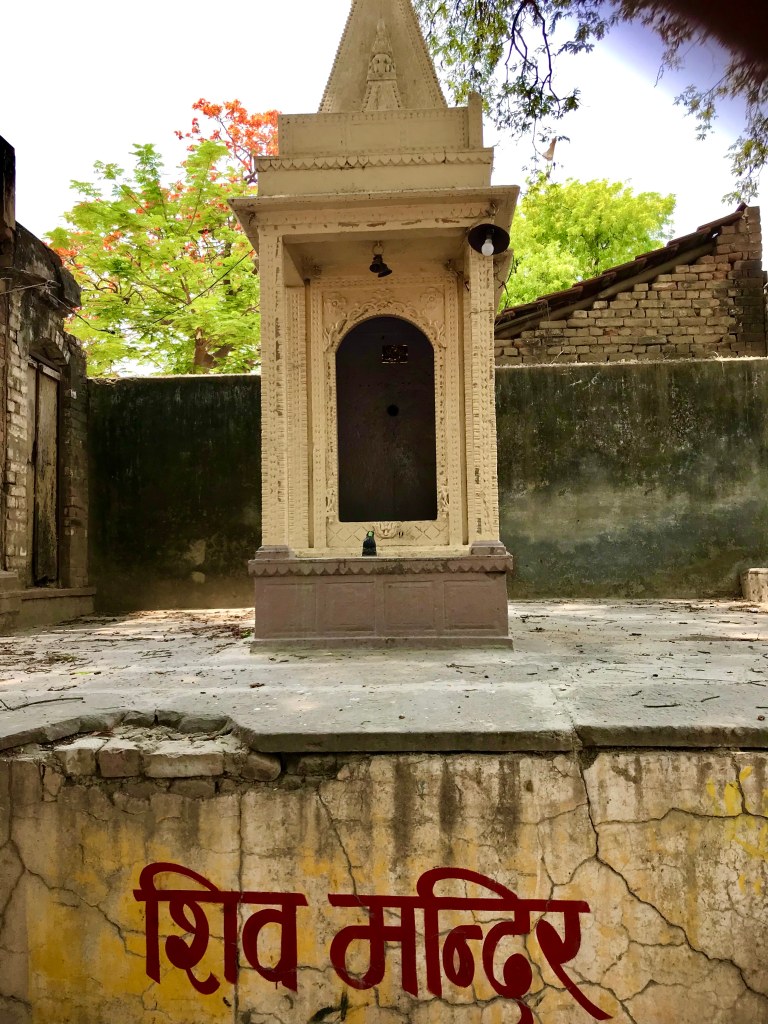
I saw a small Shiva temple on the side of the road. Made of sandstone, the temple looked beautiful and stood on a square stone platform. It is well-preserved and remains in good condition even today. However, the Dharamshala next to the temple is almost in ruins. The well attached to the temple has been closed and is no longer in use. Local shopkeepers informed me that a large part of the temple courtyard now belongs to a school situated next to it. Since the school was closed, I couldn’t see that part of the temple. The temple structure dates back to the 18th century.

Partially destroyed the entrance of Dharamshala.

(IV)

HANUMATAISHWAR MAHADEV

I drank water from this well, and it is undoubtedly clean and safe to drink.

(V)

SWARG BHUMI (paradise Land)

PRITHESWAR OR PRITHVISHESHWAR

HISTORY:-

This ancient well was rebuilt by Baijnath Ji of Banaras in 1753 AD. In 1851 AD, Gopinath Ji, Veni Ram Ji, and Kripa Ram Ji of Maharashtra renovated it again. The Gyani Fateh Ram Ji constructed the Shiva temple and Dharamshala located on the well. Later, other people completed the work of repairing this well and the building.

Structure:

This octagonal well is located in the middle of a two-story building. A temple is on the top floor of the building. However, the well is no longer in use.

Most of the ancient wells along this route have an octagonal shape.

Surprisingly, the local people, especially the younger generation, are unaware of the history of this ancient route. Hindu religious texts, Jataka tales, and Buddhist literature provide detailed descriptions of this path. Unfortunately, local history is not included in the school curriculum.

Path to Kashi: Hidden Treasures Beneath the Ancient Wells

The wells built along this route were certainly reconstructed in the 17th century, but their origins undoubtedly date back to much earlier times.

Wells have always held great significance in Hindu religious traditions, where providing water to a thirsty traveler is considered one of the highest acts of virtue.

This ancient route served as the gateway to Kashi, the holiest city for Hindus, drawing countless pilgrims and travelers over the centuries. The discovery of some of Varanasi’s oldest sites has only taken place in recent times, revealing the hidden layers of its rich history.