WORLD HISTORY, RELIGION, CIVILIZATION,CULTURAL ENQUIRY
Author: nitinsingh
Postgraduate in International relations. Experience in writing in various journals, from BBC WORLD NEWS SERVICE to India's one of the oldest hindi daily. I like to write on international relations, religion, religious conflict. Social media has bridged the distance between writing and reading. Now writing is not just the expression of one's own thought, but also knowing the expression of people on various subject.
We should all be concerned about the future because We will have to spend the rest of our life there.
*The digital revolution is far more significant than the invention of writing or even of printing. (Douglas Engel Bart)
*In this digital age, we have an opportunity to transform the lives of people in ways that were hard to imagine just a couple of decades ago. (Prime-minister Narendra Modi at Silicon Valley on 26th September 2015)
A GIRL WITH A SMARTPHONE AND THE NEW DIGITAL AGE.
How I Became a Witness to India’s Remarkable Journey of Progress
Ramnagar, a well-known place near Varanasi, is famous for being the home of India’s former Prime Minister, Lal Bahadur Shastri.
Whenever I pass through Ramnagar, I always stop at a tea shop, a habit I’ve kept for many years. The owner of this small shop is 74-year-old Ram Lal Ji.
Despite having very little formal schooling, he is cheerful, sociable, and well-versed in the history of Varanasi (also known as Banaras).
He once shared with me that he left school as a child because he wasn’t interested in it, but his love for reading novels helped him educate himself and gain knowledge.
Due to the Corona pandemic, I was unable to visit for several months. When I finally stopped a young boy was sitting at the tea shop.
He told me that Ram Lal Ji had rented out the tea shop and was now working at a nearby grocery store. I decided to walk to the grocery store to meet him. When I found Ram Lal Ji, he smiled and greeted me, though he looked a little weak. I commented, “You seem weak,” to which he quickly replied, “I am old, not weak.”
Ram Lal Ji shared with me that his only wish was for his granddaughter to receive a good education and become self-sufficient. I was already familiar with his family.
One of his two sons is alive and lives in Gujarat, while his other son passed away years ago. His deceased son’s wife and daughter now live with him.
When I asked about renting out his tea shop, he explained that the rent would provide some income and that working at the grocery store would bring in more.
He mentioned how the Corona lockdown had been tough, but it had brought a silver lining. “Corona has an advantage.” This statement made me curious about how the pandemic could have been beneficial.
He said, smiling, “A large part of my earnings had to be spent on coaching and tuition for my granddaughter, but that will no longer be the case.”
I asked him how that was possible. Ram Lal Ji explained that tuition and coaching were unavailable due to the Corona lockdown, but during this time, his granddaughter developed a habit of studying on her own. He explained that with easy access to online lectures by eminent scholars, she could learn about any subject conveniently.
Now that things were returning to normal, he said, there was no need for tuition or coaching anymore.
I understood his point clearly: he wanted to emphasize that mobile phones (especially smartphones) are incredibly useful tools, but more so for the younger generation.
I have seen firsthand how education is being democratized through mobile phones.
A used smartphone, which typically costs around Rs 4000, is now a tool that can change people’s lives. With this small investment, there’s no longer a need to travel to big cities to prepare for various competitive examinations.
This gap can now be bridged with just a little willpower and access to resources. The ability to learn from online courses, lectures, and educational platforms means that even students in remote areas can pursue their dreams and get the same opportunities as those in larger cities. It’s truly a game-changer for education in India.
Understanding the future of digitalization is hard and difficult for a common person like me to fully grasp. However, I can see signs of a change that could help remove societal inequality. It seems that digitalization can play a big role in making things fairer for everyone
Pakistan remain convinced that they can break India; that, if they cannot break India, they can bleed India to death ;if they cannot bleed India to death they can bleed India enough to hold India down to Pakistan’s level.
“Thus a thief can seize the chance to loot the property in the house when the doorkeeper and house guards are busily engaged in putting out the fire ……In war, a burning house symbolizes a nation that is suffering a major crises or is in decline. By attacking such a nation, one can get twice the result for half the effort…..”
“A burning house falls into commotion and tumult”.
[The Wiles of War]
“Those who do not remember the past are condemned to repeat it”
(Famous warning of Santayana)
Punjab (Bread basket of India)
For some days, the farmers of Punjab have been agitating about the policies of the government. (Kisan aandolan).FARMERS MOVEMENT This movement has no support across the country. Its support in Punjab (Bread basket of India) is also negligible. Farmers across the country are supporting the policies of the government. In true democracy, protest has its own importance, and the farmers of Punjab have every right to protest. My attention suddenly shifted to a pamphlet of the Bharatiya Kisan Sangh, one of the largest farmer organizations of the country. In this pamphlet, Bharat Bandh (strike) has been opposed by this organization on December eight and this organization said that the farmers’ movement has been high- jacked by pro-Khalistan and anti-national people. Social media are filled with anti-country slogans, inflammatory statements, and pro-Pakistan narrows. How can any farmer be a traitor? There was a lot of confusion about this movement in my mind as well.
“THE HIGHEST TRUTH IS ALWAYS THE SIMPLEST”
“ALWAYS THE GREATEST FRAUD BY THE SIMPLEST MEANS”
The technology of inflicting large-scale violence is becoming easier to obtain, and –per quotient of lethality – less and less expensive. In contrast to conventional weapons – field artillery, bombers, tanks-this technology costs little. Much of it can be acquired from open sources – including the internet. And the weapons can be produced in small , isolated shacks, even mobile vans.
Personal experience: – I am a blogger, and I keep writing on issues like History, Religion, and Current -Affairs. A few months ago a post was written about the renunciation of Sikh Gurus, and the sacrifice of Sikh Gurus in defence of Hinduism. As usual, I also shared my post on social media. Surprisingly a lot of Sikhs expressed anger at this post. The number of Sikhs expressing displeasure was the same as the Sikhs who agreed with the post. Some said that Hindus have done injustice to Sikhs. Some said that Hindu and Sikh are different religions. Some directly said that Sikhs should get their own country, like Muslims have already found Pakistan. When I started to research this type of post, I found that almost all such posts were from Punjab. Sikhs are found almost all over India. (, Sikhs elsewhere in the country wrote the opposite posts emphasizing Hindu Sikh unity) Something is cooking in Punjab. A little more attention and checking the profile revealed that almost all the people, who posted anti-Hindu, were associated with a pro-Khalistani group on the face book. Another post of mine was on the relation of Kartarpur( Guru Nanak Ji had spent 18 years of his life here. Its importance can be gauged from the fact that devotees consider themselves blessed by looking at Kartarpur with binoculars from Dera Nanak. (Kartarpur is currently in Pakistan) Guru Nanak Ji also died here on 22 September 1539). Pakistan considers the sentiments of Sikhs related to Kartarpur an excellent opportunity to teach a lesson to Sikhs. for more information on kartarpur and Pakistan challenges visit :- http://nithinks.com/2019/11/08/kartarpur-historical-importance-and-current-challenges/
General Singh is extremely biased against Pakistan. he spent his entire life in making plans against pakistan.we are providing the Sikhs a lot. of facilities in Pakistan. but we should not forget that the Sikhs are also our enemies. they massacred Muslims in 1947. they raped thousands of Muslim women. they destroyed thousands of mosques. East Pakistan disintegrated due to a Sikh General. General Singh is the worst enemy of the two-nation theory. we should never forget the atrocities committed by Sikhs against Muslims. instead of giving them facilities at Nankana Saheb,Panja Sahib, etc, we should give them tit-for-tat lessons for their cruelty”…
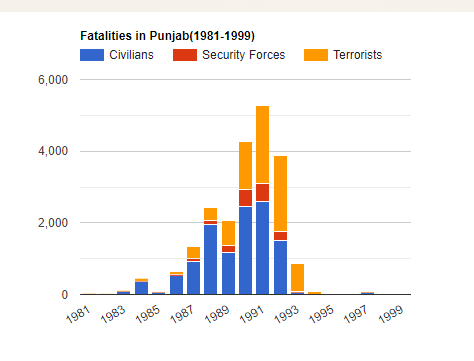
Many Sikhs opposed the Government of India and supported Pakistan. (Then the same story – Sikhs settled in another part of the country, and Sikhs of Punjab who were not members of any Khalistan related group stood by the decision of the government.) Is the second wave of Khalistan coming? Many creepy stories related to Khalistan movement which were read in books started to be remembered. In Punjab, about 15,000 people died due to the long-running Khalistani movement. The daily life of the entire Punjab was destroyed due to this movement which lasted for almost twenty five years.
South Asian Terrorism Portal:- The most authoritative and comprehensive source of information about terrorism in our region. www.satp.org
One of the finest qualities of Sikhs :– their attachment to machines. The means of transport are not only a means of employment for the Sikhs, they also reflect their attachment to the machines. In a large country like India, different modes of transport are required, Sikhs have an incredible contribution in this.
it was clear that the Khalistan movement is being tried once again.
I am from the Uttar Pradesh (U.P) and I have almost five thousand friends on Facebook page. Some are also Sikhs. Some Sikh friends in real life are not from Punjab, and are as much anti-Khalistani as I am. I am not very aware of the ground situation of Punjab but what I felt is that most of the people of Punjab are against the Khalistani movement but there are some people trying to rebuild this movement with the help of the Government of Pakistan and some Sikhs settled abroad .Communist, Marxists, traitors, Lutyens gangs, who specialize in making money from every problem, will not let this opportunity go in vain.
Pakistan;- was working to a clear, indeed to a singular aim –and that was to break india .
Pakistan is yet not able to think of an identity except as the” not India”, except as the country whose mission it is to dismember India. For more information please visit :–http://nithinks.com/2019/10/16/now-hind-will-become-pakistan-the-slogan-of-the-next-generation-of-the-islamic-terrorists/What Islamization has added is the conviction that the historical animus against India is sanctified by religious sanction –that as a matter of religion, Pakistan’s mission is to undo the error of the partition, that its mission is to wrest back the entire sub-continent for Islam. In spite of 1971, Kargil and the rest, those who exercise power over Pakistan remain convinced that they can break India; that, if they cannot break India, they can bleed India to death ;if they cannot bleed India to death they can bleed India enough to hold India down to Pakistan’s level.
The point is that all these operations were conceived and launched based on one assumption:”that the Indians are too cowardly and ill-organized to offer any effective military response which could pose a threat to Pakistan. Ayub khan genuinely believed that “as a rule, Hindu morale would not stand more than a couple of hard blows at the right time and place”
KPS GILL:-The Sikh police officer who ended the Khalistan movement from Punjab
KHALISTAN A PROJECT OF PAKISTAN
Khalistan is a geopolitical project of Pakistan, says a Canada based think tank
Khalistan is a geopolitical project nurtured by Pakistan, concludes a Canadian think tank – Macdonald-Laurier Institute in its report titled ‘Khalistan: A Project of Pakistan’, which has adverse implications for the national security of both Canada and India, observes The Times of India on September 11. The report highlights how the Khalistan movement – ‘Referendum 2020’ spearheaded by the banned secessionist group Sikhs for Justice (SFJ), owes its energy to Pakistan. The report authored by Canadian journalist Terry Milewski says: “It does not fit the Khalistani narrative that Pakistan’s treatment of its shrinking Sikh minority has brought demonstrations to the Pakistani High Commission in New Delhi. Rather, it makes it all the more bizarre that undying solidarity with Pakistan has become a kind of theme song for the American lawyer, Gurpatwant Singh Pannun, who leads Sikhs For Justice, the driving force in the campaign for a referendum on Sikh independence.”
Pannun, the report observes, has sided with China in its dispute with India and recently wrote to Pakistan PM Imran Khan, swearing that “if India ever attacked Pakistan, the pro-Khalistan Sikhs will extend full support to Pakistan”. The report marks, as a turning point, a 2018 event whenCanada’s national security report had to omit a reference to Sikh Khalistanis. The 2018 Public Report on the Terrorism Threat to Canada replaced “Sikh (Khalistani) extremist ideologies and movements” with the more generic “Extremists who support violent means to establish an independent state within India.”
South Asian Terrorism Portal:- The most authoritative and comprehensive source of information about terrorism in our region. www.satp.org
The Golden Temple, also known as Harmandir Sahib, meaning “abode of God”.
“We should all be concerned about the future because we will have to spend the rest of our life there “Charles.F.Kettering (American inventor & Businessman)
“Instead of the sound of the war drum, the sound of dharma will be heard.”
ॐ
ॐ सह नाववतु | सह नौ भुनक्तु | सह वीर्यं करवावहै | तेजस्विनावधीतमस्तु मा विद्विषावहै॥ ॐ शान्तिः शान्तिः शान्तिः॥
Om! May God protect us both together; may God nourish us both together; May we work conjointly with great energy, May our study be vigorous and effective; May we not mutually dispute (or may we not hate any). Om! Let there be peace in me! Let there be peace in my environment! Let there be peace in the forces that act on me!
Let there be peace in my environment! Let there be peace in the forces that act on me!
Om. May peace radiate in thesky and the vast ethereal space everywhere. May peace reign in water, herbs, trees, and creepers all over this earth. May peace flow over the whole universe. May peace be in the Whole Universe. And may peace always exist alone. Om peace, peace, and peace to us and all beings! (Translation by Swami Abhedananda, Ramakrishna Vedanta Math, India)
Even today, in many schools across India, children start their day with such prayers. Reciting these verses during auspicious Hindu ceremonies is also a tradition.
BUDDHA
You cannot travel the path until you have become the path itself.
This emphasizes that true spiritual progress comes from embodying the values and principles of the journey rather than just following it externally.
Oneis not called a noble who harms living beings; one is called noble by not harming living beings.
This underlines the principle of non-violence (Ahimsa), a cornerstone of ethical living, where true nobility lies in kindness and respect for all life forms.
As I am, so are these. As are these, so am I. Drawing the parallel to yourself, neither kill nor get others to kill.”
This verse teaches empathy and interconnectedness, urging us to see ourselves in others and to avoid harm, fostering a world of mutual respect and peace.
These timeless insights remain as relevant today as they were in the past, guiding us toward a life of harmony and moral integrity.
MAHAVIRA
Nagamalai Pudukottai Jain rock cut Mahavira relief near Madurai Tamil Nadu India
Everyone is my friend; I have no enemies.
All souls are equal and share the same nature and qualities.
Live and let others live; do not harm anyone, as all life is precious.
Do not kill or cause pain. Nonviolence is the highest virtue.
The contrast between the two events marked by the same date, 9/11, reveals a profound irony in the course of human history:
September 11, 1893:
This day marked a milestone in global harmony, as the Parliament of Religions in Chicago brought together spiritual leaders from various faiths. It was a shared effort to foster understanding, dialogue, and reconciliation between civilizations and religions.
Swami Vivekananda’s iconic speech at the event called for universal acceptance and mutual respect, emphasizing unity amidst diversity.
September 11, 2001:
Over a century later, the same date witnessed one of the most devastating events in modern history—the terrorist attacks on the United States. The attacks symbolized a tragic clash of ideologies and a stark failure to reconcile differences, leading to immense loss and global repercussions.
The irony lies not only in the shared date but also in the location—the United States, a nation that hosted both the call for peace in 1893 and the horrors of conflict in 2001.
This duality serves as a reminder of humanity’s potential for unity and division. It challenges us to revisit the ideals of mutual respect and understanding championed in 1893 and to strive for a world where such tragedies no longer occur.
These inspiring words are from Swami Vivekananda’s speech at the Parliament of Religions in Chicago on September 11, 1893.
The excerpt beautifully captures the essence of India’s spiritual and cultural ethos, reflecting its unique tolerance, acceptance, and inclusivity tradition. Here’s a breakdown of its significance:
Tolerance and Universal Acceptance
Swami Vivekananda highlights the core principle of Sanatana Dharma (Hinduism), which teaches tolerance and universal acceptance. This philosophy acknowledges the validity of all religions and their paths to the divine.
India as a Sanctuary for the Persecuted
He proudly recounts India’s history of offering refuge to persecuted communities, such as:
The Israelites found shelter in Southern India after the destruction of their holy temple by the Romans.
The Zoroastrians (Parsis), fled to India from Persia and have thrived here while preserving their ancient faith.
A Nation of Spiritual Wealth
By quoting a hymn familiar from childhood, Vivekananda connects his message to the lived spirituality of millions, emphasizing the universality of Indian religious traditions.
This speech was a landmark moment in world history, showcasing India’s message of peace, unity, and respect for diversity. It remains a timeless reminder of the values needed for coexistence in a pluralistic world.
Hindu Philosophy and World Peace
Hindu philosophy, rooted in the ancient wisdom of the Vedas, Upanishads, and Bhagavad Gita, offers profound insights into fostering world peace.
Its teachings emphasize universal harmony, nonviolence, and interconnectedness, providing timeless principles for resolving global conflicts and achieving a peaceful coexistence.
1. Ahimsa (Nonviolence): The Core Principle
The principle of Ahimsa teaches that all living beings are interconnected and deserve respect and compassion. By avoiding harm in thought, word, or deed, individuals can contribute to a peaceful society.
Inspired by Hindu teachings, Gandhi’s philosophy of nonviolence became a powerful tool for social and political change, influencing global movements for peace.
2. Vasudhaiva Kutumbakam (The World Is One Family)
This concept from the Mahopanishad encapsulates the idea of universal brotherhood. It teaches that humanity transcends boundaries, urging nations and individuals to work together for mutual welfare and peace.
3. Dharma: Ethical Living
Hindu philosophy emphasizes Dharma, or righteous living, as a path to harmony. Following one’s moral duty while respecting others’ rights ensures balance and avoids conflicts in personal and societal relationships.
4. Interconnectedness and Unity in Diversity
The Upanishadic teaching, Tat Tvam Asi (“You are that”), highlights the fundamental unity of all existence. Recognizing this interconnectedness dissolves divisions based on race, religion, or nationality, paving the way for global peace.
5. Tolerance and Acceptance
Hinduism preaches not just tolerance but universal acceptance. The Rig Veda proclaims:
“Ekam Sat Vipra Bahudha Vadanti” – “Truth is one, the wise call it by many names.”
This principle encourages respect for all religions and beliefs, fostering an environment of harmony and coexistence.
6. Meditation and Inner Peace
Hindu practices like yoga and meditation promote inner tranquility, essential for outer peace. A calm and centered individual contributes positively to their community and helps reduce conflicts.
7. Resolution of Conflict through Dialogue
Hindu epics like the Mahabharata demonstrate the importance of dialogue and negotiation. Lord Krishna’s attempts to mediate peace between the Pandavas and Kauravas highlight the value of addressing disputes through understanding and compromise.
Hindu Philosophy’s Global Relevance
Hindu philosophy serves as a beacon of hope for global peace in a world marked by strife and division. Its teachings urge humanity to rise above material pursuits and embrace spiritual values that promote unity, compassion, and harmony.
By adopting these principles, individuals and nations can work together to create a world where peace and understanding prevail.
“The city illumines the truth and reveals reality. It does not bring new wonders into the scope of vision, but enables one to see what is already there. Where this eternal light intersects the earth, it is known as Kashi”(Varanasi).
Paris and Varanasi: A Tale of Two Cities That Illuminate the World in Different Ways
In the Western world, Paris is known as the “City of Light.” This name comes from its important role during the Age of Enlightenment when it became a center for ideas, art, and science.
In the 19th century, Paris was also the first city to use gas street lamps, making it even more famous for its bright streets at night.
Artist: William Simpson (1823-1899) Title : Indian woman floating lamps on the Ganges
On the other hand, in the Eastern world, Varanasi is also called the “City of Light,” but for different reasons.
Varanasi, one of the oldest cities in the world, is a major religious center for Hindus. The city is known for its spiritual practices along the Ganges River, where lamplighting during rituals symbolizes the light of knowledge and the path to spiritual freedom.
So, while Paris and Varanasi are called the “City of Light,” the meaning behind the name differs in each place. Paris represents the light of knowledge and progress, while Varanasi represents spiritual light and enlightenment.
Dev Diwali: Festival of Lights in the City of Lights
The Meaning of Dev Diwali
The word Dev-Deepawali is derived from two terms: Dev, meaning the Hindu Gods and Goddesses, and Diwali, the festival of lights celebrated by Hindus. Diwali, the vibrant festival where homes are adorned with diyas (small oil lamps), marks the triumph of light over darkness.
The Divine Reasons for Dev Diwali
(I)
Kartik Purnima: The Festival of Lights and Divine Victory
Kartik Purnima, the full moon night, is a special day in Hindu tradition, as it is believed that Lord Shiva defeated the demon Tripurasura. Due to this event, Kartik Purnima is also known as Tripuri Purnima.
One of the most significant celebrations of Kartik Purnima is Dev Deepawali, a grand festival held in Varanasi.
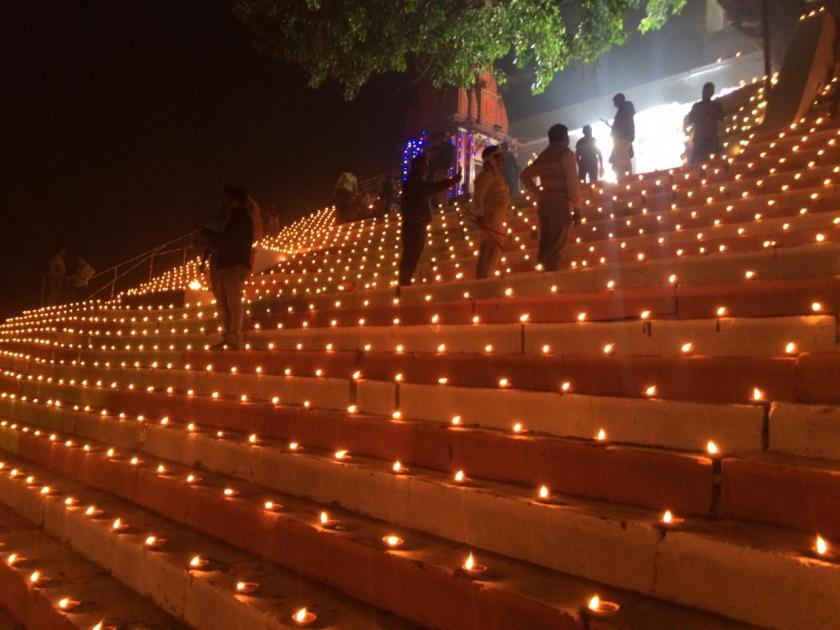
This festival takes place fifteen days after Diwali, on the full moon night of the Hindu month of Kartika. During Dev Deepawali, thousands of lamps are lit along the banks of the Ganges River. The atmosphere is filled with devotion and beauty as the Aarti is performed on the river, creating a breathtaking scene of light and spirituality.
(II)
On Dev Diwali, the ghats along the riverbanks are beautifully lit up with thousands of earthen lamps. The sacred Hindu symbols, such as Om and Swastika, are also decorated with lamps, adding to the spiritual glow of the celebration. The entire scene creates a stunning atmosphere of light, reverence, and devotion.
Dev-Deepawali: A Festival of Light and Divine Presence
In North India, Dev-Deepawali is a special day when it is believed that the Gods descend from the heavens to bathe in the holy Ganges River.
To welcome the divine presence, people light diya lamps—small, cup-shaped oil lamps made of baked clay—at temples. Traditionally, devotees also place these lamps along the banks of the Ganges after taking a sacred dip in its waters on this auspicious day.
Ancient Hindu Festivals Shine Globally: How Diwali Became a Worldwide Phenomenon
As the world became more interconnected, the charm and beauty of Dev-Deepawali began to capture global attention. Through the power of media and globalization, this sacred festival, with its radiant display of lights and reverence for the divine, spread beyond India’s borders, attracting people from all corners of the world. The glow of countless diyas on the riverbanks now symbolizes not only a deep spiritual tradition but also a celebration of unity, light, and devotion shared by many cultures worldwide.
In Varanasi, the holiest city for Hindus, the Ganga River flows for many kilometers along the city’s banks. The places where the land meets the river are called Ghats, and they are decorated with lamps. The sight is breathtaking. When millions of earthen lamps are lit together, their flickering light brightens up the entire area. It’s a scene that seems unique and unlike any other place.
From Preparation to Illumination: The Journey of Diyas on Dev Diwali
On Dev Diwali, priests create beautiful geometric shapes along the banks of the Ganges using earthen lamps and flowers. The preparation for this grand display is a full day’s marathon of work.
First, the earthen lamps are cleaned by dipping them in the holy water of the Ganges, and then they are carefully dried in the sun. Once dry, a cotton wick is placed in each lamp, and the diya is filled with mustard oil, ready to light up the sacred banks of the Ganges in a mesmerizing glow.
The Ganga Banks Sparkle with Diyas on Dev Diwali
In recent years, many ghats have started using artificial lights, laser shows, and big fireworks, but I don’t like it.
What stays with me is the sight of rows of earthen diyas, their flames flickering in the wind, and their reflections on the Ganga water. The priests reciting Hindu prayers, people bathing in the holy water, and others floating flowers and diyas in the Ganga create a unique atmosphere. Women sitting on boats performing Ganga Aarti adds to the beauty of it all. This moment is unforgettable.
Anyone, no matter where they live or what religion they follow, should experience this moment at least once in their life.
“Undoubtedly it would have been better if Nehru had been asked to be the foreign minister and Sardar Patel had made the prime minister. Had Sardar Live Longer, had he occupied the position which he rightly deserved perhaps there would have been no problems of Kashmir, Tibet, China and Religious Conflicts.”(C.Rajagopalachari)
Nehru’s nationalism was only imperialism of Red terrorist (communist killers).
An imperialist way of looking.–A man who hated nationalists. Nehru’s views on Rani Jhansi: –
RANI JHANSI (LAXMIBAI)
THE TWO MEET(NEHRU, CHOU EN LAI) FOR THE FINAL SESSION ON THE 27TH .”DID YOUR EXCELLENCY SEE THE DRAFT STATEMENT ?”PANDIT JI(NEHRU) BEGINS.”YES I SAW A FEW MINUTES BEFORE I WENT TO SEE THE PICTURE “.CHOU SAYS HE HAS BEEN TAKEN TO SEE SOHRAB MODIS JHANSI KI RANI .” IT IS A GOOD PICTURE .IT IS A TECHNICOLOUR “. PANDIT JI NOW THE FILM CRITIC: “THE STORY IS NOT SO GOOD”.HE PRONOUNCES.CHOU EN LAI IS POLITE: “IT IS QUITE GOOD AND REPRESENTS RESISTANCE AGAINST FOREIGNERS.”PANDIT JI IS NOW ALLOW DILUTION OF PROGRESSIVE TOUCHSTONES: “IT WAS A RESISTANCE BY THE FEUDAL ELEMENTS AGAINST FOREIGNERS.””YES,” SAYS CHOU. MORE GENOURLSY, “RESISTANCE ALWAYS START FROM THE UPPER CLASS.”
For Nehru, Lenin, the greatest assassin in human history, was no less than a messiah.
Nehru hated revolutionaries fighting for the freedom of the country.
Pandit Nehru believed that Indian revolutionaries were fascists.(BANDI JEEVAN)
Sachindra Nath Sanyal was the founder of “Hindustan Republican Association” and political teacher(guru) of great revolutionarieslike Chandrashekhar Azad, Bhagat Singh, Trilokya Chakraborty, Bhagwati Charan Vohra, Nalini Kishore Guh, Baba Prithvi Singh, Ras Bihari Bose, Sukhdev, Rajguru, Lala Hardayal, Ajit Singh. The book “Bandi – Jeevan” you wrote was called the Bible of Indian revolutionaries, which was translated into more than twenty-eight languages and countless people who read this book chose the path of revolution for the independence of the country.
SUBHASH CHANDRA BOSE LALA HAR DAYALCHANDRA SHEKHAR AZAD BHAGAT SINGH
He used to sing the emperor Ashoka’s nobility because imperialist, historians linked Ashoka’s greatness to Buddhism. A man who had no hesitation in seeking cooperation from the murderous communist governments to bypass nationalist popular leaders Subhash Chandra Bose, Sardar Patel. a Nehru who believed in Lenin’s killer government more than Gandhi’s “Ram Rajya“. A man who used to hum the songs of democracy in books could have strangled democracy for his selfishness.
———– “Some old inscriptions from south India tell us how the members of the panchayats were elected, their qualifications and disqualifications. If any member did not render accounts of public funds he was disqualified. Another very interesting rule seems to have been that near relative of members were disqualified from office. How excellent if this could be enforced now in all our councils and assemblies and municipalities.” (Glimpses of world history: Jawaharlal Nehru).
It’s easier to preach than act. This “Divine Knowledge does not apply to the family, it was for others. According to the needs of the family, Mahatma Gandhi, Subhash Chandra Bose, Vivekananda, Arvind Ghosh, Sardar Patel, Lal Bahadur Shastri, never been great, and sometimes a terrorist.
A man who accepted Communist imperialism even before India’s independence.“The victorious family in the game of power was writing a new history of the country”
“Who controls the past controls the future who controls The present controls the past”(George Orwell)
courtesy wikipedia :- Marxist propaganda “INTERNATIONALISM” & ‘WORLD REVOLUTION ARE NOTHING BUT OLD FASHIONED IMPERIALISM’
Nehru supporter of communist, imperialist ideology.
The Communist Party of India was formed in the Soviet Union in 1925. The communists did not influence India’s politics till then. Nehru was a supporter of the leftist group in the Congress. Marxist imperialists (red terrorists) were thinking of expanding their empire since 1917.
Lenin hailed not only the triumph of the Russian revolution but the beginning of world revolution our cause is international, and so long as a revolution does not take the place in all countries our victory is half a victory or perhaps less., for most Bolsheviks by the time Lenin died seven years later, he never lost his conviction that the inevitable collapse of the colonial empires would one day bring global revolution in its wake
The third communist international founded in Moscow in March 1919, set itself “the goal of fighting, by every means, even by force of arms, for the overthrow of the international bourgeoisie and the creation of an international Soviet republic”.
At the congress of the people of the East, convened at Baku in 1920 to promote colonial revolution,delegates excitedly waved swords, daggers and revolvers, in the air when Zinoviev called on them to wage a jihad against imperialism and capitalism. ( Even today these methods are prevalent among terrorists)Nehru also went to the Brussels Conference of Communists in 1927, after which he also travelled to the Soviet Union with Motilal.
Nehru wrote following about that period“We began a new phase in our struggle for freedom in India at about the same time as the October Revolution led by the Great [Lenin]. We admired Lenin whose example influenced us greatly.”
IF RUSSIANS AIDS THE CHINESE REVOLUTION, DOES THAT MEAN THAT SHE WANTS CHINA TO APPLY COMMUNISM? NO, SHE WANTS US TO CARRY OUT THE NATIONAL REVOLUTION” (CHIANG KAI –SHEK DECLARED IN PUBLIC)PRIVATELY, HE BELIEVED THE OPPOSITE, CONVINCED THAT WHAT THE RUSSIANS CALLS—-
“INTERNATIONALISM” & ‘WORLD REVOLUTION ARE NOTHING BUT OLD FASHIONED IMPERIALISM’
.In 1921-22, there was a terrible famine in the Soviet Union, millions of people died. The assassin communist government of the Soviet Union was engaged in the black marketing of grain instead of helping the people. How terrible was the situation This can be gauged from the fact that famine victims were eating the flesh of the “dead from famine” to live? Due to non-availability of food grains to farmers, the meat of dead people was being sold in villages. In such a situation, Nehru saw the standard of living of farmers and labourers improving.
THE ANGEL OF SORROW
“Undoubtedly it would have been better if Nehru had been asked to be the foreign minister and Sardar Patel had made the prime minister. Had Sardar Live Longer, had he occupied the position which he rightly deserved perhaps there would have been no problems of Kashmir, Tibet, China and Religious Conflicts.”(C.Rajagopalachari)
India was severely defeated in the Indo-China war of 1962. The Soviet communists wanted to avoid this conflict at any cost because it seemed to be harming the Soviet Union. [BUT]Nehru’s Soviet love did not work, the Soviet Union remained neutral.
Nehru has to lift the morale of a shattered people.In his letter of 22 December 1962, to the chief ministers, Nehru tries to put a brave construction on the humiliating defeat.” The sudden and callous invasion of India by the Chinese returning evil for good, benefit our country.” he writes in words that ring hollow,” more and more I have felt so, and therefore I have no feeling of depression; rather I have been feeling a sense of joy and satisfaction that we have to face this crisis as a united people and with a good heart. I feel confident that we shall emerge out of it. stronger in every way and chastened by what we have experienced and will experience.”[it is curious that acting in self- defence they have occupied another 20,000square mile of Indian teritory]
The well known Minute:– Macaulay,s Minute of 1835 “we must at present do our best to form a class who may be interpreters between us and the millions whom we govern, a class of persons, Indians in blood and colour, but English in taste, in opinions, in morals and intellect.”
Can Macaulay and Nehru be differentiated in thinking? I have sold my kingdom to my beloved queen for a cup of wine and a dish of soup.“Jahangir Mughal emperor in his biography”Tuzuk-i-Jahangir”Nehru did something similar.
Family’s relationship with Soviet Communists;-
YURI BEZMENOV (Russian spy, K.G.B. Agent) who worked as a journalist in R.I.A. NOVOSTI (Russia’s international newsagency) In India, his main work was to give some money and free Russian travel to lure the traitors. And for his work very easily, he got ready a gang of left-wing journalists, writers, artists, rich filmmakers, university teachers, intellectuals (Intellectuals mean to be traitor, or leftist) Many interviews of Yuri Bezmenov are available on YOUTUBE. While living in India, he has explained his and K.G.B’s working system and modalities of some traitors. The people selling their country had no respect in K.G.B. Yuri Bezmenov used the term “useful idiots“ and “political prostitution” for them. The collapse of the Soviet Union and the dissolution of the Marxist ideology was becoming harder to hide the truth. Marxists had been wiped out in the Soviet Union (Russia) and their black history was in front of everyone. During this time, Western countries got some very important documents and information through “Vasili Mitrokhin”.
There was information about the traitors working for Russia around the world. Over the years, its truth was investigated (from 1992 to 1999) And finally, it was found to be extremely useful. These documents were shocking. These documents were later published in the form of books titled Mitrokhin archive. Mitrokhin also questioned the Prime Minister of India, Smt. Indira Gandhi, about the money transactions and (K.G.B.) role. The collusion of the family and the betrayers (“useful idiots, “political prostitute” Congress, communist, leftists journalists, bureaucrats, writers, artists, leftists media organizations) had come in front of everyone. How these gangs were bent on selling India in foreign hands, (U.S.S.R, U.K U.S.A—&—&—&). it was going to open the eyes. In 1994 a world-renowned journalist and “Thesis writer on K.G.B YEVGENIA ALBATS”(Wrote Her thesis as a book: THE STATE WITHIN A STATE: THE K.G.B AND ITS HOLD ON RUSSIA-PAST, PRESENT AND FUTURE)Referring to the files of KGB in this book, it was told that: a letter signed by Viktor chebrikov who replaced Andropov as head of the k.g.b in 1982 noted:
IMAGE :-WIKIPEDIA
KGB AND R[???] GANDHI the u.s.s.r k.g.b maintains contact with the son of premie- minister[rajiv-gandhi]R. Gandhi expresses deep gratitude for benefits accruing to the prime minister’s family from the commercial dealings of an Indian firm he controls in corporations with soviet foreign trade organizations. R.Gandhi reports confidentially that a substantial portion of the funds obtained through this channel is used to support the party of. R.Gandhi. (K.G.B archive,f.5,OP.6, por.no.12,d.i3i,t.i,1,d. 103-104 ).
“One does not establish a dictatorship in order to safeguard a revolution; one makes the revolution in order to establish the dictatorship.“(George Orwell)
(courtesy :-WIKIPEDIA)- 14TH NOVEMBER ,To celebrate Nehru’s birthday as Children’s Day was to create an image of Nehru as a Santa Claus in the minds of the coming generations.
Madarsa -E-Nehru —-Universities, schools were converted to the Little (Pocket) the Soviet Union so that the family remained in power. Gangs of communist murderers started writing new political history, India’s foreign policy turned into an imperialist policy of the Soviet Union. This led to terrible consequences later. suffered a lot in dealing with Mao’s imperialism, (China) and Pakistan’s Islamic imperialism. Many communists and Marxists of India became Maoists by getting money and cooperation from China. The country, which had forgotten its interest, was now a slave of China’s foreign policy. Seeing this great opportunity, Pakistan too jumped into it. The dream of India’s ruin was now seen in India itself. Instead of strictly dealing with it, only rituals were performed.
The path shown by Lenin –building up the people,s armed forces and the republic, Lenin had said in 1905 that these two tasks must be carried out wherever possible, even if these were not feasible regarding the whole of Russia. chairman mao has enriched this path shown by Lenin. he has taught the tactics of people,s war and china have attained libration along the path. today that path is being followed in Vietnam, Thailand, Malaya, Philippines, Burma, Indonesia, Yemen, Leopoldville, Congo, in different countries of Africa and Latin America. that path has also been adopted in India, the path of building the peoples armed forces and the rule of the libration front which is being followed in naga, Mizo, and Kashmir areas.
The slogan —-” Kashmir is an inalienable part of India”
“No Marxist can support this slogan.
The Marxists should express their support in favour of the fighters.
carry on the struggle against modern revisionism.”
“So it is in the interest of the reactionary bourgeoisie of India that India has attacked Pakistan. u.s imperialist plan of the world war is also operating behind this war. By attacking Pakistan, the ruling class again wants to create a tide of bourgeoisie nationalism. But this time it is clear like daylight that India alone is the aggressor. So, as a result of the defeat of the Indian army, The anti-government struggle will fast crystallize among the masses. So Marxists want today that the aggressive Indian army should be defeated. this defeat will create new mass agitations. Not merely wishing that they should be defeated,. Marxists at the same time should make efforts so that defeat becomes imminent. In every province of India agitations should be created on the lines the mass agitations in Kashmir is progressing”.
courtesy:- wikipedia
The fundamental idea
There is, however, one general principle that must guide our explorations, perspectives, plans and projections: The primary and most effective strategy to avoid war is to prepare for it. It is one of the ironies of the human condition that, if you love peace, you must be ready and willing to fight for it. The weak, the vulnerable, the unprepared and the irresolute will always tempt the world and call misfortune and ruin upon themselves. This is tragic; but it is the inexorable lesson of history. It is strength that secures respect and dignity; conciliation, appeasement, and a desperation to avoid confrontation at all costs – these will only bring contempt and aggression in their dower.
(KPSGill) [South Asia terrorism portal institute for conflict management.]
“ that the Indians are too cowardly and ill-organized to offer any effective military response which could pose a threat to Pakistan. Ayub khan genuinely believed that “as a rule, Hindu morale would not stand more than a couple of hard blows at the right time and place”
This misconception that has been maintained by Pakistan for years has been broken by the political will of the new India in recent times. Uri: the surgical strike Famous film dialogue “This is the new India, which kills the enemy by entering into his house.” (YE NAYA BHARAT HAI JO GHAR MEY GHUSE GA BHI, AUR MARE GA BHI) Pakistan has come on its back foot this jaw-breaking answer. Surgical strikes, attacks on terrorist camps, zero tolerance on terrorism, the abolition of Article 370 shows the political will of New India.
Ladakh-based innovator and educationist, Sonam Wangchuk, started a movement to boycott Chinese products in India.
the India-China dispute that has taken place in recent times is in the news. This time, China face[New] India, who don,t believe in Nehru’s old orthodox views. This was the new India who refused to give even an inch of land to China (this is the same area that Nehru said in a careless manner after losing:-Not a blade of grass grows there we didnt even know where it was?) The political will of the Indian government, and the might of the army, not only broke the morale of the Chinese military, but also put China’s imperial intentions to dust. Is this possible by following Nehru’s ideas? Those who can not remember the past are condemned to repeat it. Now the time has come to eliminate Nehru’s imperialism. Nehru’s thoughts have been hollowing out of the country like a termite for years. Nehru’s conservative thoughts are a major obstacle in the development of the country.
Gandhi’s ideas have to be freed from the Gandhian mafia only then Gandhi’s ideas will remain meaningful.
Mahatma Gandhi is widely known as the Father of the Nation in India. His leadership, commitment to non-violence and dedication to India’s independence struggle have left a lasting legacy.
His principles of truth, non-violence, and social justice continue to inspire not only Indians but people around the world.
Even after using the internet for about 14-15 years, I used to stay away from social media platforms like Facebook, Twitter, and WhatsApp. But two years ago, I created an account on social media due to pressure from my friends.
Last year, on Gandhi Jayanti, I was shocked to see that social media was filled with vulgar jokes about Gandhi Ji. It made me think a lot and left me amazed at the disrespect.
MAHATMA GANDHI
The complex relationship between Mahatma Gandhi’s ideas and the current sentiment among the younger generation in India can be seen through various lenses.
Firstly, it’s important to recognize that Gandhi’s values—non-violence, restraint, brotherhood, and his vision of Ram Rajya—were deeply rooted in his quest for social harmony and political independence.
These principles have stood the test of time and continue to resonate with many. However, as the world and India itself have evolved, there has been a shift in the way these ideals are perceived by different generations.
For the younger generation, there are several reasons why Gandhi's popularity might be challenged, despite his monumental contributions to India's independence:
Changing Nationalism: The rise of more assertive nationalism in recent times, marked by a desire for a stronger, more self-reliant India, has led to a shift away from Gandhi’s ideas of passive resistance.
Many of today’s youth view assertive action, military strength, and national pride as more important than the philosophy of non-violence.
This shift, particularly in the context of India’s growing global influence, contrasts with Gandhi’s emphasis on peace and restraint.
Disillusionment with Politics: The association of Gandhi’s legacy with the political establishment, particularly the Nehru-Gandhi family, has led some younger Indians to question the relevance of his ideas in today’s context.
The perception that Gandhi’s legacy has been used or distorted by politicians for their gain has also affected his image, leading to feelings of disillusionment among those who feel disconnected from his philosophy.
Perception of Weakness: Some critics argue that Gandhi’s stance on non-violence made India vulnerable in certain historical moments, and this perception is often magnified in the present scenario where youth, facing contemporary challenges, might desire stronger, more direct solutions. Nationalism today often ties itself with pride in military strength and assertive diplomacy, contrasting sharply with Gandhi’s non-confrontational methods.
Economic and Technological Shifts: The focus on economic development, technological growth, and global competitiveness in India’s current narrative can sometimes overshadow Gandhi’s ideas about simple living, self-reliance, and rural empowerment.
The Appeal of Strong Leadership: The growing preference for strong leadership and decisive action in India contrasts with Gandhi’s emphasis on dialogue, gradual change, and non-violence.
As the country faces new challenges, some may feel that Gandhi’s methods of struggle no longer align with the political or social realities of the 21st century.
The younger generation may be more inclined towards rapid modernization, and the slow, deliberate pace of Gandhi’s ideas might seem out of touch with these aspirations.
The growing anger towards the Gandhi family and the Congress party in India has, unfortunately, been linked to Mahatma Gandhi's legacy.
Many people believe that the present Gandhi family, which claims to have inherited Mahatma Gandhi’s political legacy, is responsible for much of the country’s current struggles. They argue that this family was imposed on India due to Mahatma Gandhi’s influence, but rather than following his principles of simplicity, non-violence, and service to the nation, the family’s political actions have often seemed disconnected from those ideals.
This perception has fueled resentment, with a significant section of the population holding the Gandhi family accountable for the country’s political and social turmoil, which has indirectly contributed to the diminishing respect for Mahatma Gandhi’s legacy.
It is evident that in India, especially among the youth, there is no inherent resentment towards Gandhi and his ideals. However, the politicians who have built their petty political careers under the guise of Gandhi’s name have tarnished his legacy through their actions.
The principles of truth, non-violence, and service to the nation that Gandhi stood for have been compromised by those seeking personal gain, leading to a distorted view of his legacy. The disillusionment is not with Gandhi himself but with those who have misused his name for their agendas.
Varanasi, the holiest city for Hindus, was referred to as Banaras during the British era.
The Banaras Revolt: The People Stand Against British Tyranny.
*In the tug-of-war between the East India Company and the King of Banaras, the people of Banaras stood resolutely by their ruler, transforming the conflict into a significant revolt against the Company.
*The Banaras Revolt resulted in heavy casualties for the East India Company’s army, with a significant number of soldiers killed and many others injured.
*The Banaras Revolt of 1781 tells the story of the East India Company’s relentless looting in India and its excessive exploitation of Indian kings. It also highlights the timidity and submissiveness of an inactive ruler.
*Though the rebellion seemed unsuccessful, it planted the seeds for the First War of Independence in 1857. Moreover, its influence can be traced tothe revolutionary movements that followed in India’s struggle for freedom.
Background of the Rebellion: Tensions Between Hastings and Chet Singh:
BHARATKALA BHAVAN (B.H.U) VARANASI.
CHET SINGH : (MAHARAJA OF BENARES)A Pawn in the East India Company’s Game :
Chet Singh came to power in Varanasi with the support of the East India Company, replacing the hereditary king.
Chet Singh, the ruler of Benares, was burdened with increasing demands from the British East India Company, including a substantial contribution of money and troops during the ongoing war against the Marathas and Mysore.
When he failed to meet these demands, Hastings imposed heavy penalties and even sought to depose him.
WARREN HASTINGS :
Warren Hastings, the first Governor-General of Bengal, faced significant resistance during his tenure. One of the most notable events was the rebellion led by Chet Singh, the Raja of Benares (modern-day Varanasi), in 1781.
Warren Hastings Departure from Kolkata:
On July 7, 1781, Warren Hastings left Kolkata with his retinue and troops. The journey was fraught with logistical challenges, reflecting the turbulent political climate and the pressing nature of the mission.
Stops En Route:
Hastings made stops at Bhagalpur and Buxar, key locations under British control. These stops likely served as strategic points for planning and reinforcing his position before arriving in Banaras.
Warren Hastings’s Arrival in Varanasi
On August 15, 1781, Warren Hastings reached Varanasi. Serious complaints and allegations against Maharaja Chet Singh prompted his visit.
Purpose of the Visit
Hastings came to investigate allegations that Chet Singh had failed to meet the British East India Company’s financial and military support demands.
These demands were weighty due to the ongoing wars against the Marathas and Mysore. Chet Singh’s inability or unwillingness to comply was perceived as defiance, prompting Hastings to take direct action.
Chet Singh vs Warren Hastings: A Clash of Power, Pride, and Politics in Banaras
To Grasp the Chet Singh-Warren Hastings Conflict, We Must Rewind a Few Years
The Struggle of Raja Chet Singh and the Rise of the East India Company’s Power.
In 1775, following the death of Nawab Shuja-ud-Daula,Nawab Asaf-ud-Daula ascended the throne, and the political landscape in India shifted dramatically.
This shift began an era where the East India Company’s influence in regional politics grew stronger.
One significant event during this time was the rise of Raja Chet Singh of Banaras, whose reign would soon come under the heavy hand of the East India Company.
The Treaty Between the Nawab and the East India Company.
Raja Chet Singh’s ascension to the throne of Banaras was not simple. His position as ruler was secured only through the mercy of the East India Company, which had considerable sway in the region.
The Company charged an exorbitant “appointment tax” to make Chet Singh the ruler, a demand that set the stage for years of financial burden on the Maharaja. This initial tax, although steep, was only the beginning of what would become a pattern of excessive financial demands.
The Growing Demands of the East India Company
With the East India Company’s growing control, the demands placed upon Chet Singh became more severe.
Soon after securing his rule, the Company imposed an additional demand of five lakh rupees on the Maharaja. This money was supposedly required to help the Company fund its military campaigns against the Marathas in the Deccan and Tipu Sultan in the south.
For three years, Raja Chet Singh managed to meet these demands, though his resources were stretched thin. However, as the Company’s demands continued to escalate, it became clear that the burden would be unsustainable. When the Maharaja finally refused to comply with the Company’s increasing tax demands, tensions escalated quickly.
The Breaking Point: The 50 Lakh Rupees and Two Thousand Horsemen
The East India Company, led by Warren Hastings at the time, did not take kindly to Chet Singh’s defiance. In retaliation for his refusal to pay, the Company imposed an even more severe penalty: a demand for 50 lakh rupees and an additional contribution of two thousand horsemen for the Company’s military campaigns.
In 1781, Warren Hastings personally visited Banaras to enforce this new levy.
His presence signified the Company’s intent to tighten its control over the region, and the demands placed upon Chet Singh marked a significant turning point in Banaras’s history and indeed, the growing dominance of the East India Company.
The Road Ahead for Chet Singh
The mounting demands of the East India Company on Raja Chet Singh highlighted the increasing pressure faced by regional rulers in India under the influence of foreign powers.
As tensions continued to rise between the Maharaja and the Company, Banaras became one of the many battlegrounds for control in colonial India. The fate of Chet Singh, caught between his obligations to the Company and his loyalty to his people, would unfold in the years to come, ultimately contributing to the larger story of resistance against colonial rule.
MADHODAS BAG OR MADHODAS GARDEN HOUSE
Image:Dinesh Seth
When Warren Hastings arrived in Varanasi on August 15, 1781, he stayed in a prominent garden known as Madhodas Garden.
The inscription on the wall of Radhaswami Bagh is now hidden among the nearby shops. This stone slab was placed to mark Warren Hastings’ arrival in Varanasi on 15th August 1781. It commemorates his stay at this location. (Image: Dinesh Seth)
Current Name:
Over time, the garden became known as Radhaswami Bagh or Swami Bagh, reflecting its association with the Radhaswami religious community in later years.
After arriving in Banaras, Warren Hastings set up camp at Madho Das Bagh. It was there that opponents of Maharaja Chet Singh seized the opportunity to turn Hastings against the king.
Some of the king’s close associates were among them, including Rani Gulab Kunwar,Ausan Singh, and Aliuddin Kubra, who had been waiting for the right moment to air their grievances. They accused Chet Singh of disloyalty, claiming that he had forgotten the East India Company’s support and was unwilling to pay the required taxes.
~Chet Singh sought an audience with Hastings to explain his position, but his request for a meeting was denied.~
Chet Singh Fort and Ghat: A Legacy of Varanasi’s History
Credit UNSPLASH
Chet Singh Fort:
This fort, built on the banks of the Ganga in the Shivala area of Varanasi, was owned by the Maharaja of Banaras and was originally called Shivala Fort. It later became known as Chet Singh Fort, after Maharaja Chet Singh.
Ghat: A stretch of land along the river.
Chet Singh Ghat: This fort is located here, and the place is also called Chet Singh Ghat, after Maharaja Chet Singh.
(SHIVALA BHAVAN, WILLIAM DANIELL R A,(1769-1837)
(SHIVALA BHAVAN, WILLIAM DANIELL R A,(1769-1837)
A Meeting That Changed Everything
Raja Chet Singh left his Ramnagar fort and arrived at Shivala Bhawan for a meeting with Warren Hastings, the Company’s Governor-General. The purpose of the meeting was far from cordial; Hastings intended to demand compliance with the Company’s escalating demands.
Resident Markham visited Chet Singh at Shivala Bhawan the next morning with an alarming message. Hastings had ordered that the Maharaja be placed under house arrest.
Markham also read aloud a decree outlining the “crimes” allegedly committed by the Maharaja, including his failure to meet the financial and military demands of the Company.
Though Chet Singh outwardly complied with the order, the situation quickly escalated.
Markham returned to Madhodas Garden House, where Hastings was staying, after leaving behind a contingent of soldiers and officers to enforce the house arrest.
A Spark Ignites
The tension in Shivala Bhawan reached a breaking point when Chetram, a soldier stationed by the Company, began mocking and provoking the Maharaja’s soldiers. Insults soon turned into abuses, further inflaming the Maharaja’s loyal guards. The spark ignited when Chetram went too far, leading to a violent clash.
Enraged by the humiliation of their king, the Maharaja’s soldiers attacked the Company’s forces. In the skirmish that followed, the Maharaja’s men killed most of the Company’s soldiers and officers stationed at Shivala Bhawan, including Chetram.
A Dramatic Escape
The Shivala Bhavan’s rock plate marks where Maharaja of Banaras, Chet Singh, escaped from Warren Hastings. (Image: Dinesh Seth)
Amidst the chaos, Raja Chet Singh made a daring ?? escape. Using a window at the northern gate of Shivala Bhawan that opened towards the Ganga River, he descended discreetly and boarded a waiting boat. The Maharaja fled back to the safety of his stronghold at Ramnagar Fort, evading the East India Company’s forces.
Encounter between Maharaja of Benares and soldiers of East India Company at Chet Singh Ghat.
The English army faced a major defeat in the battle between the British and the native forces at Shivala. Several British officers, along with many English and native soldiers, were killed.
Tablet at Shivala: Commemorating the 1781 Encounter at Chet Singh Ghat :
(Image: Dinesh Seth)
This text appears to be a historical inscription or record commemorating a tragic event in which British officers and Indian sepoys of the East India Company’s army lost their lives near a specific location during the Banaras Revolt of 1781.
Here’s a more readable version for clarity:
In Memory of:
Lieutenant Archibald Scott (1st Battalion Sepoys)
Lieutenant Jeremiah Symes (2nd Battalion Sepoys)
Lieutenant J. Stalker (Resident Bodyguard)
And 200 Sepoys Who were killed on August 17, 1781, Near this spot, while doing their duty.
(Sepoy: An Indian foot soldier, especially one serving in the East India Company’s army.)
RAMNAGAR FORT
Ram-Nagar Fort (Varanasi)
Ramnagar Palace Entrance: A Regal Landmark from 1790s Benares
Padaav Ramnagar Encounter:
In this battle between the British and the soldiers of Maharaja Chait Singh of Varanasi, 30 foreign soldiers and 150 native soldiers from the British side were killed, and 100 were injured. On the Maharaja’s side, only two soldiers lost their lives.
Captain Mayfair’s Fate in Varanasi:
Captain Mayfair marched into Varanasi with his troops but was surrounded by the locals. The crowd attacked Mayfair and his soldiers in the streets. Mayfair, along with 36 foreign soldiers, was killed. Additionally, 108 native soldiers died, and 42 were injured in the clash.
Warren Hastings’ Escape to Chunar
CHUNARGARH: Chunar’s ancient and historical fort( Image:-Dinesh Seth) Chunar Fort on the Ganges: A Painting from 1795 by Daniels
Frightened by the hostile situation in Varanasi, Warren Hastings decided to leave the city as quickly as possible. Seeking safety, he chose to retreat to Chunar, a fort controlled by the East India Company and located just a few kilometers away. Under the cover of night and accompanied by a few trusted men, Hastings managed to reach Chunar after a perilous journey.
This kothi was built by the company(EAST INDIA COMPANY) in Chunar Fort. Warren Hasting had to stay here until he got help from Allahabad and Kolkata. (Image Dinesh Seth.)
“If Chet Singh had not run away at this time and would have attacked the garden of Madhodas, I would have been killed surely, and thus rebellion would have spread all around.”SELECTIONS FROM THE STATE PAPERS OF THE GOVERNORS-GENERAL OF INDIA: WARREN HASTINGS (George Forest Page 160)
This statement reflects Hastings’ awareness of the danger he faced during the rebellion. It also underscores a missed opportunity by Chait Singh, whose inability to exploit Hastings’ vulnerable state allowed the British to regroup and eventually suppress the revolt.
I AM NOT AFRAID OF AN ARMY OF LIONS LED BY A SHEEP, BUT I AM AFRAID OF AN ARMY OF SHEEP LED BY A LION.
ALEXANDER THE GREAT
The public was highly motivated by this incident and eager to avenge the insult of their king. However, they desperately needed capable leadership to channel their enthusiasm. Sadly, the king failed to rise to the occasion.
Instead of leading his people, he chose to flee like a coward, prioritizing the safety of himself and his family. This disappointing and self-centered behavior caused the people and the army to lose faith in their ruler, ultimately weakening the rebellion’s potential.
Some valuable lessons from this important event of modern Indian history
Responsibility of the People in Leadership Failures:
When the ruling class neglects its duties, the people must rise to the occasion, taking initiative and responsibility to lead themselves.
This perspective reflects the need for collective empowerment and the rejection of passivity in the face of failed governance. It underscores the idea that a society’s strength lies in its ability to act independently when necessary, fostering self-reliance and unity.
Timeliness in Decision-Making:
The ability to make timely decisions is crucial for shaping a brighter future. Decisions made at the right moment can determine the trajectory of events, turning challenges into opportunities. This principle highlights the importance of situational awareness, decisiveness, and the courage to act swiftly when the moment demands.
Together, these ideas advocate for proactive leadership—whether by the ruling class or the people themselves—and the value of timely, well-considered action to ensure a prosperous and just future.
Immediate Effects:
The defeat of King Chet Singh and the subsequent installation of Mahip Narayan Singh as a puppet ruler symbolizes the increased control of the East India Company in Banaras.
The rebellion’s immediate consequence was the assertion of British power and the subjugation of the local monarchy.
Long-Term Effects:
Despite the rebellion’s failure, it sparked a deep resentment among the people of Banaras, leading to heightened anger towards British rule.
This anger helped form the ideological and emotional basis for India’s first major revolt in 1857, often considered the first war of Indian independence.
The connection between the Banaras Rebellion and later freedom struggles is made clear through figures like Veer Savarkar, who identified it as a precursor to the 1857 rebellion.
Connection to Key Figures:
The rebellion indirectly influenced key revolutionaries like Rani Lakshmi Bai of Jhansi and Sachindra Nath Sanyal.
Rani Lakshmi Bai, born near the site of the Banaras Revolt, is noted for her involvement in the 1857 rebellion and likely carried the memory of these events in her heart.
Sachindra Nath Sanyal, another important revolutionary, was personally connected to Banaras through his grandfather, the chief priest of the Maharaja at the time of the rebellion.
The Banaras Rebellion, although unsuccessful, had a lasting impact on India’s freedom struggle, motivating future generations of nationalists. Its legacy is seen as an important chapter in the larger narrative of India’s resistance to British colonialism.
“I think Banaras is one of the most wonderful places I have ever seen. It it has struck me that a westerner feels in Banaras very much as an oriental must feel while he is planted down in the middle of London”.
MARK TWAIN.
Celebrating Christmas and New Year in Varanasi: A Blend of Cultures
My elder sister, who has been living in Denmark for four years, called me during Christmas. Naturally, we talked about how Christmas is celebrated there. She told me that most shops in Denmark are closed, and many people prefer to spend the holiday with their families.
But then she mentioned that she missed celebrating Christmas in Varanasi. This surprised me because Christmas is a Christian festival, and New Year traditions also come from the West. Yet, she longed for the way these festivals were celebrated in Varanasi.
It made me reflect on how, just like England’s national food Chicken Tikka, or tea time became a tradition in England (even though tea is popular in Asia), Varanasi has its unique way of celebrating Christmas. It’s a blend of cultures, showing how traditions evolve across borders.
Away from the debates of civilization clashes and misunderstandings, I thought of Marianne Williamson’s words: “Personal transformation can and does have global effects. As we go, so goes the world, for the world is us. The revolution that will save the world is ultimately a personal one.”
This made me think of the Christmas stories of O. Henry, especially “A Cosmopolitan in Café.” In this story, a man is asked where he’s from, to which he replies that it doesn’t matter. He argues that we should judge people by who they are, not by their origins. He humorously points out how people from all regions can defy stereotypes and still be human.
Similarly, in Varanasi, despite its slow pace of change, the city has welcomed elements of various cultures. Varanasi is one of the oldest cities in the world, and while it may hold on to its traditions, it has not rejected change entirely. It has adapted over time while maintaining its vibrant spirit.
The Christmas fairs in Varanasi, mostly held at churches like St. Mary’s School, are an example of this blend. Hindus, who may not know the religious significance of Christmas, still participate, understanding it as a celebration of Christ’s birth. This is similar to how Hindus celebrate Krishna’s birthday, as both have similarities in their childhood stories.
On New Year’s Day, temples in Varanasi are filled with people seeking blessings. It is an old tradition to visit the temple and seek blessings from God.
A few methods are also equally popular *Many Hindus enjoy celebrating Christmas and New Year because these holidays allow them to eat non-vegetarian food, which is otherwise restricted during Hindu festivals.
*Interestingly, the old generation in Varanasi still remembers the influence of Buddhism and Jainism on Hinduism, particularly the emphasis on non-violence. This is why eggs are not used in cakes or pastries during Christmas.
This can be confusing for foreigners, but it’s not a problem for those who have lived in Varanasi for years.
For example, the owners of Good Hope Bakery, who have been living in Varanasi for twenty years, happily distribute cakes during Christmas, offering both egg and eggless options to cater to local preferences.
In Varanasi, both locals and foreigners have adapted their ways of celebrating the New Year to respect each other’s beliefs. It’s refreshing to see such cultural coexistence in a world that often focuses on the clash of civilizations. This blend of traditions in Varanasi shows an optimistic picture of a future where cultures live together in harmony.
We believe religion to be the surest foundation of character and the truest source of human happiness. We believe patriotism to be a powerful elevating influence which inspires men to high-minded unselfish action.
I spent some of the most meaningful years of my life as a student of Banaras Hindu University. This post is born out of the memories that time has not been able to erase.
BHU
Banaras Hindu University (BHU) is situated in Varanasi, one of the world’s oldest continuously inhabited cities, also known as Kashi.
The word Kashi comes from “Kash”, meaning the light of knowledge, wisdom, and consciousness.
In ancient times, Varanasi stood alongside Nalanda and Taxila as one of the greatest centers of learning in the world.
This long tradition of education and culture found a modern expression with the establishment of Banaras Hindu University.
MAHAMANA
The name of Madan Mohan Malaviya is inseparable from India’s cultural and educational legacy. His vision, sacrifice, and tireless efforts gave birth to B.H.U, not merely as a university, but as a national institution rooted in Indian values. In recognition of his greatness, he was honored with the title “Mahamana, a name by which he is remembered even today.
An Unbroken Chain of Commitment
Dr. Ganeshi Prasad, a renowned Indian mathematician, was the Head of the Mathematics Department at B.H.U. He was also a member of the prestigious Royal Society, an institution that included legendary scholars like Isaac Newton and Srinivasa Ramanujan.
During the same period, a young and brilliant mathematician, V. Narlikar, was working at Cambridge University and was considered a rising star in his field.
Malaviya Ji was deeply committed to bringing the best minds back to India. When he met Narlikar, he urged him to return and join B.H.U. Narlikar, being a true patriot, agreed—but half in jest, he added a condition: if he were to leave Cambridge, he should be appointed Head of the Mathematics Department.
Malaviya Ji responded with honesty and humility. He explained that the department was already led by Dr. Ganeshi Prasad, a scholar senior in both age and experience.
A Rare Act of Selflessness
A few days later, when Dr. Ganeshi Prasad learned about this conversation, he went to Malaviya Ji and made an extraordinary offer. He expressed his willingness to step down from his position so that a younger and exceptionally talented scholar like Narlikar could be brought to India.
His words reflected deep national concern—a country still struggling for independence needed every great mind it could get.
Although Narlikar later clarified that his demand was made jokingly, the incident deeply moved him.
Eventually, he left Cambridge and joined Banaras Hindu University. Dr. Ganeshi Prasad continued his association with the university, contributing through his scholarship and mentorship.
The Legacy Continues
Years later, this chain extended further. J. V. Narlikar, the son of V. Narlikar, also studied at B.H.U and went on to achieve remarkable success in science and astronomy.
He taught at Cambridge University, later returned to India, and played a key role in building important scientific institutions, including the Inter-University Centre for Astronomy and Astrophysics (IUCAA) in Pune. He, too, became a member of the Royal Astronomical Society, London.
I still remember listening to a radio interview of J. V. Narlikar—something that reminded me of my hostel days at B.H.U, when listening to the radio was a daily habit. When he was asked about his favorite movie, he smiled and replied that he wasn’t much interested in films, but loved humming the Kulgeet of B.H.U—“Madhur Manohar Ateev Sundar.”
That Kulgeet was written by Dr. Shanti Swarup Bhatnagar, a distinguished scientist, teacher at B.H.U, and another member of the Royal Society. Today, India’s most prestigious science award—the Shanti Swarup Bhatnagar Prize—bears his name.
A Chain That Must Never Break
From Malaviya Ji’s vision, to Ganeshi Prasad’s sacrifice, to the Narlikars’ scholarship, and to Bhatnagar’s contribution—this is not just history. It is a living chain of values, where knowledge, humility, patriotism, and service flow from one generation to the next.This chain must never be broken.
West Bengal’s Muslim population has increased to 27% (up to 63% in some districts), as per the 2011 census and Bangladesh’s Hindu population has decreased to 8%. While the situation for Hindus in Bangladesh is certainly dire, life has become increasingly difficult for Hindus in West Bengal, home to a Muslim-appeasing government and a breeding ground and safe haven for terrorists. – Janet Levy
“The root cause of Indian weakness “not in foreign yoke or poverty or dearth of spiritual experience, but in the decline of thinking power.” (Sri Aurobindo)
THOSE WHO DON’T REMEMBER THE PAST CONDEMNED TO REPEAT IT. (SANTAYANA)
We learned nothing from history Due to this the situation is getting worse from day today.
The massacre of thousands of Hindus in 1947, the slaughtering of thousands of Hindus in East Bengal (Bangladesh)again in 1971, by raping about four lakh Hindu women and making them Islamic slaves, these very painful incidents of history also failed to teach us anything.Please visit for more information on this subject:—–
A Knowledge of History, even of the darkest past, can be quite useful, even for the future. (Anatoly Markusha, Miracles on wheels)
Ways of dealing with national problems of previous governments
T.V.Rajeshwar, the head of the Intelligence Bureau and governor of many states, wrote a series of articles on this subject in the Hindustan Times newspaper in 1996.
Their effort was to get the common people aware of this problem. Even while holding a constitutional post, he was troubled by the lax attitude of the central government.
While governor of West Bengal, he saw the Islamization of Bengal very closely.
In Cooch Bihar, Jalpaiguri, Darjeeling, West Dinapur,Bengal the signs of alarming change of population were visible. The Islamization of Bengal was a clear indication of another partition of the country in the future.
In 1989, Rajeshwar sent a detailed report to the President on the alarming increase of the Muslim population. A copy of this report was sent to the Prime Minister, and also to the Ministry of Home Affairs. Every month, reports are sent by the Governor to the President, Prime Minister, Ministry of Home Affairs.But they didn’t even respond to any report.A report was also sent to the Chief Minister of Bengal Jyoti Basu in 1989.
There is no answer. In 1990, the government of Janta Dal came to the center. I.K Gujral became Prime Minister.
Governor Rajeshwar tried once again —- no response.
Rajeshwar left Bengal on February 8, 1990, till then there was no answer from anywhere. The country most affected by Islamic terrorism was fighting Islamic terrorism in this way.
WHEN POWER IS INHERITED
“QU’ILS MANGENT DE LA BRIOC” (LET THEM EAT CAKE)
Some big leaders of the Congress of Assam met Rahul Gandhi to talk about serious issues about Assam. Surprisingly, Rahul Gandhi was busy playing with his pet dog at the place of this discussion. Gandhi was busy feeding the dog when the Assam government wanted to discuss urgent issues of the state.(Himanta Biswa Sarma)
If a political party deals with the national problem in this way, the eldest leader of a political party gives more importance to his pet dog than the national problem, then will that country be able to deal with the national problems.
This was the ground reality of our preparation.The country may not be aware of the actions of these fake leaders and officers, the enemy was aware. —To know how the bureaucracy of the Nehru model worked please visit :-
The point is that all these operations were conceived and launched based on one assumption:”that the Indians are too cowardly and ill-organized to offer any effective military response which could pose a threat to Pakistan. Ayub khan genuinely believed that “as a rule, Hindu morale would not stand more than a couple of hard blows at the right time and place”
After Independence, India’s most talented journalist, Political writer Arun Shouriementioned this national problem many times in his books, articles, but the government maintained a slow pace of functioning.
Did the Islamization of Bengal begin ten years ago, twenty years ago, or thirty years ago.
Two countries came into existence with independence – India a democracy and Pakistan an Islamic country. Even before the partition of the country, the Islamic fundamentalists had dreamed of making Bengal aMogulistan. ( Struggle to make the entire region an Islamic country, considering the rule of the Mughal Aurangzeb as the best example).
The most effective way to destroy people is to deny and obliterate their own understanding of their own history. (George Orwell )
Nazimuddin tells me that they calculated that the combined area would give them a majority of 58% of Muslims in place of 51% if only all Bengal and all Assam were to be included. He tells me that the Muslims bred faster than the Hindus and that 58% would reach 60% and more within a relatively few years. He went on to say that they believed that once this Northeastern Pakistan was established, there would be no one more keen about it than the Hindus within its borders and that he believed it possible that the Burdwan Division might come into Northeastern Pakistan in due course. (Muslim League Premier of Bengal Nazimuddin had told the governor of province R.G Casey) .
2. “Because Eastern Pakistan must have sufficient land for its expansion and because Assam has abundant forests and mineral resources, coal, petroleum, etc., Eastern Pakistan must include Assam to be financially and economically strong.”pro-India? leader like Shaikh Mujibur Rahman
Globalization of Islamic terrorism and information technology
Changes in world politics took place very rapidly after 9/11. Western countries understood that Islamic terrorism is not a regional problem. The Islamic extremists of Afghanistan, Pakistan, Bangladesh can also slaughter the citizens of the western country with their medieval ideology. The countries and governments of the west were also forced to change their old foreign policy.
In such circumstances, a new weapon had come in the hands of the nationalists too —– Mobile.
Mobile in the palm, aligned with the Internet and social site, wrote the new saga of democratization of information. Now the government, the corrupt bureaucrats, the nefarious coalition of dedicated mainstream media could not trick the country on national problems.
Rajeshwar’s worry, Shourie Ji’s struggle no longer needed any mainstream media to reach the public. The Islamization of West Bengal and the possibility of another Islamic country coming into existence were also expressed by an American journalist.
THE MUSLIM TAKEOVER OF WEST BENGAL
West Bengal’s Muslim population has increased to 27% (up to 63% in some districts), as per the 2011 census and Bangladesh’s Hindu population has decreased to 8%. While the situation for Hindus in Bangladesh is certainly dire, life has become increasingly difficult for Hindus in West Bengal, home to a Muslim-appeasing government and a breeding ground and safe haven for terrorists. – Janet Levy
Bangladesh: – In 1971, as soon as Bangladesh came into existence, Islamic radicals hijacked this country.1979 ——–
The word secular was removed from the Bangladesh Constitution. Islam was declared the state religion of Bangladesh by the 1979 President Irshad.
Since then, the minority Hindu population of Bangladesh began to decline. Imported hardcore Wahhabi culture in the name of Islam started growing.
Our Culture of Demagogy Has Engendered Bin Laden, al-Zawahiri, and Their Ilk,”
The mentality of each one of us was programmed upon entering school as a child [to believe] that… anyone who is not a Muslim is your enemy, and that the West means licentiousness, lack of values, and even enfeeblement, n Jahiliya ſa term used to describe the backward, pre-Islamic era] itself.
Anyone who escapes this programming in school encounters it at the mosque, or through the media, or from the preachers lurking in every corner…. We all focus on bin Laden and his ilk… but we have yet to focus on the more dangerous people, and I mean those who will our heads with this rhetoric in the schools, the mosques, and the media, who disseminate words without hesitation, without considering the consequences or even understanding that in this era, the entire world hears what is said.
December 2001, Sahr Muhammad Hatem, a doctor in Riyadh, bravely wrote a letter to a London-based Arabic news paper; in the letter.
HATRED’S KINGDOM HOW SAUDI ARABIA SUPPORTS THE NEW GLOBAL TERRORISM.
Madarasas are the nursery of Islamic terrorism – about seventy thousand madrasas of Bangladesh are engaged in expanding the Wahhabi ideology of Saudi Arabia.
Educated youth from here only adapt to the jihad industry. Saudi Arabia’s money and Pakistan’s weapons-training center further reinforces the concept of anti-India ideology, their dream of Mughalistan.
The kidnapping of Hindu girls, looting temples of Hindus, burning of temples is an everyday occurrence.
Not only this, the serial murder of secular Muslim journalists, bloggers who raised the issue of atrocities on Hindus is common.
Right now when I am writing this post, a few minutes ago Taslima’s tweet was seen, this tweet was about the attack on a village of Hindus of a fierce Islamic mob in Bangladesh.
(Taslima Nasreen, the exiled writer of Bangladesh who wrote books on Hindu genocide, and first exposed the painful situation of Hindu women in Bangladesh. Taslima Nasreen faced the ire of Muslim fundamentalists for this.
Ultimately Taslima had to flee to Bangladesh to save her life due to growing anger towards her in the country. Taslima has been in India for many years now.)
Bangladesh has taken a long journey, moving from a secular country to a radical Islamic country, then to Wahhabi, and now to the slaughterhouse of Hindus and Christians.
West Bengal:-Everything here is by Islamic custom.
When I first went to Kolkata a few years ago, I saw posters offering Namaz to Chief Minister Mamata Banerjee at almost all the major places in the city. I could not understand what it meant.
Thanks to NDTV for this image.
What did Mamata Banerjee want to tell by offering namaz?
Mamata, once a staunch opponent of Bangladeshi infiltrators, is now a staunch supporter of the interests of Bangladeshi infiltrators.
Mamta’s state government has been indulging in many scams and corruption since coming to power.
Many Ponzi schemes, the strings of the Saradha scam, have been directly linked to the Mamata government. The Saradha Group scam with the help of fake companies is worth $ 6 billion.
The money of the general public was drowned in this. In the Sharda Group finance scheme, the money of the weakest, poorer section of the society was drowned. Seeing her political credentials falling, Mamata Banerjee chose an easy path.
Muslim politics follows Muslim theology. Mamta Banerjee, after adopting the Islamic rituals, wanted to give a clear message to the Muslim voters that the corrupt government, the government of scams but also a Muslim government. many Muslims believed that if a government involved in a corrupt, scandal follows the Islamic method, then it is better than an honest democratic government.
This alliance was done keeping in mind their respective interests. While Mamata Banerjee got the bulk of the Muslim vote, the Islamic extremists were assured of being ignored by the government over their activities in West Bengal. The Trinmooll political party made full use of Islamic extremists to intimidate people and threaten the assassination of political opponents.
In Usti, a mob of Islamic extremists looted the house and shop of more than fifty Hindus and set it on fire.
The ruling Trinamool government did not say anything on this subject. The mainstream media was cleverly engaged in the defense of Islamic extremists.
Muslim voters vote only at the behest of their mosque and imam. As a result, Muslim religious Imams and mosques were given special facilities.
Bangladesh intrusion is at its peak in South Twenty Four Parganas, North Twenty Four Parganas, Nadia, Murshidabad, Malda.
Diagnosing this problem is not difficult. There is a nationalist government at the center. The central government has adopted a policy of zero tolerance for Islamic terrorism. Over the years, we have also seen a changed foreign policy on Pakistan-China relations.
NRC(National Register of Citizens)
Strict NRC is necessary and it needs to be implemented across the country. To prove a citizen of India under NRC, a person must prove that his ancestors had come to India before 24 March 1971.
Let it be said that it has been implemented first in Assam to expel illegal Bangladeshis. The bill to introduce it in the whole country can be brought in the next few years.
There will be separate requirements and drafts for this to be implemented across India. The central government should provide complete information about the NRC to the entire country.
Instead of focusing on the antics of mainstream media, social media should be used to give the right information to the common people. In dealing with any national problem, it is necessary for the people of the entire nation to unite and work as one power, one unit.