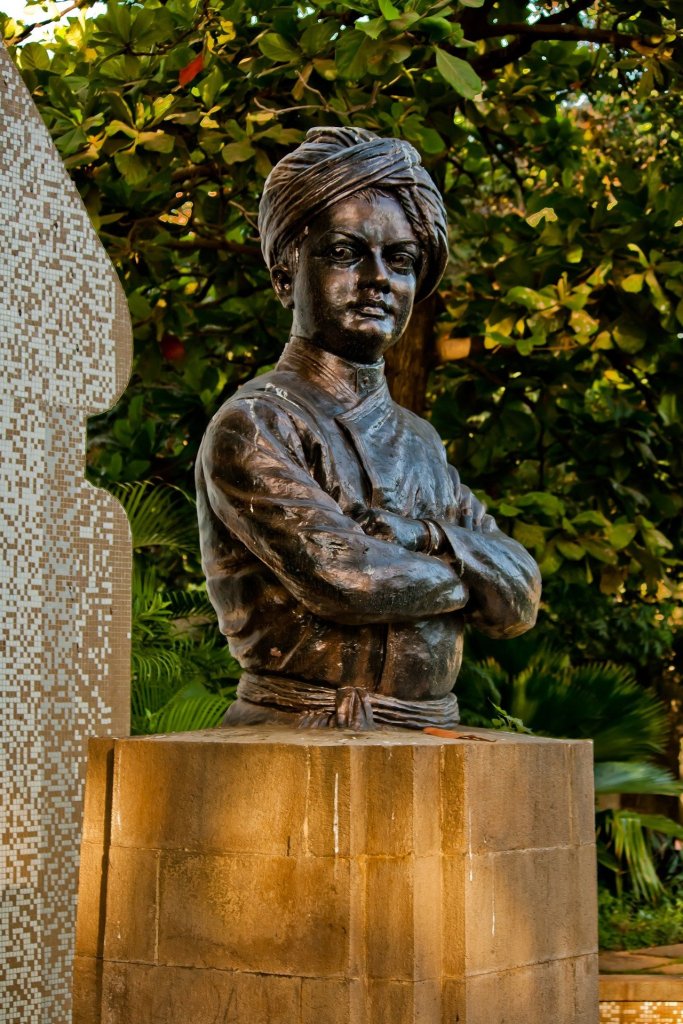
LIFE OF VIVEKANANDA THROUGH IMAGES

“Dancing mad with joy,
Come, O Mother, come!
For Terror is Thy name!
Death —is in Thy breath
And every shaking step
Destroys a world for e’er.”
“It all came true, every word of it, “he interrupted himself to say.
“Who dares misery love,
Dance in Destruction’s dance,
And hug the form of death—

Vivekanand was a very lion among man. We preceive his influence still working gigantically. We know not well how, we know not where, in something not yet formed, something leonine, grand intutive uphearing that has entered the soul of India and we say-Behold! Vivekanand still lives, in the souls of the mother and in the souls of the children.

A Journey Through Swami Vivekananda’s Life: The Quest for the 107th Photograph

Swami Vivekananda’s life and legacy continue to inspire millions around the world. In my journey to learn more about him, I set out to accomplish a seemingly small goal: finding the 107th photograph of Swami Vivekananda.

Though I have not succeeded yet, this pursuit has led me to an unexpected treasure trove of knowledge about Swamiji and his profound influence on the general public.

The Collection So Far: 106 Photographs

Over time, I have collected 106 photographs of Swami Vivekananda, each one a window into his life, personality, and mission.

Every image tells a story—of his strength, his spiritual vision, and his deep connection with humanity. The search for the elusive 107th photograph, however, has proven to be a challenge, but it is one I am determined to continue.

A Deeper Understanding of Swamiji

While the 107th photograph remains undiscovered, the journey itself has been transformative.

Along the way, I’ve encountered countless stories and lesser-known facts about Swamiji’s life. From his fearless speeches to his humble interactions with common people, every detail adds a new layer to my understanding of this extraordinary individual.

Varanasi: A City That Shaped Vivekananda

One aspect of Swamiji’s life that particularly stood out during my research was his connection to Varanasi (Banaras).

@This ancient city, with its spiritual energy and rich intellectual culture, left a lasting impression on him.

@Varanasi was the site of significant moments in his life:

@His encounters with scholars and monks.

@The unforgettable lesson to “face fear” during the monkey incident at Durgakund.

@His final days in the serene surroundings of Gopal Lal Villa in 1902.

Despite its importance, surprisingly little has been written about Swami Vivekananda’s deep ties to Varanasi. This city shaped his philosophy in profound ways, and it deserves more attention in discussions of his legacy.

A Commitment to Continue

Though the search for the 107th photograph has yet to bear fruit, I remain committed to uncovering more about Swamiji’s life. His teachings remind us that perseverance is essential, even in the face of challenges.

This journey has become about more than just a photograph; it’s about understanding and sharing the life of a man whose vision continues to guide humanity.

Swami Vivekananda 1891

The Mystery of Swami Vivekananda’s Photograph: Jaipur or Varanasi?

Swami Vivekananda’s life continues to captivate and inspire, and even a single photograph can spark curiosity and debate. Among the many photographs attributed to him, one image has been the subject of much discussion. Two distinct opinions surround this photograph:

@The Jaipur Connection: Many believe this photograph was taken during Swami Vivekananda’s stay in Jaipur.

@The Varanasi Perspective: Some family members of those with whom Swamiji stayed during his time in Varanasi are convinced that the photograph was taken there.

Unraveling the Mystery

This debate highlights not only the richness of Swamiji’s legacy but also the gaps in our collective understanding of his life. Both perspectives have merit, and the truth may lie in untold stories yet to be uncovered.

The Jaipur narrative aligns with Swami Vivekananda’s extensive travels across India, where he was warmly welcomed by kings and commoners alike. Jaipur, known for its vibrant culture, was one such destination where his presence left an indelible mark.

The Varanasi connection draws from the testimony of families with a direct link to Swamiji’s stays in the holy city. Varanasi, a place of deep spiritual significance for Swamiji, holds an enduring place in his journey.

A Window Into Swamiji’s Life

Whether the photograph is from Jaipur or Varanasi, it remains a valuable piece of history—a window into the life of a man who dedicated himself to the upliftment of humanity.

What makes this debate even more fascinating is the way it throws light on the enduring impact of Swamiji’s visits to various cities and the personal connections he formed along the way.

A HAPPY TEA ADDICT COUNTRY

Hindu sages and saints have contributed a lot in the independence of India. Many social reforms were also initiated by sages and saints. Tea revolution in the eighteenth, nineteenth centuries (under which the style of drinking tea in India changed forever.
Tea was recognized as the beverage of the common Indian from the beverage of the Europeans)

“I believe tea has helped us, as a nation. At least, our tea drinkers outnumber those who consume alcohol, One may even go so far as to claim that the spread of alcoholism has been arrested in this country because of tea.” SANKAR THE MONK AS MAN

How hard it is to believe that we Indians were unaware of tea (chai) a few centuries ago. Now hardly any Indian starts the day without tea. (The people of South India are lucky in this case that they have the option of choice, they can choose between tea or coffee according to their convenience) It is a matter of happiness that today in the use and production of both tea and coffee, India is one of the major countries of the world. According to a national survey, fifteen cups of tea are consumed in India compared to one cup of coffee.

Gradually tea became a part of our daily life. It is also like that we Indians were unaware of potato, and tobacco,(Potato &Tobacco was introduced by Portuguese ) today without them the daily life of many Indians cannot be imagined.

Herbal tea has a centuries-old history in India. Even today there is a lot of custom in India to drink it, but today this drink is also called Kaadha. Consumption of decoction has its benefits. Herbals like black pepper, mint leaves, basil leaves, liquor ice, cloves, ginger etc are used in the decoction. India has historically been a stronghold of natural medicines and spices, so it is common for such beverages to become popular. Similarly, lemon tea is also very popular in India. In recent years, the increasing awareness of people towards natural beverages has made Kaadha very popular. It has been used as a medicine in colds. In recent times, its popularity has increased a lot in the outbreak of Corona. There will be hardly any home or hospital in India where this herbal drink is not being used.

CHAI

The extraordinary story of ordinary tea The story of tea was written in India during the Bengal rule of the East India Company. And within a few years it turned into a mass movement.
The East India Company was a commercial company, whose main reason for its arrival in India was the trade of spices. After the Battle of Plassey in Bengal, the East India Company’s feet were firmly established in Bengal. During this time, efforts were made by the people of East India Company to grow tea in India. It is believed that tea plants were first planted in 1787 by a British, Mr. Kydd, in a garden called Shivpur in Howrah. This was a failed attempt. Later at one place Mr. Kydd admitted that the climate of Howrah was not suitable for the growth of tea leaves. By the year 1820, some prominent Bengali families (Prince Dwarkanath Tagore) were also engaged in the tea leaf business in Assam in an effort to grow tea leaves in Bengal and its surrounding areas.

In 1864, India’s tea leaves were sold for £3 million by the Assam Company at an auction in Mincing Lane, London, England. This was just a beginning.

This was the effort of the East India Company and the famous Indian businessman of that time to capture a part of the tea market in England. Gradually these efforts paid off, by 1870 the share of China’s tea market in England was 90%, after thirty years it was 10%, this was possible due to the development of tea gardens in India and Sri Lanka. Till then the practice of drinking tea had not started among Indians, it is believed that the trend of tea was slowly starting in the city of Kolkata, India. Kolkata was then a rapidly growing British city in India. The political and economic capital of India. Kolkata was also called the White City in those days because the population of white people in the main area of ​​Kolkata was more than the native people, and Kolkata had more white people than any city in Asia. The British people had a habit of drinking tea according to their English tradition, gradually this habit was being adopted by the elite Indians also. In those days, association with British families and eating with them was common in the famous and prosperous houses of Kolkata, as a result many customs and traditions were adopted conveniently by the noble Indians, among them the habit of drinking tea. was involved.

Tea and Nationalism

In those days a new industry was also spreading rapidly in Bengal. That was the printing industry. For the first time in India, the trend of books, newspapers was increasing, many British and Indian businessmen of Kolkata were also seeing the possibility in this new business. Due to the spread of education, the number of educated people in India was also increasing. The old gurukul system of education (which was largely based on Hindu traditions) and Muslim education which was based on madrasas was now getting out of date. Western education and employment based on western education were increasing, a new intellectual class was emerging among Hindus. (Muslims were keeping distance from this education system) This new intelligentsia was to some extent British in language, lifestyle and food, but inspired by Hindu culture, religion, and the spirit of patriotism. Many of these intellectuals did not accept to work under the British government and started working independently in journalism, Hinduism and social reformer. There was also a lot of drinking tea among such people, due to which soon the tag of white people’s beverage was removed from tea.

Tea Break চা বিরতি

Bengalis have tea in their and blood and nobody can do anything about it. Bengalis will never forget that coffee smells like burnt shal leaf, while Darjeeling tea tastes like champagne. Sankar- The Monk as MAN

Rabindra Nath Tagore, a prolific nationalist of the time, and world-renowned Writer, Poet, Philosopher ( first Indian who received the Nobel prize of Literature )
Dwarka Nath Tagore was his grandfather, who started the tea business in India with the British people. He was counted among the tea lovers of that time. He has shared his love of tea with people many times.

Swami Vivekananda A young sannyasi(MONK) whose popularity was at its peak in those days, a voice that was a ray of hope among the nationalists, was a tea lover. This young monk left an impact on the world’s finest minds of his time.
The uncivilized image of Hindus and India in the West and America, which was based on some prejudices, was broken by this great sannyasi, not only kept the true picture of India in front of the world, but also introduced the world to yoga and meditation for the first time. The great scientist Nikola Tesla, writer Aldous Huxley, Tolstoy, Ja de Salinger Rockefeller, Mahatma Gandhi, Subhas Chandra Bose, Arvind Ghosh, Nivedita, Jamshedji Tata, Vimal Mitra Shachindranath were influenced by his ideas. Vivekananda’s habits were always the subject of discussion in those days, especially among the youth and the intelligentsia in Kolkata. Swami Vivekananda, along with other poets, writers, and intellectuals associated with the Rama Krishna Mission, have mentioned the popularity of tea at many places due to Vivekananda’s influence. Swami Sardananda once jokingly told Swami Vivekananda’s younger brother Mahendranath that the habit of drinking tea to the people associated with the Math is due to your brother Vivekananda. For more information related to this topic please visit:- https://nithinks.com/2021/01/11/is-vivekananda-still-relevant-today-national-youth-day/

BELUR -MATH HOWRAH (KOLKATA )

Tilak the Chaiwala of Belur :-

Once Tilak, (LOKMANYA BALGANGADHAR TILAK)the great nationalist of that time, came to Kolkata. Tilak came to Belur Math to meet and discuss with Swami Vivekananda. On the request of Swami Vivekananda, Lokmanya Tilak made tea for all the people present in the Math. Undoubtedly, this tea party is ranked among the most historic tea parties in India.
This incident is mentioned by Shankar in his famous book the monk as man
Giving the details of this incident, Sankar has told that’ Tilak had brought nutmeg, mace ,cardamom ,cloves, and saffron with him. He boiled these things together, added the tea leaves, milk and sugar ,and made tea.’ This incident shows that Our current Prime Minister Narendra Modi whose father had a small tea shop, and whose childhood is spent selling tea, he is not the only chaiwala in Indian politics.

BODHI- DHARMA

There is a belief in china that in the fifth-sixth century, a monk from India, Bodhidharma, reached China for the propagation of Buddhism. He is credited to propagate Buddhism in china. It is believed that Bodhidharma spent nine years meditating in a cave, due to constant waking and not sleeping, Bodhidharma was feeling sleepy, due to which Bodhidharma cut off his eyelid in anger and threw it away. A few days later a tree grew at the same place. The leaves of that tree had a special quality – drinking a drink made from the leaves of that tree did not cause sleep and felt energized. This was the first tea plant.

Tea Capital of India :- Undoubtedly Kolkata is the tea capital of India. From the planting of tea leaves to the cultivation, export, acceptance of tea in the society, everything is built in the history of Kolkata itself. Although tea shops will be found in every city, nook, street square of India, but the variety of tea found in Kolkata is rare. The way of serving tea is also varied. From plastic glasses, glasses, fancy cups, to clay pots.
Many shops in Kolkata still make tea in the old style kiln, but the tea found at these shops is usually strong tea. (This is the Indian version of Britain’s sailors tea) The taste of tea in a cup made of clay changes completely, the smell of earthy aroma in strong tea – wonderful.
In Kolkata, the use of milk in tea is also less, in Kolkata tea leaves are more important, after taking a few sips of tea, it is understood that the whole game here is of tea leaves.


Cultural Capital of India & Some very unique tea shops:- Varanasi is not only the cultural capital of India, it is also called Mini Kolkata or Mini Bengal. The reason for this is a large number of Bengalis here. Most Bengalis live in one city outside the state of Bengal, then it is Varanasi. The trend of tea in Varanasi has come from Kolkata itself. Here too many old tea shops serve tea in earthen cups. (KULLHADA) But there is a fundamental difference in the tea found here – milk is used more in the tea here. Apart from this, basil leaves, ginger, bay leaves are commonly used in tea here. In their taste and aroma, it reduces the taste of tea leaves . There is one more thing that is worthy of praise at the tea stalls in Varanasi – the special attention to cleanliness. A small tea shop on the side of the road also washes the utensils used for making tea with hot water several times a day. In Varanasi, tea is a beverage to be consumed at any time, and at any place.

“I think Banaras (Varanasi) is one of the most wonderful places I have ever seen. It it has struck me that a westerner feels in Banaras very much as an oriental must feel while he is planted down in the middle of London”. (MARK TWAIN)

MAHASAMASHAN AND TEA SHOPS

If one is not familiar with the traditions and philosophy of Hindu religion, then the tea shops and tea drinking places in Varanasi can surprise him.
The most unique seems to be the hundreds of tea shops on Samashan. In Hinduism, the last rites of a dead person are performed on the banks of rivers or water bodies, in Varanasi also on the banks of the holy Ganges there are two very ancient ghats Manikarnika and Harishchandra, both these ghats are used for cremation. There are many tea shops on both the ghats. On Manikarnika, there are more tea shops than shops of materials used in cremation. The funeral rites never stop on Manikarnika, day and night. Similarly, tea is available at any time at the tea shops here. The well-wishers of the deceased who come to attend the last rites can also be seen drinking tea at the time of the last rites of the deceased. To know the thousands of years old tradition of Varanasi’s Samashan, Aghori please visit:- https://nithinks.com/2021/03/26/rangbhari-ekadsi-masan-holiashes-of-dead-persons/ This is a normal reaction. The use of tea was once banned in Hindu monasteries considering it to be a stimulating beverage, today drinking tea is a common practice among Hindus in any religious activity. Many Hindus do not consume grains during the fast, they only survive on fruits, but tea is also drunk during this time. To know the story and tradition related to fasting in Hindu festivals please visit:- https://nithinks.com/2021/03/14/mahashivratrishiv-barat-and-varanasi/ I would like to end this post with these words of Swami Vivekananda.

READ THE VEDAS AND UPNISSHADS, AND DRINK TEA –NO HARM IN IT!


In the Light of Kashi(Varanasi): Swami Vivekananda’s Holy Path from Brijeshwar Mahadev to Gopal Lal Villa

A Divine Beginning: The Birth of Swami Vivekananda in Connection with Varanasi


BIRESWAR SHIVA or Brijeshwar Mahadev


A Mother’s Faith and the Blessing of Bireshwar Temple

Swami Vivekananda’s mother, Bhuvaneshwari Devi, was a deeply religious woman living in Kolkata. She longed for a son and believed in the power of prayer.

A relative suggested she seek blessings from the Vireshwar (or Bireshwar) Temple in Varanasi, a sacred temple known for granting the wish of a son to devoted mothers.

Since she was unable to travel during pregnancy, her relative in Varanasi performed the rituals and prayers on her behalf at the Bireshwar Temple.

A Divine Answer to a Mother’s Prayer

Soon after these rituals, on January 12, 1863, which was Makar Sankranti, Bhuvaneshwari Devi gave birth to a baby boy.
Seeing this as a blessing from Lord Shiva of the Bireshwar Temple, she named him Bireshwar, meaning “Lord of Heroes.”

At home, the child was lovingly called Biley, a simple name that showed affection and joy. Later, during his Annaprashan (first rice-feeding ceremony), he was given his formal name: Narendranath Dutta.

This Vivekananda birth story reminds us of how faith and devotion can shape destiny. From the very beginning, his life was linked to Varanasi, the city of Shiva.

Vireshwar Shiva – Ground Floor – Swami Vivekananda’s Ancestral House – Kolkata

As a mark of reverence for that sacred grace, a replica of the Shiva Linga from the Brijeshwar Mahadev Temple has been enshrined in Swami Vivekananda’s ancestral home in Kolkata.

This symbolic presence of Lord Shiva is not merely a relic of faith—it is a living reminder that the spiritual energy of Varanasi never left Vivekananda.

It journeyed with him through his life’s mission, illuminating hearts, awakening courage, and spreading the divine message of fearlessness and self-realization across India and the world.

The Making of a Saint: From Biley to Swami Vivekananda

As young Biley grew, he showed unusual curiosity, energy, and courage. His sharp mind and questioning spirit amazed everyone around him.
His mother would often say, “This boy is not ordinary—he has come for a great purpose.”

Years later, Biley became Swami Vivekananda, the disciple of Sri Ramakrishna Paramahamsa, who taught him about the unity of all religions and the power of service to humanity.

But before he became world-famous, Varanasi once again became an important chapter in his life.

Swami Vivekananda in Varanasi: The Bengali Deodhi Connection


Bangali Deodhii

A Meeting Place of Great Minds

During his travels, Swami Vivekananda visited Varanasi several times, and one of his favorite places was the Bengali Deodhi, the home of Pramadadas Mitra.

Pramadadas Mitra

Pramadadas Mitra was a brilliant scholar who was well-versed in both Indian and Western traditions. He had translated the British National Anthem into Sanskrit and the Bhagavad Gita into English—a rare combination of East and West.

The Bengali Deodhi became a meeting ground for great minds and spiritual discussions. Here, Swami Vivekananda spent hours talking about India’s future, religion, and education.

Swami Vivekananda’s Visits to Bengali Deodhi

In 1888, Swami Vivekananda penned this thoughtful letter to Babu Pramadadas Mitra, reflecting his early spiritual ideas.

Swami Vivekananda first stayed at Bengali Deodhi in 1888. During this visit, he developed a close friendship with Pramadadas Mitra. They discussed the Vedas, philosophy, and India’s role in the modern world.

He returned in 1890, accompanied by Swami Akhandananda, another devoted monk. Once again, Bengali Deodhi became a center of thought, courage, and inspiration.

Vivekananda’s Fiery Words in Varanasi

One famous moment from his stay still echoes through time. When Vivekananda saw rich people ignoring social problems, he spoke with passion:

“I shall not return until I burst on society like a bombshell, and it will follow me like a dog.”

The Life-Changing Lesson at Durgakund Varanasi

Durgakund Temple Varanasi

An Unexpected Encounter with Fear

One of the most famous incidents from Swami Vivekananda’s life in Varanasi took place at the Durgakund Temple, dedicated to Goddess Durga.

One day, while returning from the temple, young Vivekananda was suddenly chased by a group of monkeys. The monkeys were loud and aggressive, and he began to run away in fear.

But the more he ran, the more the monkeys chased him!

A Monk’s Simple Advice: “Face Them!”

Just then, a monk standing nearby called out to him, “Stop running! Face them!”

Swami Vivekananda stopped, turned around, and stood firm. The monkeys, seeing his courage, slowly backed away and left him alone.

This simple moment taught him one of the most powerful lessons of his life: Never run away from fear. Face it boldly.

“Face Fear” – A Universal Teaching

Later, Swami Vivekananda often told this story in his lectures to teach people how to overcome fear and difficulties.

He said that fear grows stronger when we run from it, but it disappears when we face it.

The incident at Durgakund Varanasi became a lifelong lesson that shaped his courage and his teachings to the world.

FOR MORE INFORMATION ABOUT THE DURGA-KUND TEMPLE, PLEASE VISIT

Swami Vivekananda’s Final Days in Varanasi: The Gopal Lal Villa

The Return of the Saint


Gopal Lal Vila

In 1902, just a few months before his death, Swami Vivekananda returned once again to Varanasi. Although he was very weak and ill, he continued to serve others with his usual energy and kindness.

He stayed at the Gopal Lal Villa, a beautiful garden house belonging to King Kali Krishna Thakur. The calm environment of this villa gave him some rest, but his heart remained focused on helping others.

Service Beyond Suffering

Even during his illness, Vivekananda met visitors, shared knowledge, and encouraged everyone to work for the nation.
He truly lived by his own teaching of Karma Yoga—the path of selfless action.

He believed that true spirituality means serving others without expecting anything in return.

A Peaceful Farewell

A few days after his stay at Gopal Lal Villa, Swami Vivekananda left Varanasi and returned to Belur Math, near Kolkata.

On July 4, 1902, at the young age of 39, he passed away peacefully while meditating. His death was not an end, but the completion of a great spiritual journey that began with faith, devotion, and the blessings of Lord Shiva in Varanasi.

FOR MORE INFORMATION ABOUT GOPAL-LAL VILA, PLEASE VISIT :

GOPAL LAL VILA

The Eternal Light of Swami Vivekananda in Varanasi

The story of Swami Vivekananda and Varanasi is like a shining river of faith flowing through time.
From the Bireshwar Temple, where his birth was blessed, to the Gopal Lal Villa, where he spent his last days, the holy city was his spiritual anchor.

Each visit, each experience in Varanasi, added a new chapter to his growth—from a child called Biley to a monk who awakened the world.

Swami Vivekananda’s legacy continues to guide millions. His teachings from Varanasi remind us to live with courage, compassion, and faith.
He proved that true strength lies not in wealth or power, but in character and service to humanity.

Varanasi, the city of Shiva, witnessed his journey from birth to enlightenment to peace.
And even today, as the bells of its temples ring and the Ganga flows silently by, one can almost hear his words echo through the ghats:

“Arise, awake, and stop not till the goal is reached.”