
Varanasi is home to numerous ancient temples, but the Durgakund Temple stands out. It is not just a place for worship — it is a place that teaches strength, bravery, and respect for women.
This temple reminds us that when wrong things happen, we must stand up for what is right.
Where the Temple Stands


The attached pond, or kund, adds a serene spiritual charm, making the temple an important place of worship in Kashi.
The Durgakund Temple is located in the southern part of Varanasi, near the famous BHU area. Beside the temple lies a big square pond called Durgakund, which adds beauty and calmness to the place. Many people come here every day to pray and feel peace.
The Red Temple of Power


Durga Mandir and Kund 1829 AD (BHARAT KALA BHAWAN)
The temple is made of bright red stone. This color is not chosen just for decoration — red stands for energy, courage, and victory over evil. When you look at the temple, the red color immediately catches your eye and fills you with a feeling of strength.
The architecture follows the Nagara style, a traditional North Indian temple design. The tall tower, or shikhara, rises high toward the sky, showing devotion and faith.
Inside the temple, you will not find a big statue. Instead, the face of the Goddess and her holy footprints are worshipped. This makes the temple unique and different from other temples of Varanasi.
A Temple Mentioned in Ancient Texts
The Durgakund Temple is very old. It is mentioned in Kashi Khand, a part of the Skanda Purana. This means the worship of Goddess Durga here has been happening for many centuries.
The Skanda Purana is one of the largest Mahapuranas, primarily dedicated to Lord Kartikeya (Skanda, Murugan), son of Shiva.
It contains a vast amount of material, including legends, hymns, pilgrimage guides (especially to the Ganga and other holy places), stories of Shiva, Parvati, and other deities, and philosophical discussions.
Later, in the 1700s, Maharani Bhavani Devi of Bengal rebuilt the temple. She wanted a temple that showed the power and importance of Shakti — the divine feminine energy.
The Story of King Subahu and Goddess Durga

A beautiful legend is associated with the temple, as recorded in the Devi Bhagavata Purana.
A long time ago, Kashi had a king named Subahu. His daughter Shashikala fell in love with a prince named Sudarshan. When her father accepted this, some other rulers became angry and attacked Kashi.
Surrounded by danger, King Subahu and Prince Sudarshan prayed to Goddess Durga. The Goddess appeared and protected them by destroying the enemy kings.
To thank her, King Subahu built a temple and a pond at this very place. This is believed to be the origin of the Durgakund Temple.
The Temple Once Called the Monkey Temple

The Prince of Wales visiting the Monkey Temple, Benares. Illustration by The Graphic Newspaper, 5 February 1876.

THE GREAT DURGAKUND OR MONKEY TEMPLE OF BENARES
During the 19th century, foreign visitors saw many monkeys living around the temple. British newspapers even published drawings of the temple full of monkeys. Because of this, they started calling it the “Monkey Temple of Benares.”
Even today, some monkeys can still be seen here, sitting on the walls or trees, giving the temple a lively look.
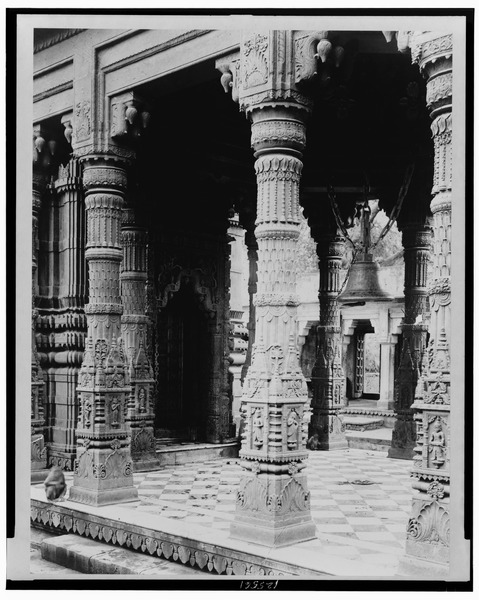
Interior view of the monkey temple at Benares, India, showing elaborately carved columns and doorways. ( between 1890 and 1924)
Swami Vivekananda’s Lesson of Courage

One of the most famous stories of Durgakund Temple is linked to Swami Vivekananda.
When he visited the temple, a group of monkeys started chasing him. As he tried to run, an old monk shouted:
“Stop! Face the monkeys!”
Swamiji stopped and turned around. The monkeys became scared and ran away. From this small incident, he learned an important lesson — running from fear makes it bigger, but facing it makes it disappear.
Later in New York, Swamiji said:
“That was the best lesson I ever learned — the lesson of fearlessness.” This message continues to inspire thousands of visitors.
A Message of Respect for Women
The Durgakund Temple teaches that women are not only gentle and caring — they are powerful protectors too. Goddess Durga represents Shakti, the strength that protects truth and destroys injustice.
The temple’s strong red color reminds everyone that respecting women is not just a duty but a sacred responsibility. In Indian culture, women have always been honored as mothers, teachers, and symbols of knowledge.
A Temple Full of Life Today
Even today, the Durgakund Temple is full of activity. A large Havan Kund inside the temple is used for daily fire rituals. There are also small temples dedicated to Bhaironath, Lakshmi, Saraswati, and Kali.
During Navratri, thousands of people visit the temple. It is decorated with lights, flowers, and red chunri. The whole area becomes bright and joyful.
In the month of Sawan, a big fair is held near the temple. People come to pray, enjoy food, and celebrate with their families.

Very interesting history of some of the great temples in India and how they came to be built and the reasons for building them
thank you very much sir ji
Durga temple, Manas Mandir and Sankatmochan Mandir were on the way to BHU. Thank you for reminding me of those golden days.
Nice story sir..
Thanks sir ji 🙏🏻🙏🏻
dhanyawad sir ji
I went through your blog on DURGA KUNND . Very precise information has been given about the deity called Maa Durga installed in the temple . I liked your blog very much . I enjoyed reading it . We have forgotten our history . And History , thy name is India . And History of India is made out of not only the written sources but the tradition and culture of India also . That all officials historians have forgotten . We have to revive them all . Thanks !
Totally agree with you, there is a lack of awareness among people about history especially ancient history in India.
.👌👌👌
Thanks !